




Global Hybrid Vehicle Market: Predicted Expansion to 28 Million Units by 2030
Global Hybrid Vehicles Market Forecast
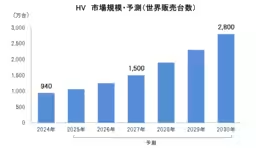
The hybrid vehicle (HV) market is undergoing significant transformations, with projections suggesting an increase to approximately 28 million units sold annually by 2030. This insight is derived from the research conducted by the Marketing Data Bank of the Japan Management Association Research Institute, encapsulated in the “MDB Promising Market Forecast Report” series.
Overview of the HV Market
In essence, hybrid vehicles operate using a combination of a gasoline engine and an electric motor, adapting their energy sources based on driving conditions to maximize efficiency. They have garnered renewed interest due to several factors:
- - Reevaluation of Advantages: As the demand for electric vehicles (EVs) experiences a slowdown, particularly in Europe and the United States, the advantages of HVs—such as better fuel economy and cost-effectiveness—are being reconsidered.
- - Regulatory Changes in the U.S.: The recent invalidation of the zero-emission vehicle (ZEV) sales mandate in California, alongside the expiration of EV tax incentives, has created a beneficial environment for hybrid vehicles.
- - European Union Stance: In December 2025, the EU is expected to effectively retract its ban on new gasoline engine sales beyond 2035, further supporting the HV market.
These factors underscore a shift towards HVs as a practical choice, free from the limitations of charging infrastructure and range anxiety associated with fully electric vehicles.
Characteristics and Advantages of HVs
Hybrid vehicles make the most of energy recovery during deceleration by storing it as electrical power, while the electric motor aids the gasoline engine during acceleration, striking a balance between performance enhancement and decreased emissions.
With a lag in charging infrastructure and the high costs associated with EVs, the appeal of HVs is growing in regions like North America, Japan, and Southeast Asia. Consumers are increasingly placing a premium on resell value, solidifying HVs as a mainstream choice among diverse users.
Market Share and Future Prospects
Historically, Japanese manufacturers dominated the HV market, capturing 90% of the global share until 2016. While they are still leading with a majority stake projected for 2025, there is a noticeable decline as European brands adapt their strategies to focus more on a practical hybrid path rather than a pure EV transition.
The forecast for global HV sales indicates a rise to approximately 10.56 million units by 2025. With many traditional automakers shifting their strategies towards a multifaceted approach that includes hybrid technology, HVs are expected to remain integral to automotive solutions until around 2030. Growth may accelerate post-2028 as hybrid strategies become more pronounced.
Research Methodology
The findings are based on sales figures for hybrids excluding plug-in hybrids and include light trucks and buses. The detailed report is available through MDB Digital Search, providing an in-depth look at this evolving market.
MDB Digital Search
This is a specialized database providing comprehensive business information, with over 500,000 entries available. Users can query a variety of topics using AI Search capabilities, accessing market overviews, relevant details, and foundational documents related to hybrids and more.
For a demo of MDB Digital Search, visit: MDB Digital Search Demo.
Conclusion
With HVs poised for substantial market growth in the coming years, they present significant value as a pragmatic automotive option. The potential expansion to 28 million units by 2030 reflects an evolving landscape that increasingly favors hybrid technologies over fully electric alternatives in many key global markets. As consumer preferences and regulatory frameworks continue to evolve, the role of hybrids in achieving both performance and sustainability objectives will become ever more critical.

Topics Consumer Products & Retail)
【About Using Articles】
You can freely use the title and article content by linking to the page where the article is posted.
※ Images cannot be used.
【About Links】
Links are free to use.