



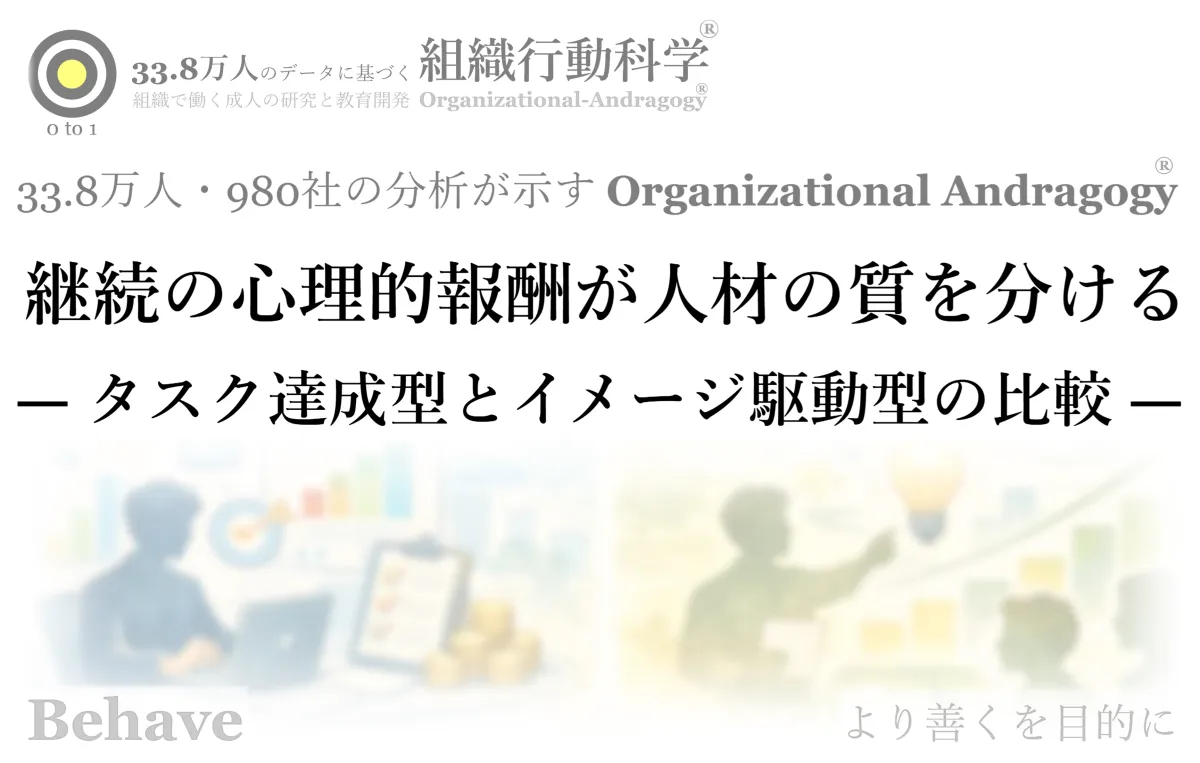
Redefining Talent Disparities Through Market Alignment and Sustainability Mechanisms
Understanding Talent Disparities in Today’s Market
In the evolving landscape of the workforce, the distinction between talent often hinges not on the abilities possessed by individuals, but rather on how well these talents align with market conditions and the mechanisms for sustaining their development. Request Inc., based in Shinjuku, Tokyo, has recently published a report titled 'The Psychological Rewards of Continuity Distinguish Talent Quality.' This report draws upon data from 338,000 individuals across 980 organizations, fundamentally reexamining the structural basis of talent disparities in the workplace.
Key Insights from the Report
The report challenges the common notion that enhancing the skill sets of individuals invariably improves competitive advantage. Instead, it presents empirical findings illustrating that talent assessment is predominantly driven by the fit between market dynamics and the established continuity mechanisms within organizations.
Why This Perspective is Vital Now
For many companies, differences in their workforce are often interpreted through the lens of abilities, skills, and motivations. However, the reality unveils that even individuals starting from similar competency levels can exhibit significantly different judgment capabilities and adaptive skills after a few years in varying environments.
This report attributes this phenomenon to differences in the behavioral standards that persist within organizations and how these standards are reinforced.
Crucial Findings from Data Analysis
Through analyzing an extensive dataset, the report reveals critical trends:
1. In industries characterized by minimal market changes, the focus on adaptability to objectives and processes tends to favor the 'Task-Oriented' talent, leading to a stable evaluation.
2. Conversely, in sectors experiencing substantial market fluctuations, those who can reassess and redesign foundational assumptions ('Image-Driven') have a significantly higher promotion likelihood (with promotion odds in high-variability markets being 1.64 times greater).
These findings underscore the premise that talent superiority is not a fixed entity but rather varies in value based on its compatibility with market structures.
In stable markets, the 'Reproducibility' of outcomes is paramount, while in dynamic markets, the ability to 'Redefine' standards becomes essential.
Mechanisms Producing Talent Differentiations
The report further elaborates on the notion of continuity, categorizing it into two layers:
- - First Layer: Habitual Structures (Stabilizing Existing Standards)
- - Second Layer: Meaning-Updating Structures (Reassessing Judgment Criteria)
Talent differences, it argues, stem not from varying levels of effort, but rather from which layer continues to operate more effectively.
Behavioral Models in Continuity
The analysis indicates two distinct behavioral models:
| Model Type | Behavioral Standards | Key Strengths | Compatible Environment |
|---|---|---|---|
| ---- | ------- | ----- | --------- |
| Task-Oriented | External standards (goals, evaluation, procedures) | Reproducibility, Stability | Established markets |
| Image-Driven | Internal standards (future vision, role consciousness) | Redefinition, Adaptability | Variable markets |
The imperative here is not determining superiority but gauging compatibility with the market's demands.
Redefining Human Capital Development
This report prompts a redefinition of human capital development:
Human capital development is not merely about enhancing abilities but designing continuity mechanisms that align with market environments. Strategies surrounding evaluation systems, introspective opportunities, and hypothesis testing dictate which layer of talent development gains prominence. Simply managing effort levels does not penetrate the essence of talent disparities.
Organizations are challenged to consider:
- - Is our market stable or volatile?
- - Which structures of continuity should we strengthen?
- - Which layer are our systems reinforcing?
Overview of the Analysis
- - Sample Size: 338,000 individuals across 980 organizations
- - Methodology: Logistic regression analysis (interacting with market volatility)
- - Key Result: Increased probabilities of promotions for 'Image-Driven' individuals in high-variability markets.
Report Summary
- - Title: The Psychological Rewards of Continuity Distinguish Talent Quality
- - Total Pages: 14
- - Theoretical Foundation: Organizational Andragogy®
- - Format: PDF
For further insights, download the full report here.
About the Human Capital Development Planning® Center
The Human Capital Development Planning® Center conducts research and practice aimed at understanding human growth by integrating behavioral data from over 338,000 individuals, focusing on designing work roles and decision-making structures.
For inquiries, contact: [email protected]
Visit us at: Request Corporate Profile
Download the company overview here
Meet our CEO here
Request Inc. aims to foster improvement based on data from 338,000 working individuals, supported by seven research institutions across 980 companies. Harnessing Organizational Behavior Science®, we explore why and how our thoughts and actions in the workplace arise and persist, enabling optimized reproducibility in various business environments.

Topics Business Technology)

【About Using Articles】
You can freely use the title and article content by linking to the page where the article is posted.
※ Images cannot be used.
【About Links】
Links are free to use.