



GSMA Unveils Experience Specifications for AI Calling Applications at MWC 2026
Unveiling the Future of AI Calling: Insights from MWC 2026
During the recently held 5G Futures Summit at MWC Barcelona 2026, the GSMA published a groundbreaking white paper titled Gigauplink that explores the integration of AI into mobile communication. This document underlines the transformative potential of mobile AI, focusing on how operators can evolve traditional voice services into advanced AI calling experiences.
Key Highlights from the White Paper
The white paper emphasizes the synergy created by the convergence of 5G-A and artificial intelligence, marking the entry of mobile communications into a new phase—the mobile AI era. Operators are now in a position to shift their native voice services from traditional voice calls to AI-driven voice interactions. By leveraging AI algorithms and computational power within their IMS voice networks, the evolution of conventional voice calls into enhanced services and innovative applications offers users a new generation of stable, high-definition, visual, intelligent, and efficient calling experiences.
Innovations in AI Calling Services
New AI calling services, such as immersive AI calls and interactive AI calls, demand improved network connections and AI capabilities. Immersive AI calling, for instance, employs AI algorithms for noise reduction. This technology utilizes artificial intelligence to eliminate background noise in various environments—whether it’s a crowded office exceeding 40 dB, a noisy street over 60 dB, or even a construction site above 80 dB—delivering clear and immersive native calls.
Interactive AI calling, on the other hand, introduces functionalities like real-time translation. Enhanced capabilities within voice networks now eliminate long-standing language barriers. AI calling allows for accurate speech transcription or translation in real-time during video calls, making it indispensable for international business meetings, tourists abroad, and individuals with hearing impairments.
Enhancing Business Models with AI
The white paper advocates that by integrating AI into their native voice services, operators can reinvent their business models and breathe new life into everyday calling. Users can opt for subscription models that grant access to improved AI functionalities during routine calls, transforming the operator's monetization approach from mere throughput to a more nuanced experience-based monetization strategy.
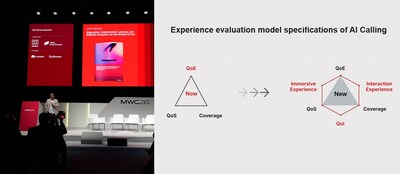
Evaluating user experiences presents a new challenge within AI calling scenarios. To address this, GSMA systematically defines experience evaluation model specifications, which now include three additional metrics: immersive AI experience, interactive AI experience, and QoI (Quality of Information). Enhancing immersive calling can greatly improve user satisfaction, elevating metrics like Mean Opinion Score (MOS) and Signal-to-Noise Ratio (SNR).
However, interactive calling necessitates network advancements with new interaction channels and features, including data channels (DC) and video channels (VC) which enable features like screen sharing and real-time translation. The key performance indicator for measuring the intelligence of voice networks is identified as QoI, which encompasses high-quality AI models, responsive AI management, and AI-driven awareness of network/user status.
Collaborative Efforts Towards Standardization
The International Telecommunication Union (ITU) has initiated a project called P.AI-MOS aimed at assessing user experiences with multimodal AI applications. As standards for AI calling experience criteria are currently under research, GSMA is calling on industry players to collaborate in establishing guidelines that will align Key Quality Indicators (KQI) of AI applications with Key Performance Indicators (KPI) of networks. The primary goal of these efforts is to expedite the formulation of standards for mobile AI services, enhancing industry development and ensuring superior service capabilities.
In conclusion, the advancements in AI calling presented at MWC 2026 mark a significant step in the evolution of telecommunications, promising enhanced user experiences and innovative service offerings. The synergy between AI and 5G technology is set to transform the way we communicate.
Topics Telecommunications)
【About Using Articles】
You can freely use the title and article content by linking to the page where the article is posted.
※ Images cannot be used.
【About Links】
Links are free to use.