




Scientists Uncover the Origin of Bright Points in Metallic Glass Using High-Resolution Microscopy
Exploring the Mystery of Bright Points in Metallic Glass
Recent research by a team from Waseda University led by Assistant Professor Zha Siyuan and Professor Akihiko Hirata has made significant strides in understanding the structural characteristics of metallic glass, particularly the Zr-Pt alloy, through high-resolution electron microscopy images. The findings, published in the journal Acta Materialia on May 12, 2026, shed light on the origins of the perplexing bright points often observed in these images.
Key Findings
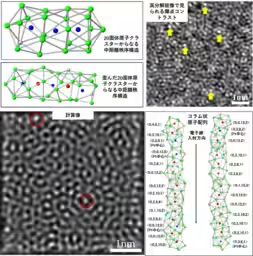
The researchers discovered that the metallic glass in question contains icosahedral atomic clusters and distorted icosahedral clusters. These clusters exhibit unique spatial distribution characteristics. The study revealed that these icosahedral clusters engage in interpenetration, forming medium-range ordered structures, which are known to contribute to relatively short columnar atomic arrangements. The central axis of these columns produces bright dots in high-resolution images.
Furthermore, the research indicated that various types of atomic clusters, including distorted icosahedral ones, connect in one direction to create much larger columnar atomic arrangements than previously anticipated. These structures appear as particularly bright spots in the high-resolution images, providing a clearer interpretation of the previously complex high-resolution views of metallic glass.
Background
Understanding the behavior of atomic clusters and their transitions during the glass formation process is crucial for exploring the properties of metallic glass, such as mechanical strength. However, interpreting high-resolution transmission electron microscopy (HRTEM) images of glass structures has been challenging due to the lack of periodicity in glass, which contrasts with crystalline structures.
In previous studies since the 1960s, metallic glasses were created by rapidly cooling metals from the liquid state, resulting in random atomic arrangements. Yet, these disordered structures may harbor hidden forms of order. This notion has spurred numerous investigations aimed at unraveling the characteristics of atomic clusters that serve as the fundamental structural units of metallic glasses.
Methodology
The research team employed a combination of molecular dynamics simulations and HRTEM observations to analyze Zr-Pt metallic glasses. They particularly focused on the interactions and distributions of the identified atomic clusters, using Voronoi polyhedron analysis to confirm the dominance of icosahedral atomic clusters. One significant outcome was the identification of an axis along which atomic sequences exhibited heightened brightness, aligning with the structural observations noted in high-resolution images.
By comparing experimental HRTEM images with computed images derived from molecular dynamics models, the researchers highlighted the role of columnar atomic arrangements in producing bright dots within the images, thereby refining the interpretation of structural features in metallic glass.
Implications
This groundbreaking work not only enhances the comprehension of the Zr-Pt metallic glass structure but also offers a fresh perspective for future studies on glass materials. The contrasting distribution features of the icosahedral and distorted clusters suggest a level of structural inhomogeneity in metallic glass that may further influence its mechanical properties.
The study emphasizes the necessity for further detailed investigations into the structural characteristics of columnar atomic arrangements, including their impact on material properties. As the exploration continues, the research promises to deliver novel insights into the fundamental structure of various glass materials, reshaping our understanding in the field.
Future Directions
Despite successfully revealing the underlying atomic arrangement of the bright points, several questions remain. Future research will focus on conducting thorough quantitative analyses of the columnar atomic arrangements and understanding their implications on the mechanical properties of other glass materials. Additionally, verification of the generalizability of these findings across other types of glass will be crucial for broader applications in materials science.
Conclusion
The research from Waseda University marks a significant leap in comprehending metallic glass structures, fostering a deeper appreciation for their complex arrangements and informing future advancements in material science. The newly established theories and insights could pave the way for innovative applications of metallic glasses in various industries.

Topics Consumer Products & Retail)

【About Using Articles】
You can freely use the title and article content by linking to the page where the article is posted.
※ Images cannot be used.
【About Links】
Links are free to use.