



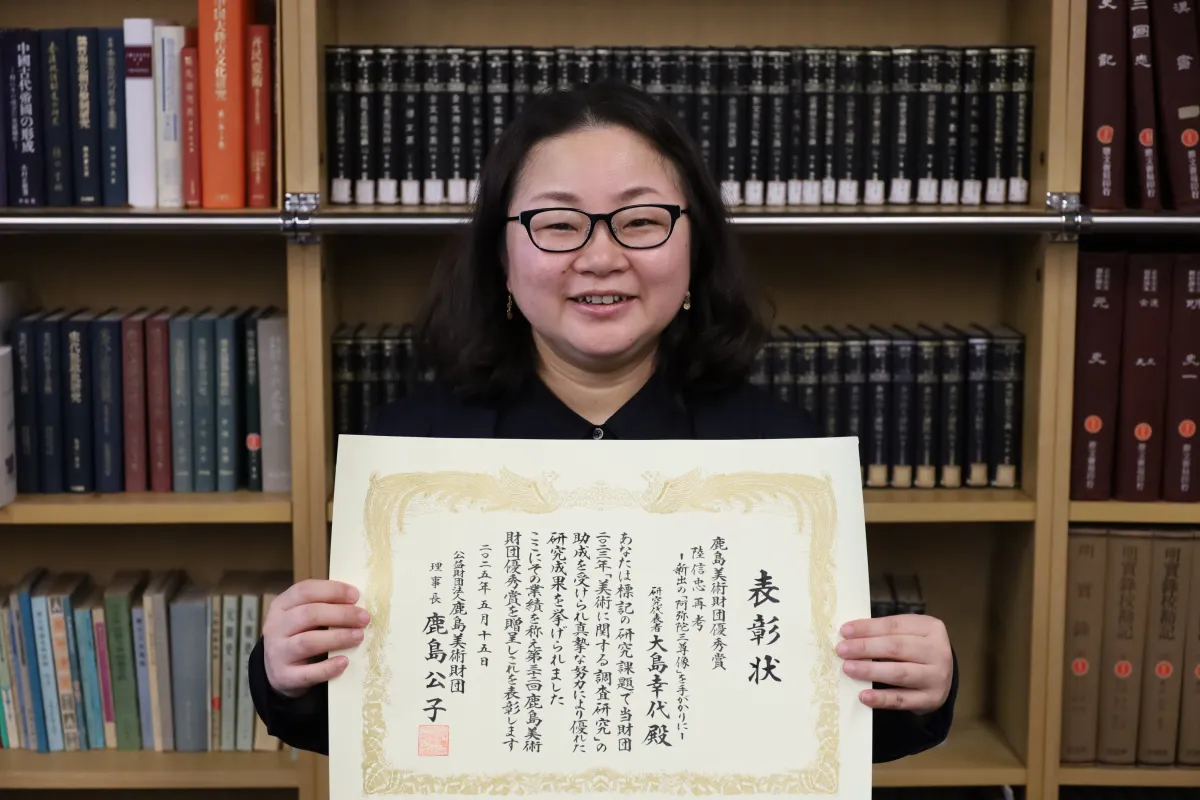
Kayo Oshima Receives the 32nd Kashima Art Foundation Excellence Award
Kayo Oshima Receives the 32nd Kashima Art Foundation Excellence Award
Kayo Oshima, a lecturer in the Department of History at Taisho University located in Toshima, Tokyo, has been awarded the "32nd Kashima Art Foundation Excellence Award" in the Japanese and Eastern Art category. This award recognizes her outstanding research as the principal investigator in her paper titled Reconsideration of Riku Shinchuu — Using the Newly Discovered Amida Three Deities as Clue, where her findings were formally acknowledged during the award ceremony held on May 15.
Established in 1994, the Kashima Art Foundation's Excellence Award aims to promote art research through recognizing exceptional scholarly contributions. Each year, it is presented to the most remarkable research achievements among those that received financial support from the foundation. Due to the limited number of prestigious awards in the field of art research in Japan, this recognition garners significant attention among art scholars.
Kayo Oshima's Perspective
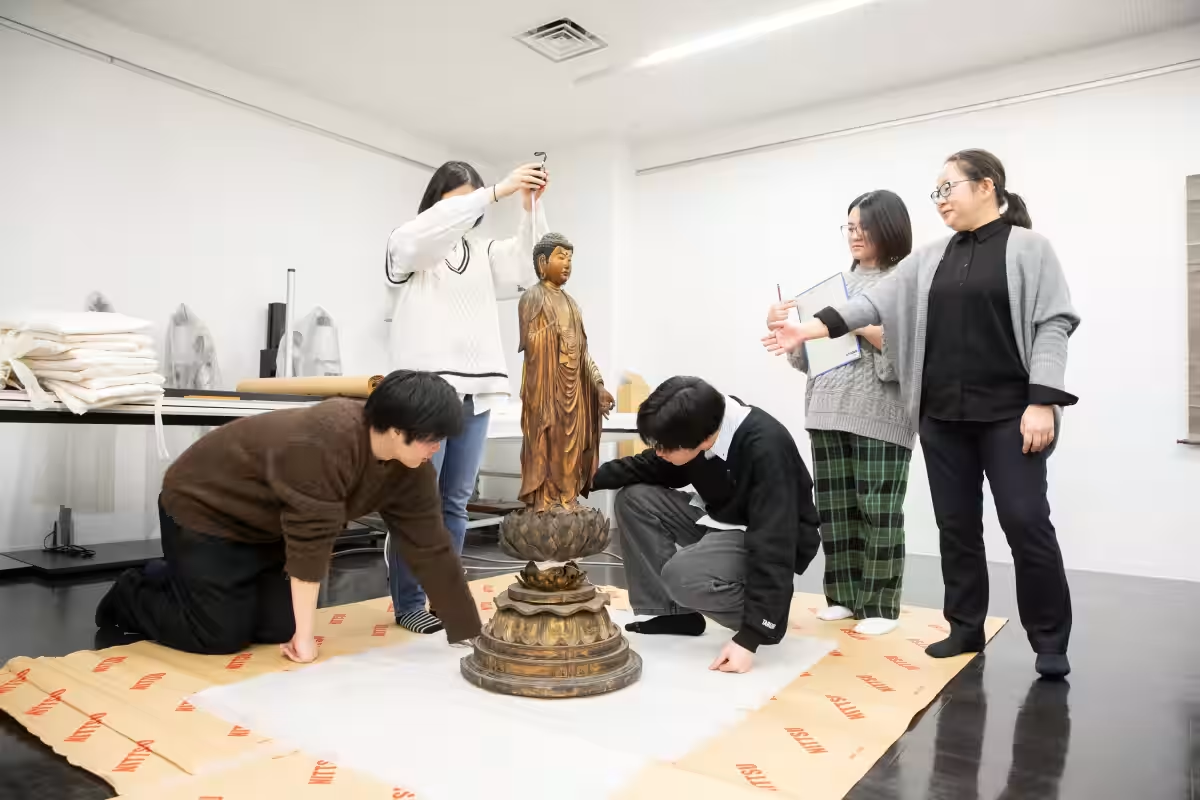
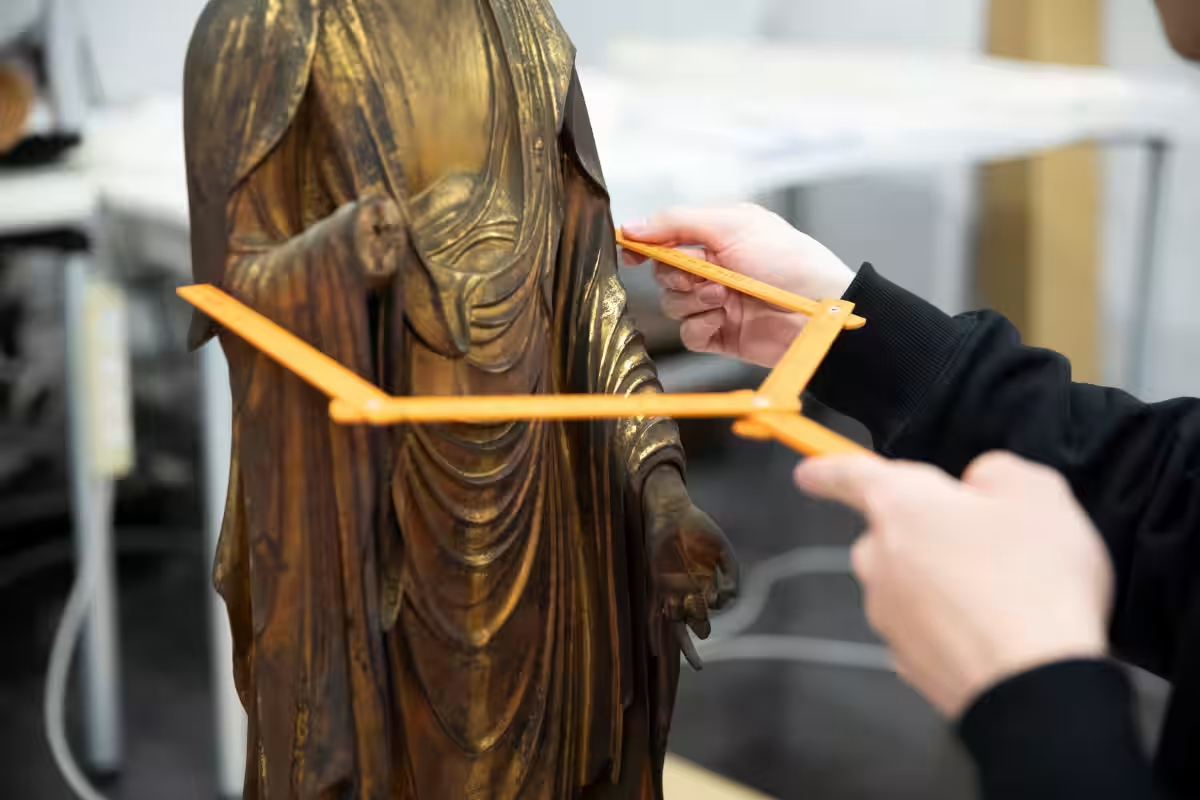
Oshima expressed her joy at receiving this distinguished award, stating, "I am truly happy to have been honored with the 32nd Kashima Art Foundation Excellence Award. My research aims to illuminate the creation process of artworks, particularly paintings, in as much detail as possible. By thoroughly observing the works of Riku Shinchuu, a Buddhist painter active in the Southern Song period in Ningbo, I scrutinized the materials, techniques, and unique characteristics of his methods. From this analysis, it became apparent that many works were created systematically in workshops led by professional artists. Although many ancient artworks have been preserved, the specific conditions under which they originated remain largely obscure. My research attempts to reveal this obscured perspective by interpreting the subtle information embedded within these works. In our Cultural Heritage and Archaeology course, we emphasize the importance of directly engaging with artworks to extract various insights, which I hold dearly in my research. Through various classes, I frequently visit museums and temples to confront these artifacts, gather information, and think critically about new revelations. This process is the foundational work of art history research and truly one of its greatest pleasures."

Key Points
1. Kayo Oshima from the Department of History has won the 32nd Kashima Art Foundation Excellence Award.
2. Her research, which reconstructs the environmental context of art production from intricate details, has garnered high acclaim.
3. The Kashima Art Foundation's Excellence Award is a highly respected acknowledgment among art researchers.
About Kayo Oshima
Kayo Oshima was born in Aichi Prefecture and graduated from Aichi Prefectural Kariya High School. Subsequently, she pursued her studies at Waseda University, where she earned a Master’s degree in Literature. Oshima’s career includes serving as an assistant at Waseda University, a curator at the Ryukoku Museum, and Nakano Island's Koyuki Museum, before joining Taisho University in April 2023. She is set to obtain her Doctorate in Literature from Waseda University in February 2025. Oshima specializes in the art history of East Asian Buddhist practices, focusing on cave artwork and Buddhist paintings from Japan and China.
Cultural Heritage and Archaeology Course at Taisho University
The Cultural Heritage and Archaeology Course emphasizes various disciplines including Art History, Archaeology, Museum Studies, and Conservation Studies. Students engage with cultural heritage through practical classes that explore preservation and restoration methods and opportunities for hands-on museum and gallery experience. Courses designed for future curators and archaeological surveyors cover essential theoretical and practical knowledge, enabling students to cultivate a historical perspective using both in-class theory and fieldwork.
About Taisho University
Taisho University is collaboratively managed by four prominent Buddhist sects: Tendai, Shingon, Jodo, and Jishu. The university operates under the principle of 'Practical Wisdom and Compassion' established at its founding in 1926, and advocates the ideals of a Bodhisattva — individuals committed to their education while aspiring for the happiness of others. The institution hopes that students will embody the spirit of a Bodhisattva throughout their lives, supported by educational visions derived from Buddhist principles that promote compassion and coexistence. For further details, visit Taisho University's official website.
Topics Other)


【About Using Articles】
You can freely use the title and article content by linking to the page where the article is posted.
※ Images cannot be used.
【About Links】
Links are free to use.