



Palladium Global Science Award Celebrates Innovations in Hong Kong
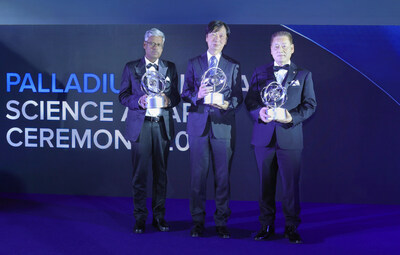
Palladium Global Science Award 2025
The first-ever Palladium Global Science Award took place in Hong Kong on November 22, 2025, celebrating groundbreaking innovations in industrial applications of palladium. This newly established international scientific competition aims to promote and stimulate advanced research in new technologies leveraging palladium's unique properties. With nearly 100 applicants from over 30 countries, the award recognized significant contributions across a range of fields including traditional and alternative energy, metallurgy, chemistry, nanotechnology, medicine, electronics, and environmental technologies.
The event attracted prominent scientists, business representatives, officials, and international partners, all gathered to witness the official announcement of the winners and to acknowledge the high level of innovation shaping the future of palladium applications.
Five scientists stood out in the competition, sharing a total prize of $350,000. They were awarded in three categories, each highlighting remarkable advancements in palladium technology:
1. Best Scientific Developments in New Applications of Palladium
2. Best Scientific Paper on New Applications of Palladium
3. Best Applied Concept for New Applications of Palladium
In the category for the best scientific development, Professor Chao-Jun Li from McGill University, Canada, claimed the first prize with a novel palladium catalyst designed to convert methane and carbon dioxide into methanol, a crucial chemical feedstock. This innovation contributes to reducing greenhouse gas emissions and promotes more sustainable raw material utilization and minimizes production waste.
Professor Makoto Fujita from the University of Tokyo, Japan, was awarded second place for his development of a new method for constructing palladium nanostructures, paving the way for unique materials applicable in electronics, medicine, and cutting-edge industrial technologies.
For the best scientific paper, Professor Natesan Thirupathi from the University of Delhi, India, took the top award for his research on organopalladium chemistry, which enhances pharmaceutical development and fosters greener pharmaceutical production. Second place went to Professor Michael Joseph Krische from the University of Texas at Austin, USA, for devising a method utilizing palladium for simultaneous hydrogenation and coupling reactions, streamlining the synthesis of vital medicinal compounds.
The award for the best applied concept was presented to Associate Professor Safa Faris Kayed from Prince Sattam bin Abdulaziz University, Saudi Arabia, for PalladClear, a palladium-based wastewater treatment system. This device is effective in purifying water, recovering metals for reuse, and minimizing environmental impact, essential for creating cleaner and safer urban environments.
Francis Verpoort, chairman of the International Advisory Council of the Palladium Global Science Award, expressed the importance of these innovations, stating, "We evaluated not only original ideas but also their tangible impact, where deep scientific understanding meets practical implementation. From the early submissions, it became evident that palladium's applications extend beyond traditional uses; we witnessed innovations transforming it into a strategic and functional resource."
The next edition of the Palladium Global Science Award is scheduled to be launched in Spring 2026, inviting scientists and engineers worldwide to present new projects that have the potential to transform technology, enhance environmental sustainability, and strengthen palladium's role in the future industry.
Topics General Business)
【About Using Articles】
You can freely use the title and article content by linking to the page where the article is posted.
※ Images cannot be used.
【About Links】
Links are free to use.