



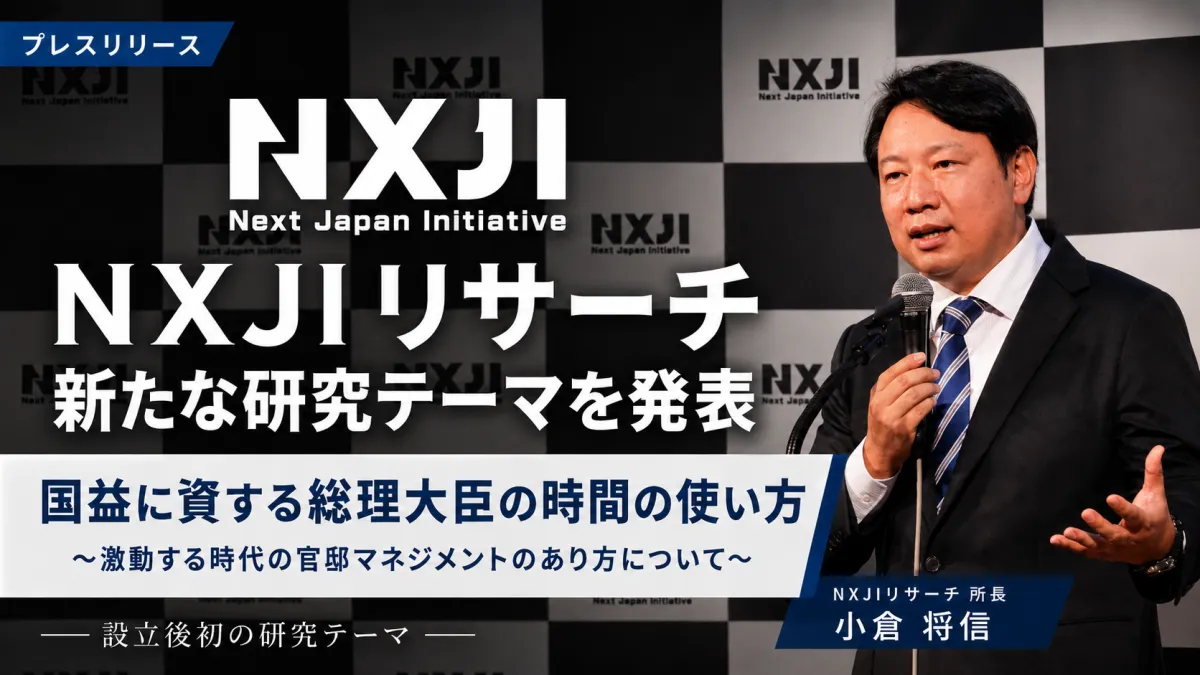
NXJI Research Launches Study on Prime Minister's Effective Time Management
NXJI Research's New Initiative on Prime Minister's Time Management
The think tank division of the Next Japan Initiative (NXJI), known as NXJI Research, has taken a significant step by launching its first research topic, focusing on "the utilization of time by the Prime Minister for national interests: A study on the management of the Prime Minister's office during turbulent times."
This research project is designated as the first theme for NXJI Research’s upcoming quarterly report, tentatively named "Quarterly Report (Tentative)". The primary aim of NXJI Research is to contribute to enhancing the quality of policy making in Japan through long-term optimal, comprehensive, and global perspectives on policy research and recommendations. This study will specifically focus on the time management of the Prime Minister and how it underpins the decision-making processes at the Prime Minister's office.
The Importance of Time Management for Leadership
The Prime Minister of Japan holds the crucial role of decision-maker on matters that determine the nation’s direction and serves as the highest authority in crisis management. For leaders responsible for such significant decisions, effective time management is paramount.
For instance, Jeff Bezos, the founder of Amazon, emphasizes ensuring eight hours of sleep and a deliberately slow-paced morning to make optimal decisions at his first meeting of the day at 10 AM. While comparing business leaders and political figures may not be entirely accurate, the correlation between time management and decision-making quality is an important subject to revisit, particularly in the context of Japan’s Prime Minister's daily routines.
The daily agenda of the Prime Minister encompasses a wide range of duties, including responding to parliament, attending meetings with various ministries, participating in the Economic and Fiscal Policy Council, and engaging in discussions with legislators, local governments, and private sector representatives, as well as conducting diplomatic relations. According to the respective parliamentary websites, the number of days that heads of state have spoken in parliament in developed countries varies significantly; while the U.S. has 1 day, the U.K. has 50 days, Germany has 13 days, and Japan has recorded 72 days.
Moreover, it is exceptionally rare on a global scale for a head of government to endure lengthy sessions in parliament, sometimes spending up to seven hours answering questions from legislators.
When preparing for parliamentary deliberations, the Prime Minister must be ready to address inquiries across a broad spectrum of policy areas. The extensive time involved not only in the responses themselves but also in the preparatory work is substantial, often resulting in study sessions that last until the early hours or begin early in the morning, imposing considerable strain on the Prime Minister and their close associates.
In addition to adhering to parliamentary discussions, their responsibilities include attending policy briefings from various ministries, participating in numerous meetings, engaging with stakeholders, and managing diplomatic relations, adding to the complexity of their role.
A Changing Environmental Landscape
Japan faces a rapidly changing environment. The increasing frequency of large-scale disasters, Russia's invasion of Ukraine, and rising tensions in the Strait of Hormuz highlight the diverse challenges in crisis response that the nation must address. In this context, understanding how the Prime Minister should fulfill vital roles in national strategy, crisis management, and diplomatic relations becomes a crucial topic for future discussions on governance.
This research endeavors to view the Prime Minister’s heavy workload not merely as an issue of personal labor but as a question of effective office management contributing to national interests. Through forthcoming domestic and international case studies and interviews with relevant stakeholders, it aims to outline vital considerations regarding the Prime Minister’s time management and explore the ideal model of office management.
Key Discussion Points for the Research
1. Should the Prime Minister devote more time to critical roles such as making strategic national decisions and handling diplomacy, which can only be executed by the Prime Minister?
2. Should we create a decision-making environment that facilitates appropriate judgments, including provision for rest periods?
3. How should we reevaluate parliamentary operations and the Prime Minister's office management based on these insights?
4. What infrastructure and support systems should be established to assist the busy Prime Minister?
Future Plans
NXJI Research plans to compile the findings from this research into the first issue of the quarterly report "Quarterly Report (Tentative)" with an expected publication date of the end of August 2026.
About NXJI Research
NXJI Research is the think tank arm of the Next Japan Initiative (NXJI), aimed at improving the quality of policy making in Japan through policy research and recommendations based on long-term optimal, comprehensive, and global perspectives.
Previously, NXJI has operated programs for nurturing the next generation of political leaders, such as the "Reiwa Political Leadership Training School," and has been involved in publishing relevant literature. NXJI Research, in collaboration with these initiatives, seeks to form a policy ecosystem that connects research with implementation. Primary activities include publishing the quarterly report, organizing policy symposiums, managing subcommittees on policy themes, and nurturing young policy talent.
Contact Information
Next Japan Initiative (NXJI)
NXJI Research
Location: 2-6-24 Akasaka, Minato-ku, Tokyo, 3F Mizuno Building
E-mail: [email protected]
Official Site: https://nxji.jp/
Topics Policy & Public Interest)
【About Using Articles】
You can freely use the title and article content by linking to the page where the article is posted.
※ Images cannot be used.
【About Links】
Links are free to use.