



Understanding Global Biodiversity Impacts of Land Use Changes with Enhanced Precision
Understanding the Global Impacts of Land Use Changes on Biodiversity
In recent years, the issues of climate change and biodiversity loss have emerged as pressing global challenges. The need for accurate and timely insights into how land use changes affect biodiversity on a worldwide scale is more critical than ever. A cutting-edge research team from Waseda University, alongside several notable collaborators, has developed innovative methodologies that deliver high-resolution assessments of biodiversity impacts derived from land use changes.
Background of the Research
The study was motivated by the increasing urgency to halt the loss of nature by 2030 and to set a course toward recovery, in alignment with global goals termed 'Nature Positive.' Companies are urged to understand and mitigate their impact on nature, as stipulated by the recommendations of the Taskforce on Nature-related Financial Disclosures (TNFD) promoting transparency concerning environmental risks and dependencies.
Traditional methods for assessing environmental impacts have been largely limited to national averages, resulting in a lack of localized data that reflects the true nature of biodiversity threats. Therefore, considering the distinct characteristics of locations where land is utilized for various activities is paramount. This demand has catalyzed research into location-based assessments that focus on specific impacts of business activities on biodiversity.
Key Findings of the Study
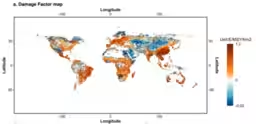
Supported by Japan's Cabinet Office through the Bridge Program, the research team, including Professor Norihiro Itsubo and researcher Runya Liu, has refined the Life Cycle Assessment (LCA) framework. The new methodology allows for quantifiable evaluations of the expected impacts on biodiversity resulting from future land use changes by calculating 'damage factors' at a resolution of 0.25 degrees globally. This granularity permits a nuanced understanding of extinction risks associated with land modifications, leading to a more tailored approach for assessing environmental risks across different settings.
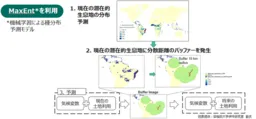
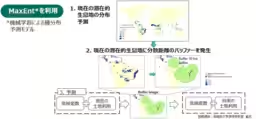
By leveraging advanced habitat prediction models and thorough simulations, the team scrutinized the potential habitats and assessed extinction rates for over 6,569 species. As a result, they developed spatial maps indicating how changes in land use can heighten extinction risks in specific locales, significantly diverging from previous generalized evaluations.
Future Applications
The newly established methodology holds promising prospects for various stakeholders, notably companies and financial institutions, by enabling:
1. Impact assessments of corporate activities and their value chains on nature.
2. Portfolio analyses for financial entities that include investment and insurance underwriting.
3. Improved reporting in alignment with TNFD guidelines, which demand firms reflect on their environmental exposures based on specific geographical locations.
4. Enhanced transition planning considerations that reflect the natural perspective.
With increased focus on nature-related risks in financial industries, location-based analyses will become more critical for effective decision-making. The intention is to analyze real financial portfolios, generating case studies to encourage social implementation of these findings, ultimately supporting businesses in transitioning towards nature-positive operations.
Guided by the findings from this research, organizations will be better equipped to adjust funding allocations and implement strategies that minimize negative environmental impacts, thereby fostering an ecosystem where economic growth and biodiversity conservation go hand in hand.
Conclusion
In sum, this pioneering research establishes a robust groundwork for quantifying the impacts of land use changes on biodiversity, paving the way for more strategic and informed business and investment decisions. The future landscape of natural resource management may be significantly altered thanks to these scientific advancements in understanding biodiversity risks associated with land alterations.
Topics Environment)

【About Using Articles】
You can freely use the title and article content by linking to the page where the article is posted.
※ Images cannot be used.
【About Links】
Links are free to use.