



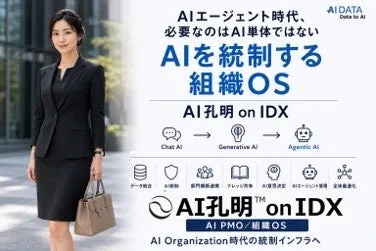
In the Age of AI Agents: Implementing Organizational OS for Control and Optimization
Introduction to AI Kōmei on IDX
As we enter the era of AI agents, it is crucial for organizations to adapt beyond simply deploying artificial intelligence tools. AI Data Corporation, headquartered in Minato, Tokyo, has launched a project aimed at creating what they're calling an "Organizational OS" specifically designed to govern AI applications in retail.
With the rapid proliferation of AI technologies, retail businesses have started to deploy various AI-driven solutions such as sales analysis bots and customer support agents. However, these AI systems often operate in silos, leading to fragmented data management across different sectors of the organization. This fragmentation complicates the success of strategic initiatives and campaigns, making it harder to link data effectively and generally hinders overall sales improvement.
The organization has recognized these challenges and is moving to establish a comprehensive AI control infrastructure to mitigate potential risks, ensuring that diverse data from a retail environment—including membership information and sales data—is efficiently integrated and utilized.
The Transition to the AI Agents Era
The AI market is currently transitioning from generative AI solutions to a more advanced phase: AI agents. Unlike prior AI applications that primarily provided information and basic analysis, AI agents are capable of performing complex tasks including:
- - Data collection
- - Comparative analysis
- - Predictive analytics
- - Execution support and system integration
AI Data Corporation perceives this as a natural evolution in the market, moving through various phases: from chat AI, then generating AI, and now to what they term agentic AI.
However, with the rise of AI agents comes a new complexity. Businesses could potentially deploy numerous AI systems across various functions such as sales, support, finance, HR, marketing, and development. The pressing question remains, who will manage and control this multitude of AI agents? This challenge is aptly termed the "AI Silo Problem" by the company.
The Essential Need for Organizational Control
AI Data Corporation firmly believes that simply having numerous AI agents is not sufficient. The organization argues for the necessity of a mechanism that enables these AI to work harmoniously within a structured framework.
Many companies today grapple with several challenges, including:
- - Proliferation of SaaS tools
- - Departmental disintegration
- - Fragmented data spread across various silos
- - Reliance on specific individuals for data management
Introducing AI agents without an overarching governance structure risks leading to disjointed systems that prioritize localized optimization rather than company-wide efficiency.
Redefining Competition in the AI Era
According to AI Data Corporation, the competitive landscape has shifted. Previously, the battle was about data ownership. In the age of AI agents, success hinges more on who can proficiently manage AI as part of a cohesive organizational strategy.
Moreover, as customers begin to adopt their own AI solutions to streamline comparisons, contract assessments, risk evaluations, and future forecasts, the dynamics shift. This leads to a scenario where the customer's AI capabilities outstrip the organizations that fail to integrate their AI agents properly. This shift is described by AI Data Corporation as the "Customer Intelligence vs. Corporate Intelligence" dilemma.
Overview of AI PMO by AI Kōmei on IDX
AI Kōmei on IDX transcends traditional generative AI offerings. It is framed as the AI PMO—essentially an operational nerve center for managing AI deployments within an organizational context. The AI PMO encompasses:
- - Data integration
- - AI governance
- - Cross-department collaboration
- - Knowledge sharing initiatives
- - AI decision-making processes
- - Management of AI agents
- - Overall optimization strategies
This initiative aims to evolve organizations into intelligent entities known as "AI Organizations," capable of fully utilizing the potential benefits of AI technologies.
Case Study of Retail Company A
Let’s consider Retail Company A, which operates a moderate-scale network of 40 to 180 stores primarily focused on supermarkets and drugstores. Initially contemplating the implementation of a stock optimization AI, they soon realized that merely optimizing inventory wouldn't significantly enhance sales outcomes.
Thus, they pivoted towards utilizing the AI RetailBooster on IDX as a foundation to unify previously siloed operations under the AI PMO framework. Starting in the inventory department, they plan to progressively optimize logistics and customer management efforts, providing a comprehensive one-year plan to aggregate disparate data sources into a robust organizational OS that governs AI deployments effectively.
In doing so, Retail Company A aims to meet the nuanced demands of customers who are now seeking complex solutions that meet their diverse needs across various retail channels. This proactive approach places them on solid footing as they prepare for an age defined by AI agents and advanced organizational intelligence.
Conclusion: AI Data Corporation's Vision
As the AI landscape continues to evolve, AI Data Corporation emphasizes that merely increasing the number of AI tools at one's disposal will not automatically translate into organizational intelligence. The essential requirement lies in effectively governing these AI entities and orchestrating them within a singular organizational strategy. The era of competition will not be defined by who owns the most AI but rather by those who can adeptly manage them in an integrated fashion. AI Kōmei on IDX serves as a pivotal framework to support organizations in achieving better control and enhancing their operational intelligence as we transition into the future of AI.
Topics Consumer Products & Retail)
【About Using Articles】
You can freely use the title and article content by linking to the page where the article is posted.
※ Images cannot be used.
【About Links】
Links are free to use.