



Innovative Glass Development: Achieving Stronger, Thinner Glass with New Composition Design
The Future of Glass: Breakthroughs in Strength and Thinness
In a remarkable advancement in glass manufacturing, researchers from the National Institute of Advanced Industrial Science and Technology (AIST), led by Hirokazu Masai of the Advanced Research Group for Photonic Functional Materials, have successfully formulated a new type of glass. This innovative glass not only boasts exceptional hardness but is also resistant to deformation, achieved through standard glass-making practices and a novel composition design.
Overview of the Research
Glass plays an integral role in our daily lives, utilized in products ranging from smartphone screens to structural materials. With its unique ability to be molded and processed for various applications, the demands for glass performance vary widely. For instance, cover glass necessitates thinness and transparency, while glass fibers need to provide strength to resins and building materials. In recent years, the quest for a glass that meets the criteria of being both thinner and stronger has intensified.
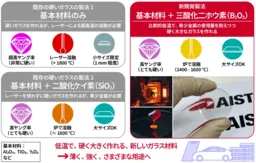
The innovative approach taken by Masai and his team involved using the conventional melting method while cleverly avoiding the typical main component, silicon dioxide (SiO2). Instead, they developed a composition that achieves a Young's modulus exceeding 130 GPa, pushing the possibilities of glass performance further than previously reported. This achievement is significant as it promises to revolutionize not only large-scale glass manufacturing but also the production of glass fibers.
This breakthrough is detailed in an upcoming publication in the Journal of the Ceramic Society of Japan, scheduled for release on May 1, 2026.
Societal Background
In contemporary society, glass-based products are ubiquitous. The increasing reliance on high-performance glass, especially in applications such as smartphone and PC displays, necessitates ongoing enhancements to its properties. Consumers are yearning for glass that meets higher standards for thinness and strength.
Current market solutions like chemically or physically strengthened glass enhance durability by applying compressive stress to the surface. However, these methods often require separate treatments post-manufacturing, which has prompted the search for inherent strength within the glass itself. Traditional methods for creating scratch-resistant glass have involved high temperature melting of hard-to-fuse materials or the use of costly rare metals, both of which drive up production costs.
Research Development
The research team at AIST has dedicated itself to developing novel glass materials that possess unique value, surpassing existing options. Typically, glass is manufactured by heating raw materials such as silica sand and soda ash to high temperatures between 1500-1600°C. Yet, through meticulous examination of the glass composition using established melting techniques, the team successfully produced glass with heightened Young’s modulus.
This research is supported by the Japanese Society for the Promotion of Science, focusing on groundbreaking scientific investigation between 2020 and 2024.
Analysis of Glass Properties
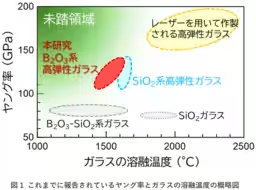
Graphical illustrations highlight the correlation between the melting temperature and Young's modulus of various types of glass. Typically, obtaining high Young's modulus glass requires the use of high-melting-point raw materials like aluminum oxide (Al2O3) or titanium dioxide (TiO2); however, these are not feasible in standard melting operations due to their soaring melting points. Consequently, methods such as laser-induced heating have been explored, but limitations in sample size remain a challenge.
The research team tackled these issues by utilizing boron trioxide (B2O3), which melts at significantly lower temperatures, and meticulously adjusting the composition to include high-energy raw materials, yielding glass with Young's moduli of 130 GPa. This achievement doubles the performance compared to typical B2O3-SiO2 glasses, enabling cheaper production through minimized rare metal usage.
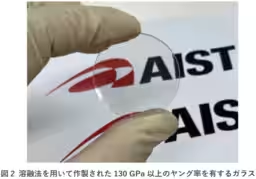
The newly developed transparent high-elasticity glass can be produced in larger sizes, demonstrating versatility from ultra-thin sheets to glass fibers and complex shapes.
Future Prospects
The successful development of this hard, scratch-resistant glass opens avenues for further exploration into mitigating glass's inherent brittleness under strong impacts. Addressing this element, alongside enhancing hardness, could lead to the creation of
Topics Other)





【About Using Articles】
You can freely use the title and article content by linking to the page where the article is posted.
※ Images cannot be used.
【About Links】
Links are free to use.