




New Mathematical Model for Slime Mold Computers Advances Energy-Efficient Computing
Breakthrough in Slime Mold Computer Research
Recent advancements in the field of bio-inspired computing have led to remarkable discoveries regarding slime mold computers. Researchers from Waseda University, Yuusuke Miyajima and Masahito Mochizuki, have introduced a new mathematical model for slime mold computers. This groundbreaking model is significant as it overcomes barriers that previously hindered the implementation of energy-efficient information processing technologies inspired by slime mold behavior.
Understanding Slime Mold's Unique Intelligence
Slime molds, single-celled organisms without a central nervous system, exhibit exceptional problem-solving abilities, such as maze-solving and optimizing routes. Their ability to process information collectively—without any central command—has attracted attention for developing next-generation, low-power computing technologies. The emerging concept of a slime mold computer aims to replicate their unique computational algorithms for various optimization problems.
However, past models faced significant challenges due to constraints that complicated physical implementation and limited practical application to general optimization problems. The research team at Waseda University has successfully proposed a new mathematical framework that simplifies these constraints while demonstrating superior performance in solving complex optimization problems.
Enhancements in Computational Efficiency
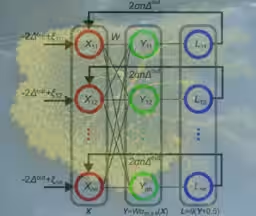
The newly proposed model has shown to quadruple the problem-solving speed of traditional models when applied to the Traveling Salesman Problem. This transforms its scalability, enabling it to handle larger instances of optimization, up from a maximum of roughly 100 cities to 180 cities. Additionally, the research revealed that slime mold's information processing shares certain core structures with neural networks used in artificial intelligence, raising interesting possibilities for enhanced computational models.
Through robust numerical simulations, the proposed model has proven not only to improve the speed of solution discovery but also indicated promising flexibility in controlling the speed and quality of results through newly integrated parameters. This positions the slime mold computer as a significant contender for future computing paradigms.
Spintronics - A Path to Physical Implementation
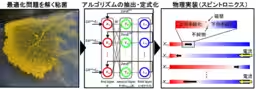
To harness these innovative computational techniques, the researchers suggested that spintronic elements could serve as a physical implementation method for slime mold computers. Spintronics, which utilizes the spin of electrons alongside their charge, could significantly lower power consumption while maintaining the benefits of advanced computational techniques.
This method allows for the incorporation of more versatile materials and phenomena in the computer’s design, enhancing its adaptability and efficiency. The proposed spintronic implementation not only circumvents the constraints of maintaining constant volume as required by previous models but also utilizes the inherent randomness of thermal fluctuations during operation, making it simpler and more efficient.
The Broader Implications
The success of this research lays a critical foundation for developing slime mold computers that function on principles distinct from conventional computing methods. It promises to address pressing issues such as rising power consumption in current computing as AI and massive data processing requirements increase.
Moreover, the findings offer fresh insights into understanding slime mold intelligence, pushing the frontier in computational theory by suggesting a connection between its information processing mechanisms and recurrent neural networks.
Future Directions
While significant strides have been made, further evaluation of the proposed mathematical model will be vital to firm up its applicability across various combinatorial optimization problems. The research team aims to advance their work into practical applications, exploring the model's versatility and ultimately creating a slime mold computer that can operate effectively at the level of real-world challenges.
Conclusion
This study represents a critical junction in the convergence of biology and technology, showcasing how understanding biological intelligence can pave the way for innovative computing solutions. Researchers hope to bridge the gap between mathematical models, materials, devices, and applications in their future endeavors. If successfully implemented, slime mold computers could revolutionize energy-efficient computing.




Topics Consumer Technology)
【About Using Articles】
You can freely use the title and article content by linking to the page where the article is posted.
※ Images cannot be used.
【About Links】
Links are free to use.