



GlobalData Reveals Voice Services Evolution in AI Era at MWC 2026
Overview of GlobalData's White Paper on Voice Evolution
During the Mobile World Congress (MWC) 2026, a significant event in the telecommunications industry, Andy Hicks, the Senior Principal Analyst at GlobalData, unveiled a groundbreaking white paper titled Reinventing Voice: A Converged, AI-Enabled, and Multimodal Voice Core for the Next Generation of Telecommunications. This paper sheds light on how voice service providers can leverage completely converged networks to innovate their AI-driven services and redefine the value proposition of voice communications.
The Need for Fully Converged Voice Networks
As the adoption of 5G technology accelerates, the global evolution of network standards remains uneven. Older networks, including 2G and 3G, are becoming outdated, yet they still need to be maintained to support essential services like M2M communication and international roaming. In this context, fully converged voice networks that can seamlessly manage 2G, 3G, 4G, and 5G services are becoming essential for telecom operators. These converged networks help tackle operational challenges associated with the lifecycle of various technologies, paving the way for a smooth future transition.
With a global shift towards containerization, a fully converged architecture facilitates the transition from virtual machines to containers. This approach enables operators to reduce Total Cost of Ownership (TCO) while promoting continuous innovation and rapid updates in voice services.
Integrating AI with Voice Services: A Three-Phase Approach
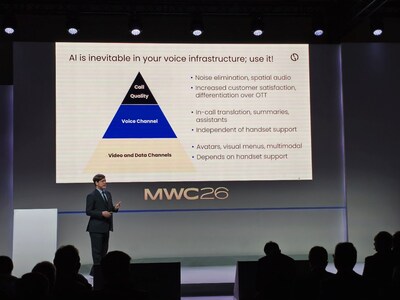
The rapid advancements in AI open up new opportunities for innovation in voice services. Hicks emphasizes that profound integration between AI and voice technology can be achieved through three key phases.
1. Enhancing Basic Call Functions: Initially, AI can be utilized to improve fundamental call operations and create a competitive edge over Over-the-Top (OTT) applications. Typical enhancements include intelligent noise suppression and an augmented spatial audio experience, which elevate the quality of communication significantly.
2. Innovative Features via AI Integration: The next step involves embedding AI into audio channels to introduce innovative functionalities such as real-time translation and intelligent call summary features. These enhancements do not necessitate additional requirements on terminals, allowing operators to implement these services rapidly to gain a competitive advantage in voice-related innovations based on AI.
3. Promoting Multimodal Solutions: Finally, AI can be integrated into video and data channels to encourage further vocal innovations, transitioning from a unimodal approach to one that is multimodal. This shift allows for the introduction of services like interactive customer support and healthcare assistance, effectively realizing the concept of Call-as-a-Service.
Andy Hicks reiterated the importance for telecom operators to seize the opportunities presented by AI. By relying on a fully converged voice network, they can drive service innovation and completely renew the intrinsic value of voice services, leveraging advancements in both 5G technology and AI.
For those interested, the complete white paper can be accessed here.
Topics Telecommunications)
【About Using Articles】
You can freely use the title and article content by linking to the page where the article is posted.
※ Images cannot be used.
【About Links】
Links are free to use.