



Typhoon Forecast for 2026: What to Expect This Summer and Fall
Typhoon Forecast for 2026
As we look forward to the summer of 2026, the Japan Meteorological Association has released its expectations regarding typhoons impacting Japan. This year's report pointed out an increase in the number of typhoons expected in August, with a need for vigilance during the fall season as stronger typhoons could approach the archipelago.
Summary of Key Points
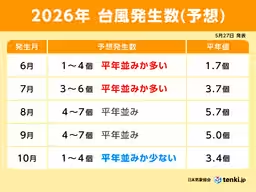
- - Expected typhoon activity from June to July is likely to be around average or above average.
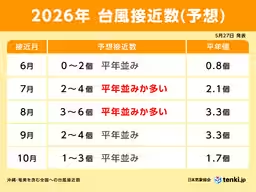
- - From August onwards, the number of incoming typhoons is predicted to be above average.
- - The likelihood of transitioning to an El Niño phenomenon may result in an increased risk of powerful typhoons approaching during the autumn months.
Detailed Insight into Typhoon Activity
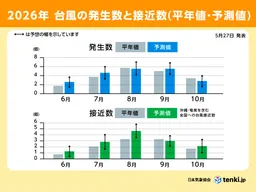
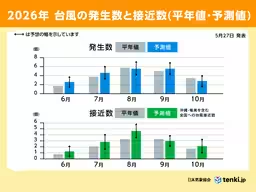
According to the long-term weather forecasting model developed by the Japan Meteorological Association, which is protected by patent, the conditions in 2026 indicate that the prevalence of typhoons will escalate, particularly in the months of June and July. These months are characterized by an increase in convective activity in the western North Pacific ocean, a prime breeding ground for typhoons.
While August through September is expected to yield average typhoon counts, October could see a decline in typhoon activity due to anticipated weaker convective conditions in the typhoon genesis areas.
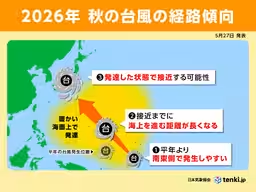
In terms of incoming typhoons to Japan, the data predicts that August will see above-average counts. This increase can be attributed to the anticipated weakening of the Pacific High's influence over the Honshu region, which usually acts as a barrier against typhoons. As a result, typhoons are likely to penetrate further north into Japan, heightening the chances of several typhoons impacting the region during this time.
However, the number of typhoon approaches is forecasted to stabilize after September, as the transition towards an El Niño state may shift the typhoon formation locations further southeast towards the International Date Line. This means that typhoons will travel longer distances over water prior to approaching Japan, potentially arriving in a fully developed state, thus posing a significant risk even if the number of approaches is not very high. Consequently, it is prudent to remain vigilant during the second half of the typhoon season, especially considering the possibility of intense storms.
Similar Weather Patterns from the Past
To better understand the forecasting for 2026, we can draw parallels with the weather conditions observed in 2023. This particular year marked the end of a La Niña episode, leading to the emergence of El Niño by spring. Throughout the summer and fall, abnormal sea surface temperature distributions in the Indian Ocean also impacted weather patterns, significantly affecting typhoon tracks and the Pacific High's influence.
Interestingly, the typhoon count in 2023 was largely average until August, followed by fewer occurrences afterward. Nevertheless, significant events such as Typhoons No. 6, 7, and 13 caused heavy rainfall across Okinawa and multiple areas of western and eastern Japan, highlighting how even a limited number of typhoons can lead to considerable impacts.
In summary, as we approach the middle of 2026, the likelihood of transitioning to an El Niño state remains high, along with the potential for phenomena like the positive Indian Ocean Dipole, reminiscent of 2023. Hence, the second half of the typhoon season will require a close watch on the developing intensity, trajectory, and speed of incoming storms, emphasizing the importance of ongoing awareness and preparedness for all citizens.
Staying Informed
It is essential to constantly check for the latest weather updates from reliable sources. The Japan Meteorological Association offers real-time insights into typhoon developments through its various channels, including its dedicated weather prediction platform, tenki.jp. The organization provides crucial information on warnings, earthquakes, tsunami updates, volcanic activity, and typhoon-related advisories throughout the year.
For further queries or insights, you can reach out to the Japan Meteorological Association.
- ---
Contact Information for Inquiries
General enterprises or municipal inquiries can be directed to:
Japan Meteorological Association, Disaster Prevention and Weather DX Division.
Phone: 03-5958-8143
Email: [email protected]
This report serves solely for informational purposes and is not intended as an invitation for business transactions. While compiled from reliable data sources, we do not guarantee completeness or accuracy. Please use your discretion when utilizing this document. Changes to the report may occur without notice. Reprint or reproduction requires permission from the copyright holder.

Topics Environment)

【About Using Articles】
You can freely use the title and article content by linking to the page where the article is posted.
※ Images cannot be used.
【About Links】
Links are free to use.