



New Theory Ensures Comprehensive Operation Assurance for Radiation-Resistant Cryptographic Circuits in Space
A Breakthrough in Space Communication Security: Ensuring the Functionality of Cryptographic Circuits
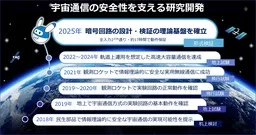
In the realm of private space exploration, maintaining high reliability while reducing costs poses a significant challenge. Recently, researchers at the National Institute of Information and Communications Technology (NICT) have developed a groundbreaking theory that unifies the design and verification of cryptographic circuits. This advancement has achieved the remarkable feat of mathematically ensuring the correct operation of these circuits even under the harsh conditions of space radiation. It stands as a testament to innovation in space technology, garnering an Honorable Mention at NASA’s International Conference on Formal Methods 2025.
The Challenge of Space Radiation
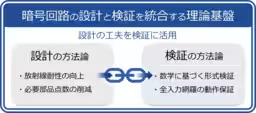
When designing cryptographic circuits for spacecraft, it is crucial to enhance radiation resistance to prevent malfunctions caused by cosmic rays. Additionally, due to the constraints of power supply and cost on these missions, minimizing the number of components is essential. However, this necessity complicates circuit design, making it difficult to guarantee comprehensive operation for all possible input values. The new theoretical framework developed by NICT successfully addresses this complexity.
A New Theoretical Foundation
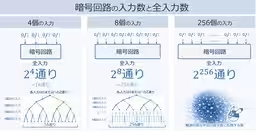
The innovative theory integrates the processes of design and verification, allowing the intricacies of the design to be directly utilized in the verification phase. By treating correctness as a mathematical property, the framework achieves a formal verification of the operation of cryptographic circuits against all potential inputs, calculated at 2^256 possibilities (approximately 10^77). This is a historic milestone, as it represents the first time such a guarantee has been mathematically demonstrated.
What’s more, the verification process using a standard computer was completed in approximately 17 hours, thus facilitating a significant enhancement in the reliability of spacecraft communication systems while contributing to reduced power consumption and costs—a vital aspect for the emerging NewSpace industry.
Recognition at NASA
The theoretical foundation's implications are profound. As private entities increasingly develop satellite systems for various purposes, there is a growing need for robust communication protocols that can effectively withstand potential interference or cyber attacks. The recognition at NASA’s NFM2025 Conference underscores the global significance of this achievement, as NFM is known for validating the reliability of critical systems through mathematical techniques. The presence of barely detectable bugs or faults in such systems can lead to catastrophic failures, thereby highlighting the critical nature of this research.
Implications for Future Space Applications
Looking ahead, the theory holds promise not only for space communication but also for any sector where safety and reliability are paramount. Its application could revolutionize the way cryptographic circuits are designed, making them safer and more efficient across various uses. The developments in security technology rooted in this mathematical framework are not merely academic; they represent a necessary shift toward creating a safer digital infrastructure in an era where satellites and space services are integrated into our daily lives.
Conclusion
In conclusion, this novel theoretical approach offers a robust solution to the challenges faced in space communications. By ensuring the reliability of cryptographic circuits against the detrimental effects of space radiation while maintaining a cost-effective design, NICT paves the way for an advanced and secure future in aerospace technology. Continued R&D based on these principles is essential to push the boundaries of what is possible in space exploration and beyond. The full research paper detailing these findings is accessible in the Lecture Notes in Computer Science from Springer, showcasing the work titled "Formal Verification of Composite Field Multipliers for Information-Theoretically Secure Radio Communication in Spacecraft Control."
References
- - Morioka, S., Obana, S., Yoshida, M. (2025). Formal Verification of Composite Field Multipliers for Information-Theoretically Secure Radio Communication in Spacecraft Control. NASA Formal Methods (NFM 2025), Lecture Notes in Computer Science, Vol. 15682, pp. 236-253. Springer. DOI: 10.1007/978-3-031-93706-4_14
- - NICT Press Release (August 17, 2021)
- - NICT Press Release (July 10, 2019)
Topics Consumer Technology)



【About Using Articles】
You can freely use the title and article content by linking to the page where the article is posted.
※ Images cannot be used.
【About Links】
Links are free to use.