



AI Implementation Assessment Reveals Gaps in Organizational Strategy and Execution
Addressing AI Implementation Gaps with Kakero
In today’s business landscape, the adoption of artificial intelligence (AI) by companies is no longer a matter of if, but when. However, despite the increasing number of organizations implementing AI solutions, many still find themselves questioning whether these tools are genuinely enhancing their operational efficiencies and driving meaningful outcomes. Kakero Inc., an AI implementation firm based in Chuo City, Tokyo, aims to bridge this gap with the introduction of a free diagnostic tool that assesses a company’s AI implementation across six foundational pillars.
The Shift Towards Organizational AI
The emergence of AI technologies designed for individual use is evident; personal assistants, chatbots, and recommendation engines are becoming commonplace. However, the challenge lies in transitioning from individual AI usage to effective organizational AI integration. Many organizations grapple with stagnation post-implementation. Some employees may be utilizing the tools, but the organization as a whole may not see any substantial changes or improved outcomes. Companies are often left stumbling in the dark, unsure of why they aren't reaping the promised benefits from their AI investments.
Six Foundations of AI Implementation
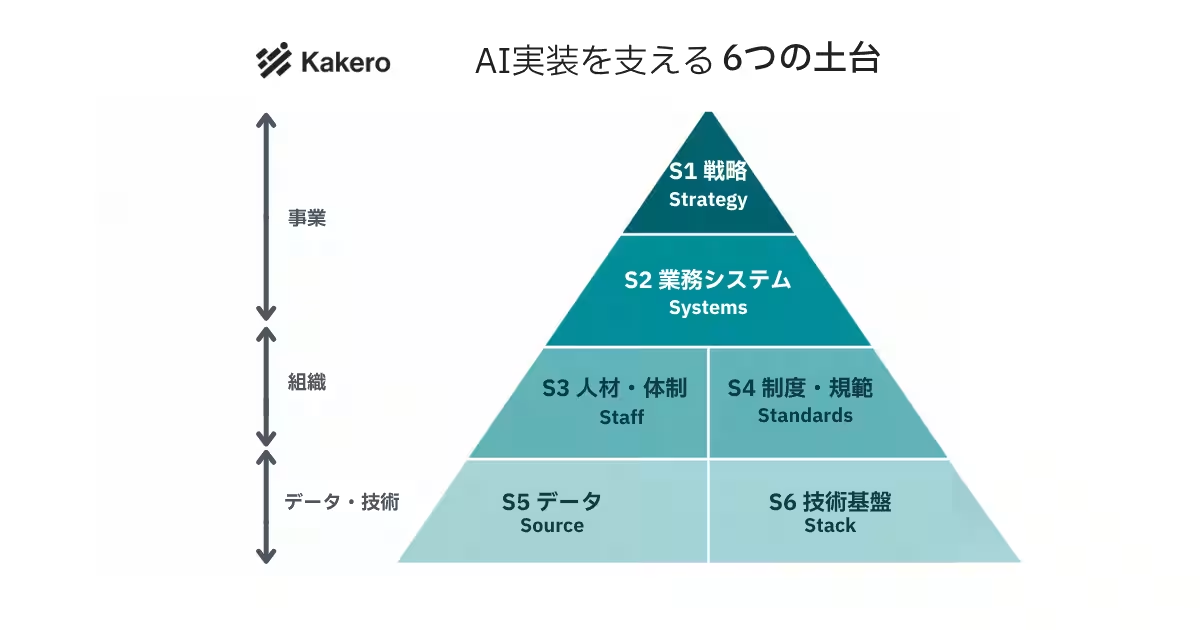
Kakero's diagnostic approach, articulated within the framework known as AINX (AI Native Transformation), categorizes AI implementation into six essential components, coined as 6S. This methodology serves as a roadmap for organizations to develop AI capabilities comprehensively. Here’s a breakdown:
1. Strategy (S1): Formulating a clear AI investment roadmap that aligns with business objectives and identifying how AI can transform competitiveness over a 3-5 year horizon.
2. Systems (S2): Redesigning operational systems to incorporate AI effectively, delineating roles for both AI and human members of the organization.
3. Staff (S3): Identifying who in the organization will lead AI initiatives, supported by the necessary skills and structures to nurture an AI-friendly culture.
4. Standards (S4): Establishing governance structures, guidelines, and a cultural framework that promotes responsible AI usage across the organization.
5. Source (S5): Determining what data should be leveraged for AI learning while sorting, structuring, and ensuring data is accessible for effective use.
6. Stack (S6): Selecting the right AI technologies and platforms that align with business goals, carried out in a vendor-neutral manner.
These foundational blocks highlight that the obstacles to effective AI utilization are multifaceted. For instance, having a well-defined strategy can become futile if data is poorly structured, or even the best tools can’t be effectively employed without established organizational operations. Conversely, pinpointing a weak foundation helps streamline intervention strategies.
The Free Diagnosis Tool
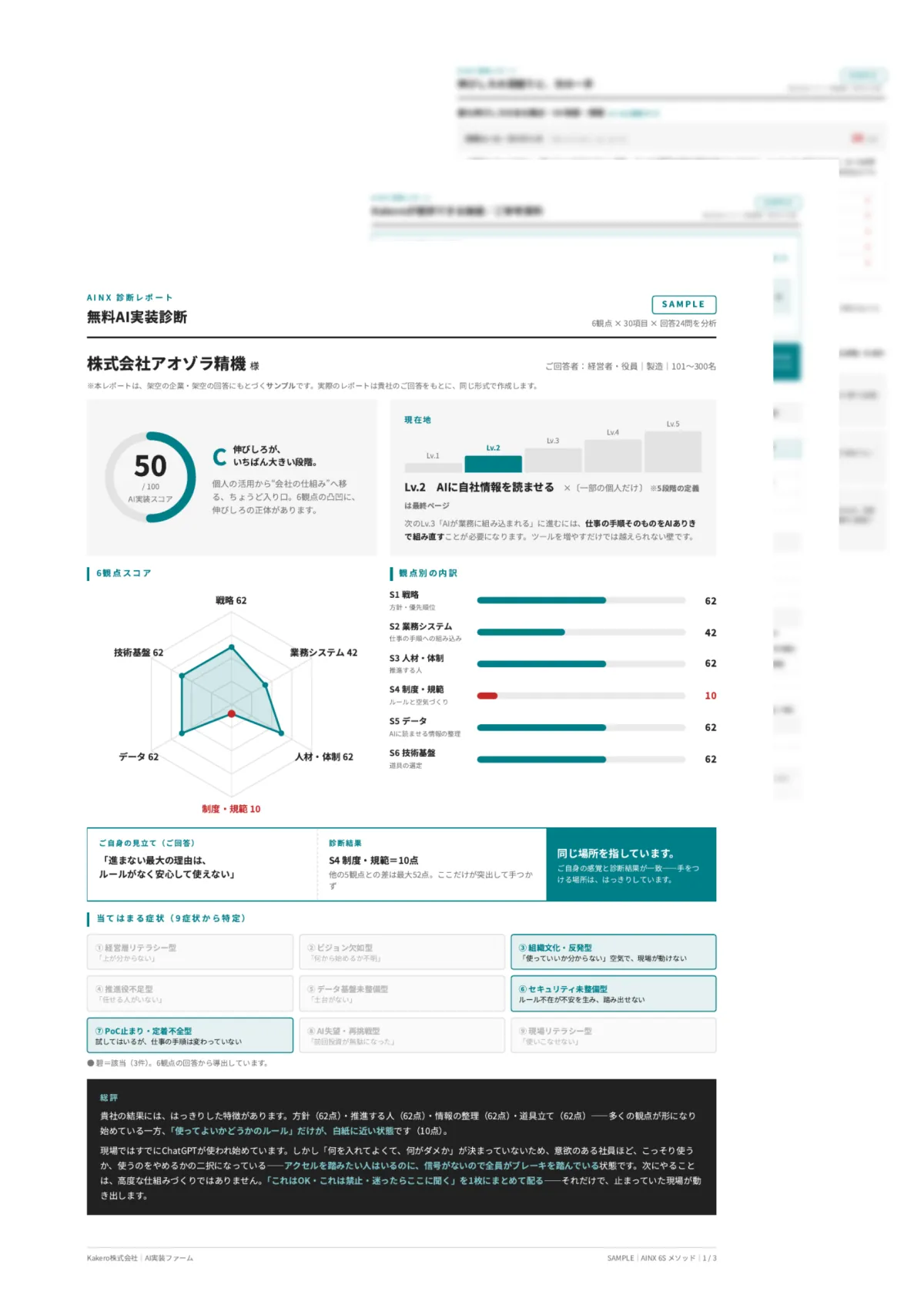
Kakero's AI Implementation Diagnosis is not only a free service but a vital instrument for businesses looking to evaluate their AI readiness. The assessment consists of 24 multiple-choice questions designed to identify where organizations stand in their AI adoption journey. Here’s a quick overview of what businesses can expect:
- - Overall Score: A quantitative measure of a company's AI implementation effectiveness.
- - Current Stage: Insights into which of the five stages of AI deployment the organization currently occupies.
- - Stumbling Blocks: Identification of one of nine common challenges hindering progress.
- - Next Steps: Tailored recommendations on where to focus next to enhance AI integration.
Results are shared via email, providing a detailed report that helps businesses understand their standing and strategize their next moves in the AI landscape.
Understanding Common Pitfalls
The diagnostic tool also reveals several prevalent challenges organizations often face, such as:
- - Lack of Executive Literacy: Even with contracts in place, companies find that leadership remains disconnected from active AI engagement, stalling progress.
- - Absence of a Clear Vision: Organizations struggle with defining which business areas to prioritize for AI-driven transformation
- - Cultural Resistance: Employees resistant to changing established workflows can hinder effective AI adoption.
- - Personnel Shortages: A lack of dedicated personnel leads to ineffective implementation and utilization of AI technologies.
- - Insufficient Data Infrastructure: Without organized data, even the best AI solutions fail to deliver results.
- - Undefined Governance: Unclear boundaries regarding AI usage can complicate compliance and oversight.
- - Failure to Move Beyond PoC: Many organizations get stuck at the proof-of-concept stage without scaling AI solutions for broader operational use.
Insights for the Future
Kakero’s CEO, Satoshi Ikedo, emphasizes that understanding an organization’s current AI maturity level is crucial. Many companies already possess AI tools yet often struggle to see tangible results. The insights gathered from the diagnostic tool will inform future reports indicating the general state of AI implementation across industries in Japan, correlating AI utilization with concrete data rather than subjective assessments.
Conclusion
As Kakero embarks on this journey, the company plans to offer additional support through services such as AI advisory, implementation aid, and tailored training for various businesses. This free diagnostic is not merely a service but a stepping stone towards realizing the untapped potential of AI in business.
For more information on the AI Implementation Diagnosis and additional services, visit the official Kakero website at kakero.co.jp/diagnosis.
Topics Business Technology)
【About Using Articles】
You can freely use the title and article content by linking to the page where the article is posted.
※ Images cannot be used.
【About Links】
Links are free to use.