




Taisyo University Launches Survey on Regional Revitalization 2.0 Amidst Population Decline
Taisyo University's Insights on Regional Revitalization 2.0
Taisyo University's Institute for Regional Planning recently conducted a comprehensive survey targeting 1,741 local governments across Japan in response to the government’s initiative known as "Regional Revitalization 2.0." The survey aims to assess how local authorities are adapting their strategies and training to address the pressing issue of population decline.
Overview of the Survey
The survey, distributed via postal mail with a URL for responses, was conducted between March 21 and April 30, 2025, yielding 494 completed responses, which corresponds to a 28.4% response rate. The primary focus areas included:
1. Awareness and responses to the "Regional Revitalization 2.0" policy.
2. Stances on policy-making amid inevitable population decline.
3. Current needs for human resource development and training.
The detailed results from the survey can be accessed here.
Key Findings
Diverse Attitudes Towards Regional Revitalization 2.0
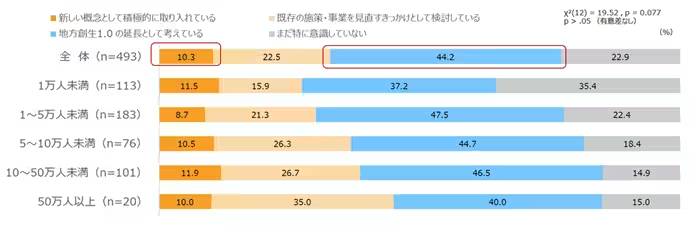
When asked how they perceive "Regional Revitalization 2.0," 44.2% of respondents considered it an extension of the previous policy, while only 10.3% viewed it as a new initiative to be embraced proactively. This mixed reception suggests that local governments are experiencing differences in opinion based on their unique challenges and current policy context. Interestingly, a Chi-square test showed no significant differences based on population size (p=0.077), indicating a complex landscape of views within various municipalities.
Policy Stances on Population Decline
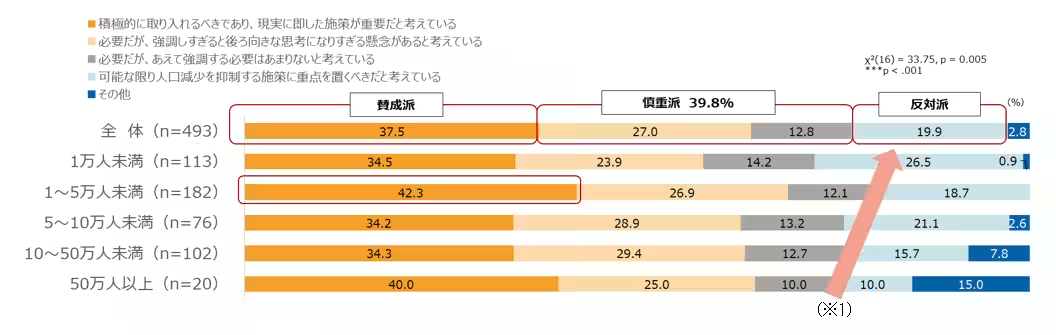
Regarding policy-making influenced by population decline, opinions were notably divided. About 37.5% endorsed a proactive approach to integrating population decline into their strategies, particularly among smaller municipalities (with populations under 50,000). Conversely, 39.8% exhibited caution, recognizing the necessity of addressing decline without overly emphasizing it. Additionally, a segment of 19.9% opposed policies accepting population decline, particularly salient among smaller municipalities. Comments from respondents highlighted the need for balanced strategies considering both population retention and adaptation.
Demand for

Topics Other)
【About Using Articles】
You can freely use the title and article content by linking to the page where the article is posted.
※ Images cannot be used.
【About Links】
Links are free to use.