



Unlocking the Potential of Microsoft 365 Copilot in the Construction Industry
Unlocking the Potential of Microsoft 365 Copilot in the Construction Industry
In an era where technology is revolutionizing business operations, many companies find themselves struggling to fully leverage tools at their disposal. A significant case is the experience of a major Japanese construction company, which faced challenges in utilizing Microsoft 365 Copilot despite having distributed licenses across the organization.
Copilot Implementation with Irwin&co
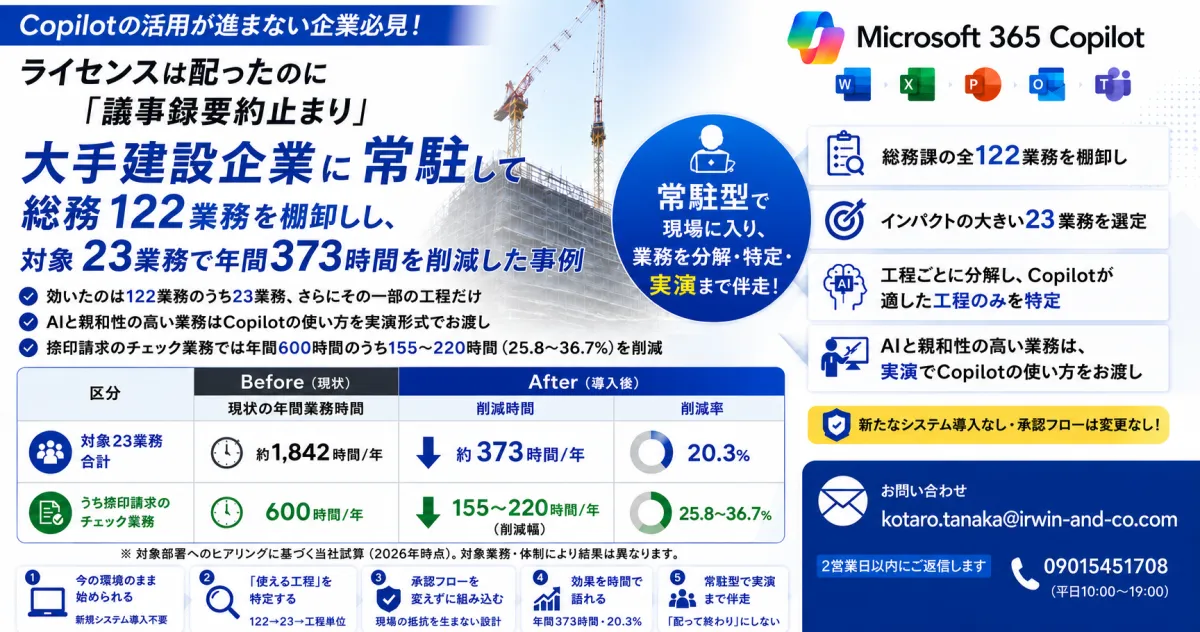
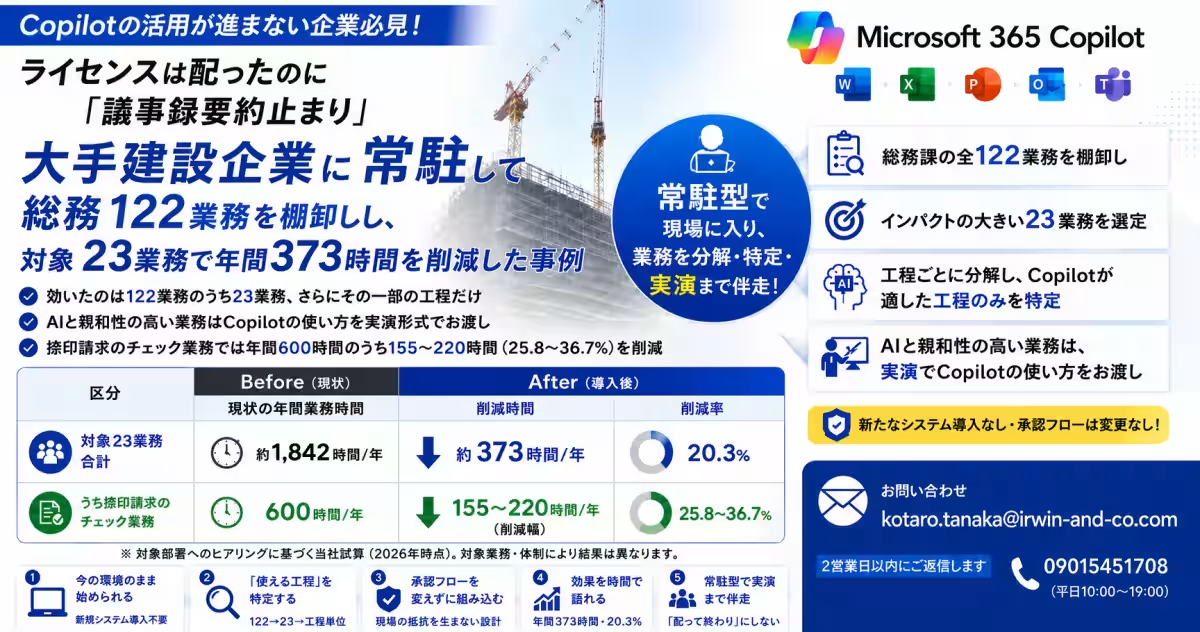
Irwin&co, a company based in Shibuya, Tokyo, led an initiative to assist the construction firm's general affairs department by optimizing their workflow through the use of Microsoft 365 Copilot. By embedding their team directly into the department, Irwin&co was able to conduct a thorough inventory of 122 distinct tasks performed within the department. Out of these, they identified 23 high-impact tasks that could be streamlined with Copilot.
Step-by-Step Approach
The process was systematic and comprised four key steps:
1. Task Inventory: All tasks within the general affairs department were cataloged, leading to a clear understanding of workflow.
2. Task Selection: Focusing on frequency and the total hours spent, Irwin&co narrowed down the list to 23 tasks that held the most promise for impactful automation.
3. Detailed Process Analysis: Each task was thoroughly dissected into individual steps, analyzing who performed them, what materials were used, and how much time each took.
4. Identifying and Demonstrating AI Application: Only those steps suited for AI intervention were selected for implementation, and Irwin&co demonstrated the operational processes in real-time.
Remarkable Time Savings
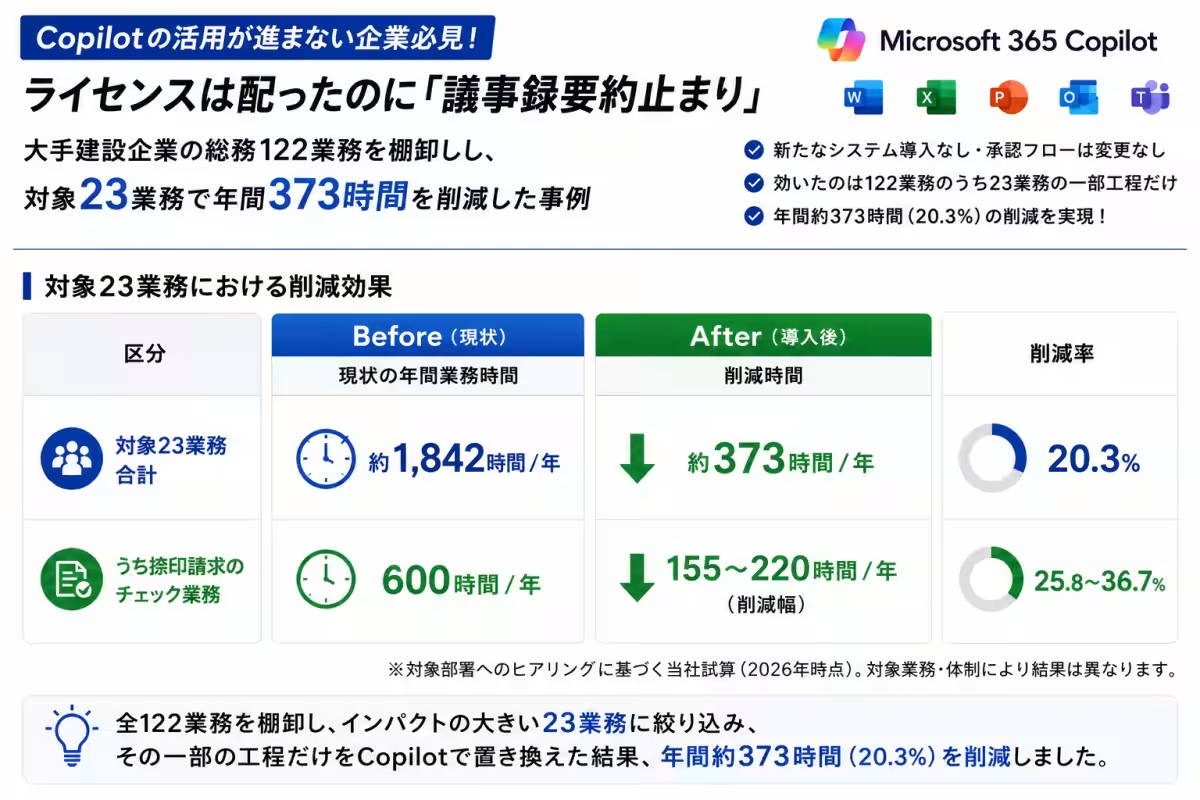
The outcome of this initiative was impressive, showcasing a reduction of approximately 373 hours annually, which represented around a 20.3% efficiency gain. Not only were processes optimized, but this was achieved without altering existing approval workflows, maintaining continuity in operations.
Common Pitfalls of AI Utilization
Despite having access to Microsoft 365 Copilot—a generative AI capable of working seamlessly within familiar applications—many organizations fail to utilize these capabilities effectively. Their common struggles include:
- - Sticking to basic functions, like summarizing meeting minutes, instead of exploring broader applications.
- - Leaving the exploration of AI usage up to individual initiative, resulting in inconsistent outcomes.
- - Reliance on manual checks for routine tasks, even when they could be automated.
- - Inability to quantify the benefits realized from AI integration.
These limitations are not simply due to the capabilities of the technology itself but stem from a lack of detailed breakdown of tasks within the organization.
Implementation Insights
One key example is the handling of stamp-request checks for documents, which represented one of the most substantial time savings. Initially, employees would spend up to 600 hours each year manually verifying each request against accompanying documents. After integrating Copilot, the verification process was revamped. AI could now automatically check essential details while providing reasoning for its assessments, thus reducing the manual workload dramatically by 155 to 220 hours annually, translating to a 25.8% to 36.7% decrease in processing time.
Advantages of Irwin&co's Approach
This case study from Irwin&co emphasizes several critical advantages:
1. Instant Integration: There was no need for new systems or major overhauls; existing tools were utilized effectively.
2. Identifying Actionable Processes: By focusing on a narrower set of tasks, teams could effectively pinpoint where to deploy AI.
3. No Changes to Approval Processes: This helped mitigate resistance from staff wary of new changes, as existing flows remained intact.
4. Measurable Outcomes: Results were expressed in terms of saved time rather than vague improvements, providing tangible metrics for assessment by management.
5. Hands-on Training: The presence of Irwin&co's team facilitated practical demonstrations, ensuring that employees were not just informed but trained in using AI in their specific context, vastly increasing retention and practical application.
Conclusion
The journey of integrating Microsoft 365 Copilot into the operations of a leading construction firm illustrates a larger trend of how businesses can derive immense value from existing resources when they approach optimization methodically. Irwin&co's framework showcases a replicable model that other companies can follow to realize significant gains in productivity and efficiency through advanced technology, thereby paving the way for enhanced performance across various sectors.
For companies facing similar challenges, reaching out to specialized consultants like Irwin&co can open doors to unlocking untapped potential within their operational strategies as they adapt to the demands of modern business challenges.
Topics Business Technology)
【About Using Articles】
You can freely use the title and article content by linking to the page where the article is posted.
※ Images cannot be used.
【About Links】
Links are free to use.