



Job Market Insights: Japan Sees 1.18 Job-to-Applicant Ratio Amid Rising Demand
Job Market Insights: A Closer Look at Recent Trends
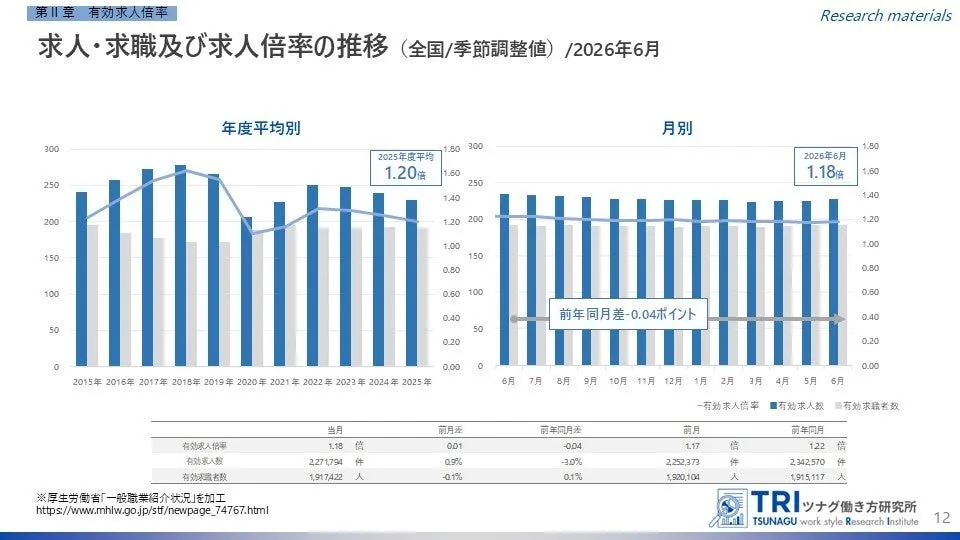
In the latest report from the Tsunagu Work Style Research Institute, part of Tsunagu Group Holdings, significant developments in Japan's job market have been highlighted. With a job-to-applicant ratio of 1.18 in June 2026, it marks a notable increase for the first time in four months. The report compiles monthly labor market data released by government agencies, providing key insights into employment trends.
Job-to-Applicant Ratio Rise
The June 2026 job-to-applicant ratio stands at 1.18, indicating a slight uptick of 0.01 points from the previous month. However, it is important to note that this figure is 0.04 points lower compared to the same month last year. The ratio for part-time jobs is reported at 1.11, which also shows a decrease of 0.04 points year-on-year. On the other hand, the effective job-to-applicant ratio for full-time positions has increased to 1.00, reaching parity for the first time in nine months, despite a decline of 0.02 points when compared to the previous year.
These slight shifts indicate a relatively stable market, even though the numbers remain below last year's levels. Analysts suggest that while there is some recovery, the overall employment landscape is experiencing stagnation.
Unemployment Rates Remain Steady
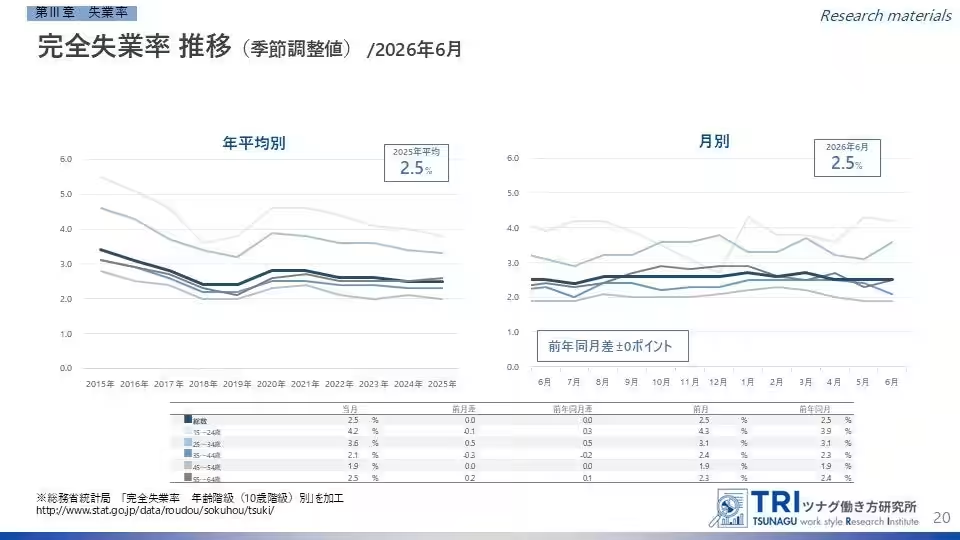
In June, the unemployment rate held steady at 2.5%, consistent with both the previous month and the same time last year. Specific age groups showed varied results, with the 35-44 age bracket experiencing a minor decrease of 0.2 points from the previous year. The total number of unemployed individuals reached 1.78 million, reflecting an increase of 20,000 compared to last year. The overall situation appears to show little fluctuation, indicating a stable albeit challenging job market.
New Job Openings on the Rise
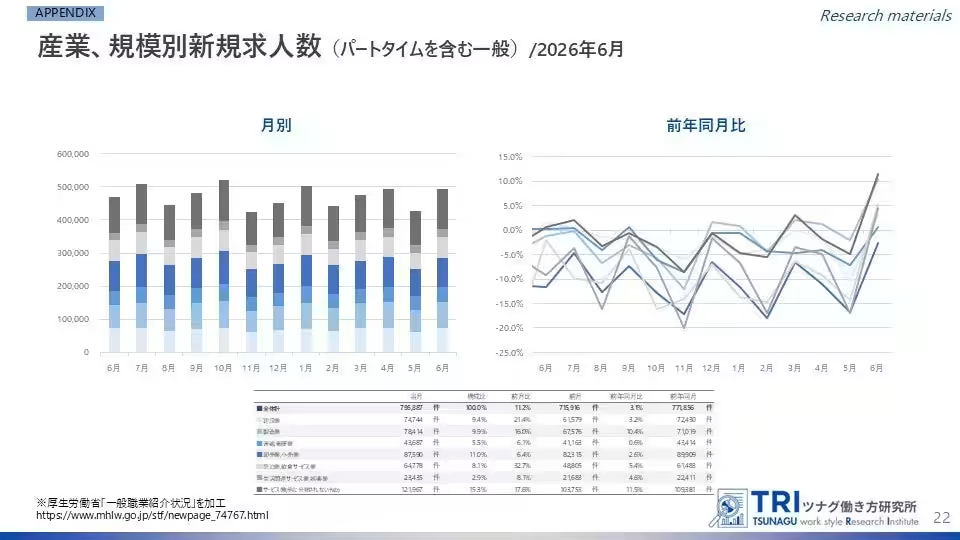
Encouragingly, June 2026 witnessed a 3.1% increase in new job openings compared to the previous year, marking the first rise in 14 months. This upturn is primarily driven by significant growth in industries such as services (not elsewhere classified) with an 11.5% increase, manufacturing at 10.4%, and accommodation and food services at 5.4%. However, some sectors, including information and communication (-6.4%) and wholesale and retail trade (-2.6%), saw declines.
The growth in new job openings offers a hopeful perspective that demand in certain sectors is recovering after a long downturn, particularly in services and manufacturing, which are crucial for employment.
The Tsunagu Work Style Research Institute categorizes seven major industries that comprise a significant portion of job offers, where part-time employment is prevalent. These industries include construction, manufacturing, transport and postal services, wholesale and retail trade, accommodation and food services, life-related services, and miscellaneous services.
About the Tsunagu Work Style Research Institute
Established in 2015, the Tsunagu Work Style Research Institute operates under Tsunagu Group Holdings, headquartered in central Tokyo, with Hiroshi Ohno as its director. The institute partners with experts in human resources and labor legislation to analyze the evolving landscape of labor laws and propose viable future strategies. As a research institution focused on employment, it aims to elucidate aspects of labor policies and the desired state of work environments in Japan.
In conclusion, the latest findings indicate cautious optimism in Japan's job market, particularly with rising job openings and a steady unemployment rate. The data underscores the ongoing challenges while hinting at potential recovery in specific sectors, setting the stage for future developments in employment.

Topics Business Technology)
【About Using Articles】
You can freely use the title and article content by linking to the page where the article is posted.
※ Images cannot be used.
【About Links】
Links are free to use.