



Introducing Digidigi: A New Tool to Measure Brand Recognition and Hallucination in LLMs
Digidigi: Revolutionizing Brand Recognition in LLMs
In an era where large language models (LLMs) like ChatGPT are reshaping how consumers access information, Todo Onada, a Tokyo-based company, has officially launched Digidigi. This innovative tool separates from its existing service, Qlipper, to focus explicitly on measuring brand recognition and hallucination within LLMs.
The Emergence of LLM Optimization
The rapid adoption of generative AI has highlighted a critical new challenge for brands: ensuring that large language models accurately recognize and remember brand information. If an LLM does not acknowledge a brand, or misremembers it, that brand may not even appear in recommended options. This new situation presents a urgent task for public relations professionals.
LLMO, an acronym for Large Language Model Optimization, emphasizes preparing LLMs for interactions by ensuring that vital brand data is incorporated into their training datasets. This preparation mainly occurs through media exposure, an area that the public relations sector has a significant impact on.
The Birth of Digidigi
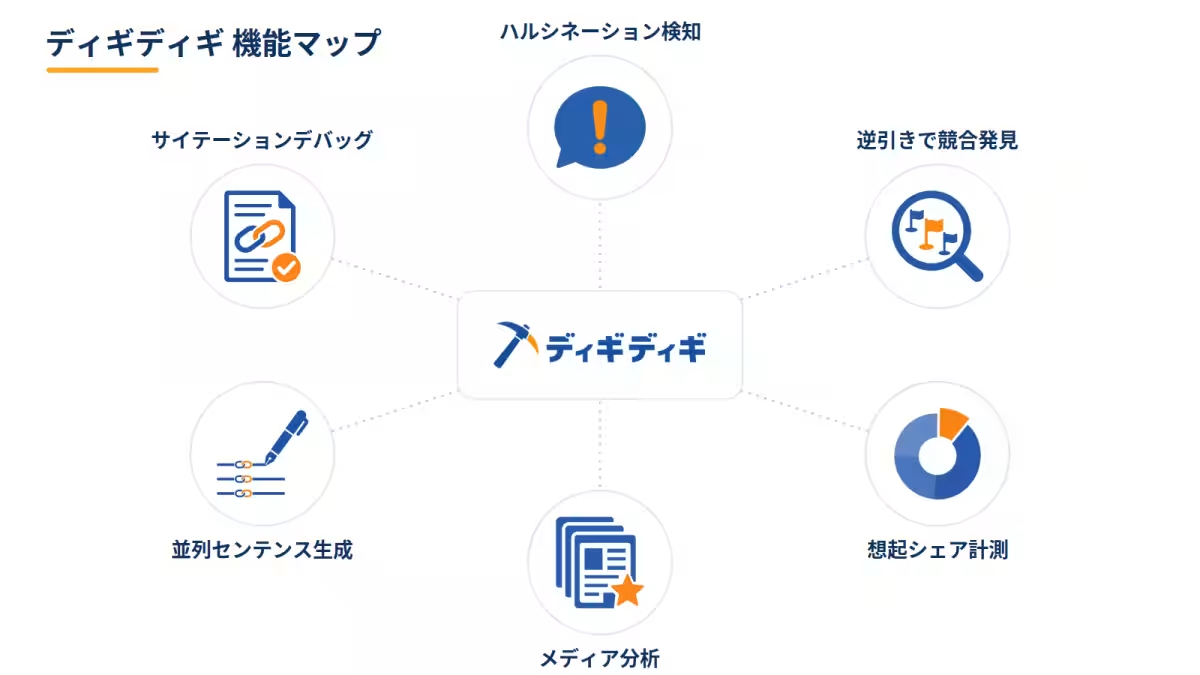
Historically, there was no tool available to evaluate how public relations efforts influenced LLM memory. Digidigi fills this gap, providing a thorough way to assess the effectiveness of pre-training strategies on LLMs. Here are Digidigi's six core functionalities:
1. Hallucination Detection
Digidigi can determine whether responses generated by an LLM about a brand contain any inaccuracies or hallucinations. By analyzing this data, companies can gain insights into how their brands are remembered by the technology.
2. Recall Share Measurement
Through selected categories, brands can measure their share in the LLM’s recall set—the collection of brands that the model thinks of when prompted with a category. This offers a way to quantify a brand's presence when asked the question, “What comes to mind when you think of _____?”
3. Reverse Competitor Discovery
This feature enables brands to uncover competitors that are listed alongside them within the LLM recall set, thus creating an enhanced visualization of the competitive landscape unique to LLM recognition.
4. Citation Debugging
Digidigi assesses the URLs of acquired citations to ensure that they effectively convey the desired brand relationships within the LLM's learning data. This includes evaluation of the sustainability of the content post-publication and whether key questions and answers are appropriately co-occurring.
5. Parallel Sentence Generator
To engrain associations of brands and categories within LLM memory, Digidigi generates

Topics Other)

【About Using Articles】
You can freely use the title and article content by linking to the page where the article is posted.
※ Images cannot be used.
【About Links】
Links are free to use.