



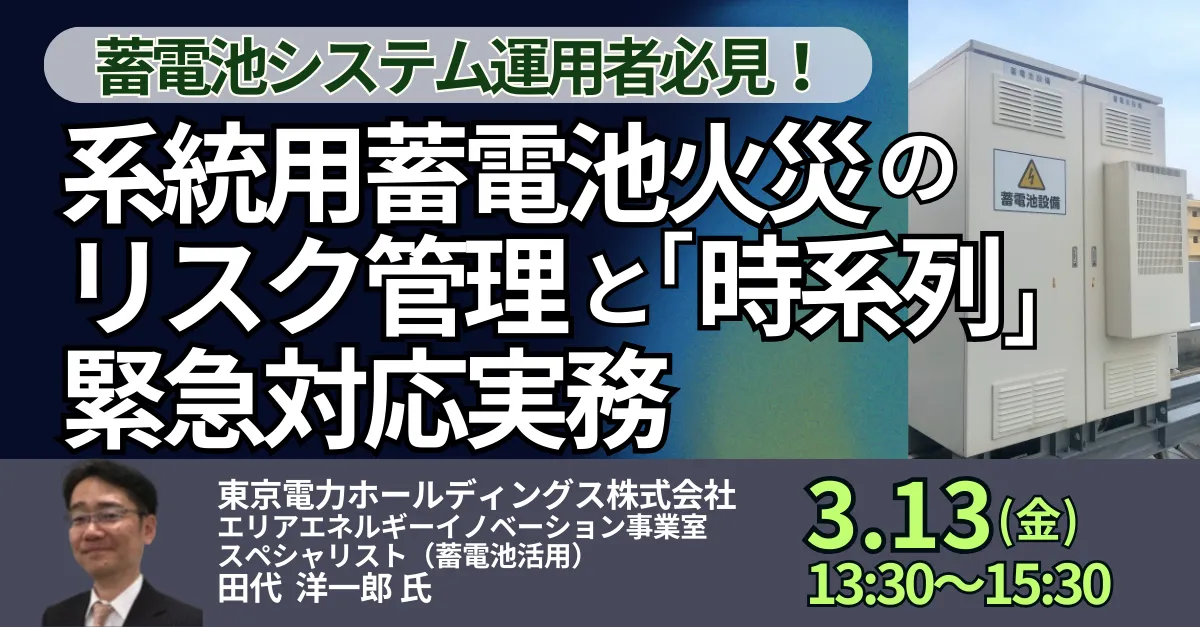
Essential Seminar on Managing Fire Risks in Battery Systems
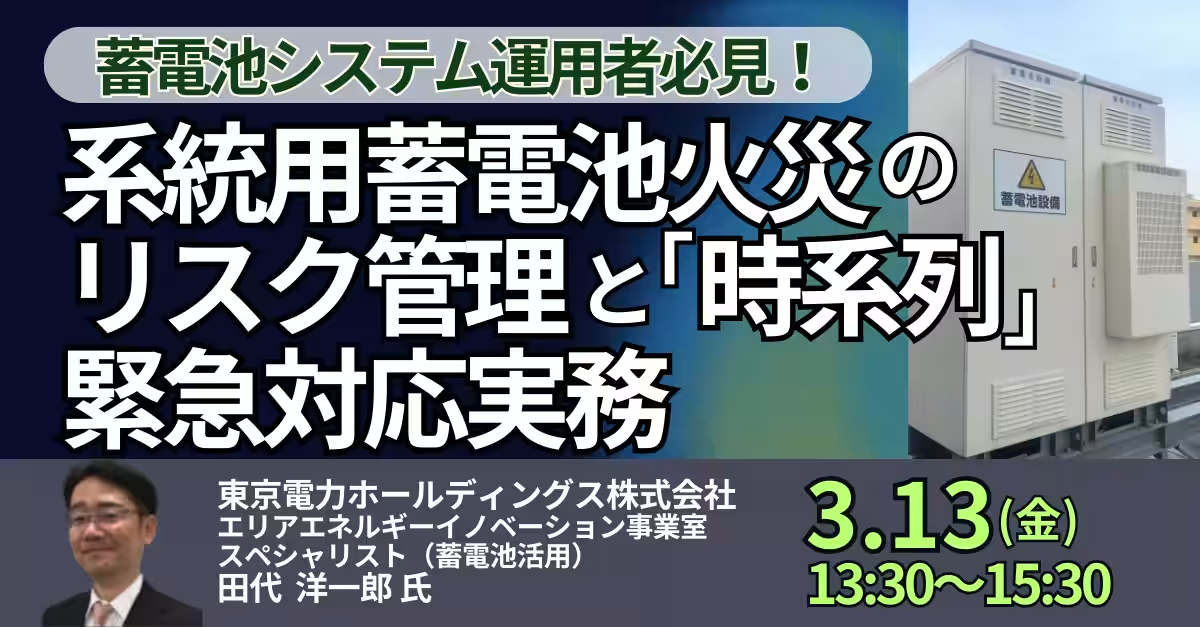
Essential Seminar on Managing Fire Risks in Battery Systems
As the world accelerates the adoption of energy storage systems, Japan is experiencing a surge in the consideration of grid-connected battery systems. This increasing reliance on battery technologies, particularly lithium-ion batteries, presents significant challenges, including the risks associated with battery fires. To tackle these pressing issues, the Japan Planning Institute (JPI) is hosting a detailed seminar titled "Managing Fire Risks and Timely Emergency Responses for Grid Battery Systems" on March 13, 2026.
Seminar Details
The seminar will feature esteemed expert Yoichiro Tashiro from the Area Energy Innovation Division at Tokyo Electric Power Company Holdings. Tashiro will provide invaluable insights into risk management strategies for battery systems, emphasizing the importance of emergency preparedness and response methods. The evolving landscape of battery technology and incidents, such as the recent spate of fires involving a similar battery system from Tesla, underscores the need for robust training and knowledge-sharing within the industry.
Importance of the Seminar
Recent years have witnessed a rise in fire incidents linked to battery systems worldwide, including several notable cases in Japan. For instance, a fire in Isa City, Kagoshima Prefecture, underscored the potential hazards and prompted legislative revisions. Such incidents highlight that while prevention measures are vital, the possibility of manufacturing defects or unexpected failures remains. Understanding the 'self-ignition' characteristics of lithium-ion batteries is essential for mitigating these risks.
Key Takeaways
During the seminar, participants will gain a comprehensive understanding through a logical timeline-based approach to handling potential fire emergencies. Key topics will include:
1. Overview of global fire incident case studies from 2025 and resultant legislative changes.
2. Analyzing risks associated with battery fires, covering equipment, human safety, and environmental concerns.
3. Effective strategies for responding to battery fire risks.
4. Illustrating real-world sequential responses during battery system operations.
5. Conclusion and summary of key learning points.
6. Open Q&A session for participant inquiries.
7. Networking opportunities for meaningful exchanges between participants and the speaker.
This seminar presents a unique opportunity to engage directly with an industry expert, facilitating vital knowledge transfer that can shape organizational policies and emergency protocols. It also provides a platform for networking, fostering relationships and collaborations among professionals from various sectors.
Registration and Participation
Participants can choose from several formats:
- - In-person attendance (note: archive viewing is not included)
- - Live streaming (archive viewing not included)
- - Archive-only access
Seminar Fee: 37660 JPY (inclusive of tax) for one participant; discounts are available for additional registrations from the same organization. Additionally, government staff can register at a reduced rate of 11000 JPY for two attendees.
For further details and registration, please visit this link.
Contact
Japan Planning Institute (JPI)
106-0047, Tokyo, Minato, 5-2-32, Kowa Hiroo Building
Tel: 03-5793-9761 | Fax: 03-5793-9767
Website: https://www.jpi.co.jp
At JPI, our mission has been to connect the realms of politics, administration, and the private sector, providing policymakers and senior executives with vital information via exclusive seminars for over fifty years. Join us to contribute to the evolution of battery safety management and to be part of this crucial conversation.

Topics Policy & Public Interest)
【About Using Articles】
You can freely use the title and article content by linking to the page where the article is posted.
※ Images cannot be used.
【About Links】
Links are free to use.