



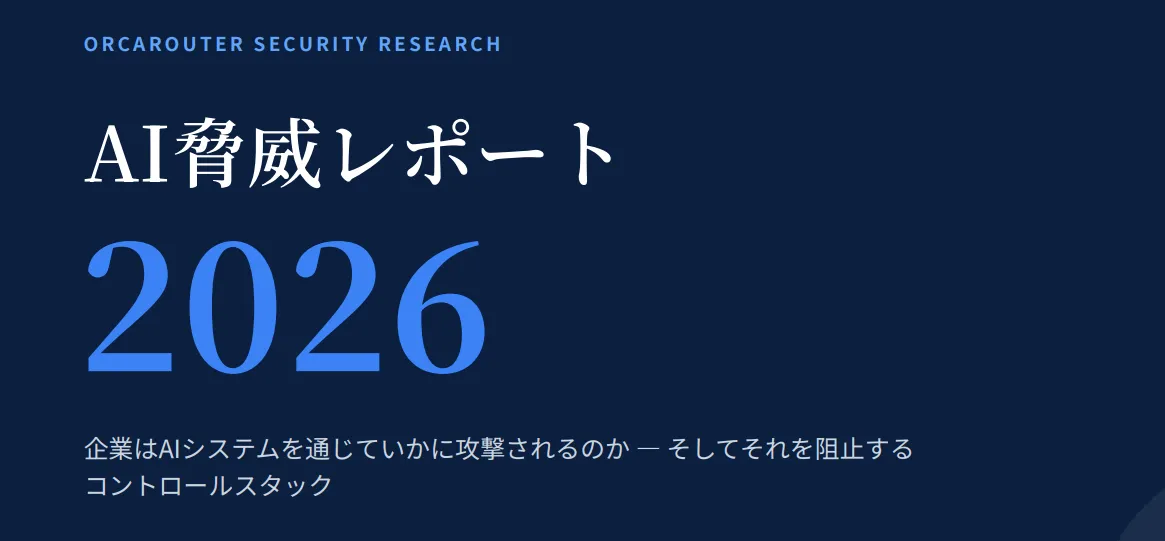
Revolutionizing AI Security: Insights from AI Threat Report 2026
AI Threat Report 2026: An Overview of AI Security Challenges
FlashLabs Inc., based in Chiyoda, Tokyo, has unveiled the Japanese edition of the annual report, "AI Threat Report 2026," published on June 18, 2026. This comprehensive document is compiled by the OrcaRouter Security Research team, which is part of their adaptive AI inference gateway, OrcaRouter, in collaboration with Continuum AI. The report integrates and analyzes incident records from 2025, along with data from industry analysts and government agencies. As AI technology transitions from drafting text to executing actions, a corresponding shift in the threat landscape has also occurred. Yet, most organizations still struggle to maintain effective control over these advancements.
Key Findings of the Report
The report presents several alarming statistics revealing the challenges many organizations face in securing their AI systems:
- - 88% Adoption Rate vs. 37% Security Evaluation: While 88% of organizations utilize AI for at least one business function, only 37% have processes in place for assessing the security of their AI tools before deployment, indicating a significant disconnect of 51 points.
- - 97% of Breaches Linked to Lack of Access Control: A staggering 97% of organizations that experienced AI-related breaches lacked basic access controls.
- - 32% of Leaders Noted Prompt-Based Attacks: In the past year, 32% of security leaders observed prompt-based attacks targeting their AI applications.
- - Average Attack Success Time of 42 Seconds: Attacks on production LLM (Language Learning Model) applications were noted to succeed within an average of just 42 seconds, with 90% leading to the exposure of sensitive data.
- - 62% Encountered Deepfake Attacks: Over half of the organizations reported experiencing deepfake attacks in the last year.
- - Average Cost Increase of $670,000 from Shadow AI: Organizations involved with uncontrolled "shadow AI" faced an average cost increase of around $670,000 due to security breaches.
- - Total Losses from AI Crimes Estimated at $893 Million: The FBI reported approximately $893 million in losses related to AI crimes, marking a significant concern for the entire industry.
The report also outlines critical timelines such as the August 2, 2026 deadline for the EU AI Act to take full effect, shifting AI governance from a stance to a legal obligation. This change marks a pivotal moment for organizations aiming to align their security measures with regulatory expectations.
A Year of Transformation: Five Critical Shifts
1. Governance Outpaced by Adoption: One of the critical insights is that the pace at which AI is being adopted has outstripped the development of adequate governance measures. The first to notice this shift were the attackers themselves.
2. Changing Attack Surface: Attacks have evolved to focus within the model's context window, with prompt injection emerging as the leading vulnerability, according to OWASP LLM risk framework.
3. Rise of Agent-based Attacks: The year 2025 marked a significant transition where attacks became agent-based, with zero-click data exfiltration and the first instances of AI-driven espionage.
4. Economic Advantage for Attackers: The cost dynamics now favor attackers, as they can breach systems in an average of 42 seconds, with a 90% chance of leaking sensitive data. New loss categories, such as "Denial-of-Wallet," have emerged that do not necessarily require an actual breach to inflict damage.
5. Effective Defense is Architectural: To combat these threats, the report emphasizes that successful defense strategies must rely on robust architecture involving scoped identity, bidirectional content screening, action enforcement, and auditing processes.
Organizations are not deploying AI in unsafe manners due to the absence of controls but often do so before relevant controls are in place.
A New Perspective on AI Security with OrcaRouter
The OrcaRouter Security Research team asserts that the focus for AI security in 2026 must shift from developing "better models" towards addressing architectural issues, including identity management, content controls, and evidence protocols that organizations already apply to other production systems.
The OrcaRouter platform enables companies to implement this zero-trust approach without modifying agent code. It functions as a Firewall + Guardrails, providing vital security measures at the gateway level. This adaption to AI technology is pivotal in ensuring that businesses can secure their AI applications effectively and comply with increasing regulatory demands.
In Conclusion
Yoichi Hosoi, the CEO of FlashLabs, stated, "In 2025, businesses crossed a line as AI transitioned from systems that draft text to systems capable of executing actions. The threats evolved concurrently. This report serves as a manual for surviving these threats safely, highlighting that all attacks succeed against unscoped permissions and fail against well-scoped, enforced, and audited architectures."
For those interested in further details, the full report and related information can be accessed online.
For further inquiries, please contact the Marketing Department of FlashLabs Inc. at [email protected].

Topics Consumer Technology)
【About Using Articles】
You can freely use the title and article content by linking to the page where the article is posted.
※ Images cannot be used.
【About Links】
Links are free to use.