



Breakthrough in Quantum Computing: New Photon Number Identification Principle Demonstrated
Introduction
In a significant advancement for quantum technology, researchers at the National Institute of Advanced Industrial Science and Technology (AIST) have successfully demonstrated a new principle that enables the direct observation of magnetic flux quanta generated by photons in superconductors. This new photon detection method not only enhances the ability to identify the number of photons but also offers potential for high-speed performance, which is essential for the development of large-scale quantum optical computers.
Research Details
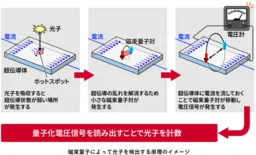
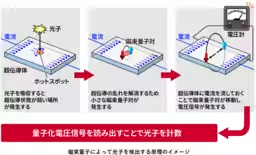
The study, led by Chief Researcher Daiji Fukuda and Senior Researcher Tetsuya Tsuruta from the AIST's Global Research Center for Quantum and AI Fusion Technology (G-QuAT), reveals that when a photon is absorbed by a superconductor, it destabilizes the superconducting phase, leading to the creation of magnetic flux pairs. As these magnetic flux quanta traverse the superconductor, a phase slip occurs, generating a quantized voltage signal. The research team managed to observe this quantized voltage, allowing them to determine the number of incoming photons based on the generated magnetic flux quanta.
Traditionally, photon detection has relied on measuring temperature changes in superconductors, specifically the superconducting transition edge sensors (TES), which required a thermal equilibrium state to register photon counts. In contrast, the newly developed method harnesses the dynamics of the superconducting phase immediately after photon absorption, enabling much faster photon number identification.
Background and Importance
The importance of accurate photon detection is paramount in quantum photonic computing and communication technologies. Photons serve as qubits in quantum computers, facilitating rapid large-scale quantum computations, while in quantum communication, they act as secure carriers of quantum information. Advanced quantum photonics technology necessitates efficient and precise photon detection methodologies.
One of the pivotal elements of this research is the photon number resolving detection (PNRD) technique, which allows researchers to identify individual photons, making it vital for single-photon source evaluations, bosonic quantum computing, and advanced quantum communication methods. Current superconducting detectors like TES and SNSPD (Superconducting Nanowire Single-Photon Detector) exhibit limitations; while TES provides excellent photon number resolution, it is hampered by thermal delay. On the other hand, SNSPD operates at high speeds but cannot ascertain the energy of detected photons. Therefore, integrating the benefits of both technologies presents a significant challenge.
Research Background
AIST has been pioneering TES research for years, achieving a detection efficiency of 99% and the capacity to measure over 30 photons at once—one of the highest standards globally. However, the thermal relaxation time poses limitations for subsequent photon measurements. This challenge underlined the necessity for breakthroughs in photon detection methodologies, especially as large-scale quantum computers require rapid and accurate identification of multiple photons in quick succession to correct computational errors efficiently.
The research group redirected their focus toward the superconducting phase dynamics occurring immediately after photon absorption. Utilizing this rapid response time could provide a new framework for photon number identification that surpasses traditional thermal methods.
Research Findings
The investigation confirmed that each time a photon is absorbed, it generates a localized region within the superconductor where the superconducting state is compromised, termed a “hotspot.” As the hotspot develops, it leads to an instability in the superconducting phase, causing magnetic flux pairs to form—a phenomenon that had been theoretically predicted but never directly observed. When the magnetic flux follows through the superconductor, it undergoes a phase change of 2π, resulting in a measurable quantized voltage.
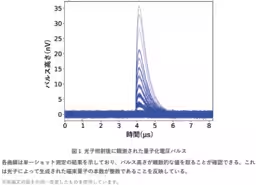
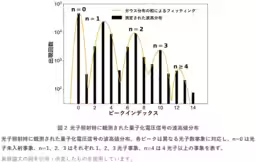
The researchers employed this voltage change to achieve direct observation of magnetic flux quanta and correlate their movement to the photon counts. By measuring the magnitude of the voltage signals resulting from multiple phase slips, they were able to identify the discrete photon numbers corresponding to the absorption events. Notably, the signals displayed distinct peaks correlating to the quantity of absorbed photons, validating the effectiveness of this novel approach.
Future Work
The successful demonstration of this photon number identification principle marks a vital step towards integrating high-speed, high-accuracy photon detection in quantum computing and communications. Future developments will focus on enhancing detection efficiency, improving photon number identification accuracy, and refining the device structure for scalability. This pursuit aims to meet the escalating requirements of quantum technology, steering closer to achieving robust quantum photonic computing systems.
Conclusion
By employing the dynamics of the superconducting phase generated post-photon absorption, this research presents a groundbreaking method for fast and accurate photon number detection. The concept links photons, magnetic flux quantization, phase slips, and quantized voltage signals, providing an innovative pathway for advancing quantum computing capabilities. The findings were published in Physical Review Applied and recognized as an Editor's Suggestion, underscoring their significance in the field of quantum technology.
References
- - Jodoi, T., Tsuruta, T., Kikuchi, T., & Fukuda, D. (2026). Direct observation of photon-induced vortices in superconducting films. Physical Review Applied. DOI: 10.1103/n295-rfl8
- - For further information on superconducting technologies, refer to the published works and ongoing studies conducted by AIST.
Topics Consumer Technology)
【About Using Articles】
You can freely use the title and article content by linking to the page where the article is posted.
※ Images cannot be used.
【About Links】
Links are free to use.