



Explore the Latest Trends in Cooling Technologies for AI Data Centers
The Latest Report on Cooling Technologies for AI Data Centers
Introduction
In response to the evolving demands of data management and computing power, CMC Research has released a comprehensive report titled "Latest Industry Report on Cooling Technologies and Materials for AI Data Centers." This report, slated to be published on July 18, 2025, is essential for stakeholders involved in the data center sector. The report is priced at 200,000 yen (including tax) for the book alone and 300,000 yen (including tax) for the bundled CD set.
Key Features of the Report
This report delves deep into the various cooling methods deployed in contemporary AI data centers. Here are some key highlights:
- - An in-depth analysis from Direct Liquid Cooling (DLC) to immersion cooling and hybrid systems. The report includes market predictions until 2030.
- - A review of single-phase and two-phase immersion cooling systems, their characteristics, and the companies adopting these technologies.
- - Insights into the increasing adoption of mineral oil as a cooling liquid and the strategic shift of companies after 3M’s withdrawal from PFAS production.
- - Examination of bio-based coolants, silicone oils, and the emerging trends in the industry.
- - Analysis of cooling technologies including chillers, cooling towers, heat exchangers, and Coolant Distribution Units (CDUs).
- - Pros and cons of containerized data centers, focusing on why they are gaining traction in AI development environments.
Impact of AI on Data Center Cooling Needs
The rise of generative AI necessitates powerful computing capabilities, resulting in increased heat generation within data centers. Traditional forced-air cooling systems can manage approximately 10kW per rack, suitable for standard CPU servers. However, the energy consumption of GPU servers, particularly in AI data centers, can exceed 10kW per server, making it imperative to adopt more efficient cooling solutions.
Recent trends show a significant shift towards liquid cooling, primarily driven by the high-density workloads resulting from AI applications. Techniques like Direct Liquid Cooling are gaining popularity among major tech companies and cloud service providers due to their ability to effectively manage the heat produced by densely packed servers.
Transitioning Cooling Methods
Immersion cooling is gathering attention as a long-term solution for heat management. The report asserts that immersion cooling can reduce Power Usage Effectiveness (PUE) to as low as 1.05, which is over three times more efficient than traditional air cooling systems. Furthermore, it discusses how the adoption of a hybrid cooling approach, combining conventional air cooling with liquid immersion systems, is likely to increase in the short to medium term. However, the reliance on existing infrastructures raises cost implications that need careful consideration.
A Glimpse into the Report Structure
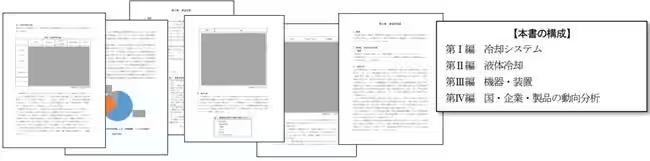
The report is structured into several comprehensive chapters:
- - Cooling Systems: Outlining the latest cooling technologies and methodologies.
- - Forced Air Cooling Analysis: Investigating industry trends and player movements, from STULZ to local enterprises like E-SCAT.
- - Immersion Cooling: A spotlight on the performance metrics and the evaluation of key market players such as Supermicro and Equinix.
- - Hybrid Cooling Systems: Insights into companies like Schneider Electric and Fujitsu that are pioneering these solutions.
- - Devices Overview: Covering chiller systems, cooling towers, and heat exchangers, presenting their roles in the cooling industry.
Global Trends and Business Strategies
The report also looks into the behavioral trends across different countries, with sections dedicated to the U.S., Europe, and China. Insights on business strategies from key players such as Amazon Web Services and Microsoft provide a broader context of the industry's direction, illustrating how local regulations and market demands shape cooling technology adoption.
Conclusion
As the AI industry continues to rise, understanding the critical cooling technologies adopted by data centers becomes essential for all stakeholders. CMC Research's report serves as a valuable resource to navigate these trends, providing detailed analyses that can inform future business decisions. For more information, or to purchase the report, please visit CMC Research.
- ---
Topics Consumer Technology)
【About Using Articles】
You can freely use the title and article content by linking to the page where the article is posted.
※ Images cannot be used.
【About Links】
Links are free to use.