



Rising Data Policy Violations Amidst Expanding AI Connections in Enterprises
Rising Data Policy Violations Amidst Expanding AI Connections in Enterprises
In a recent study by Netskope Threat Labs, the growing integration of AI agents within corporate systems has led to a notable increase in data policy violations associated with AI outputs. Their latest report, titled Netskope AI Report: 2026, reveals that violations occurring during the downstream process from AI systems are now the second most common type of AI-related policy infraction faced by businesses, marking approximately 924 incidents per 10,000 alerts. Notably, only the prompt inputs to AI showed a higher frequency of violations.
Downstream data policy violations occur when users or agents access information that they are not authorized to retrieve, thanks to responses returned by AI services. Alarmingly, the frequency of these incidents has more than doubled in the past year—from an average of 12 violations per organization per week to 31. In the top 25% of organizations, this figure escalated from 72 to 206 weekly violations.
The surge in these violations can be largely attributed to the rapid uptake of the Model Context Protocol (MCP), an open standard allowing AI models and agents to connect to external data sources and tools. In just the last ten weeks, the number of users accessing remote MCP servers has skyrocketed by 250%, with MCP transaction counts increasing by an astounding 375%. While this connectivity enables AI systems to access more corporate data, it also significantly raises the risk of sensitive information being disclosed to unauthorized users or agents.
Conversely, upstream data policy violations—which occur when users or agents send confidential information to AI applications—remain the most prevalent form of violation, accounting for 8,752 incidents per 10,000 alerts. The report indicates that the diversity of threats associated with AI is expanding, identifying downstream data policy violations, alongside content filtering violations (154 incidents), prompt injection, and jailbreak attempts (129 incidents), as well as requests for sensitive information (28 incidents). Although alerts related to malicious code are the least frequent—just five per 10,000—they pose a serious threat if executed by autonomous agents or embedded within large code bases.
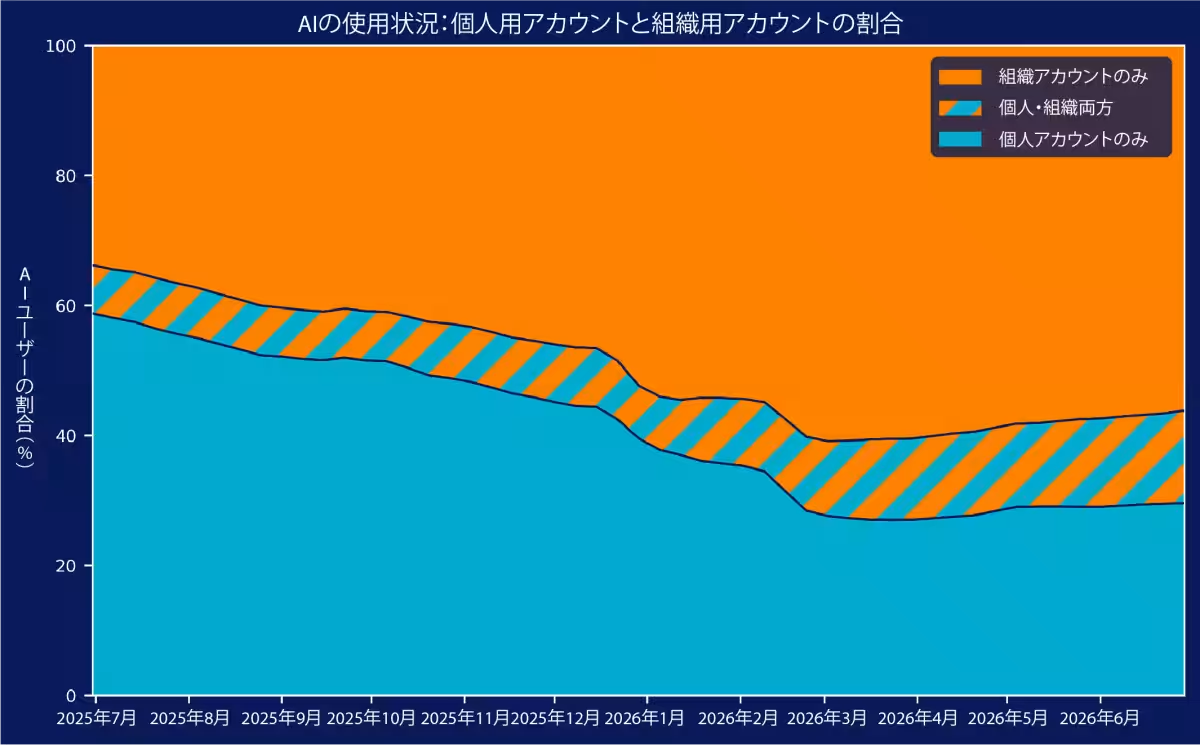
The report also discusses the persistent challenge of shadow AI within organizations. Currently, a staggering 30% of AI users are reportedly utilizing only personal AI applications, while another 14% employ a mix of personal AI applications and company-controlled AI tools. Despite some decline in shadow AI usage with the gradual implementation of managed AI tools, this trend is projected to plateau around March 2026, suggesting a slight uptick thereafter. Consequently, organizations may focus on implementing controls around the use of personal AI apps instead of completely migrating all users to managed platforms.
Ray Canzanese, Director at Netskope Threat Labs, commented on the challenges presented by these evolving dynamics:
Topics Other)









【About Using Articles】
You can freely use the title and article content by linking to the page where the article is posted.
※ Images cannot be used.
【About Links】
Links are free to use.