



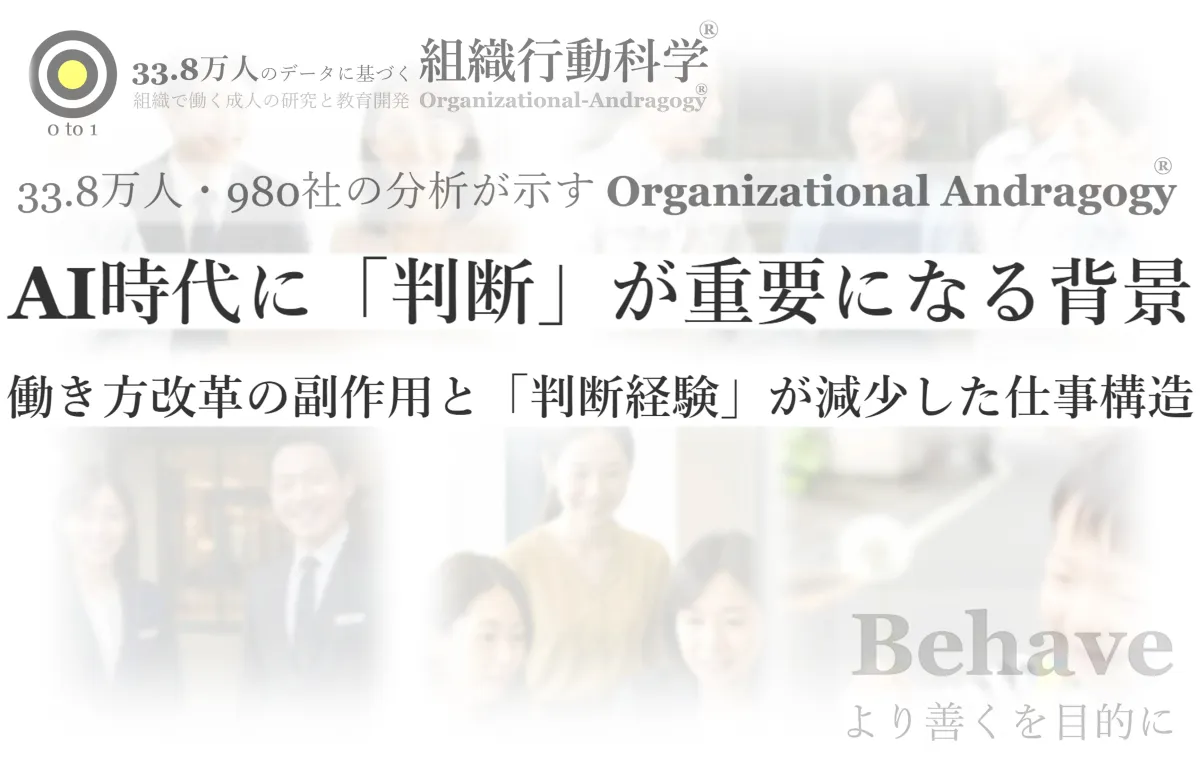
The Importance of Decision-Making in the Age of AI: Insights from 338,000 Workers
The Shift in Decision-Making in the Age of AI
In light of the recent analysis conducted by Request Co., Ltd., which examined the behaviors of 338,000 workers across 980 companies, it has been confirmed that 82% of organizations are witnessing a decrease in decision-making experiences. This alarming trend suggests a critical shift in how work is structured and executed in the context of AI integration.
AI's Role in Business Competitiveness
The introduction of AI in the workplace has altered the competitive landscape, but the true differentiator is not the technology itself—rather, it is the availability of personnel capable of making informed decisions. Many enterprises have opted for standardization and automation, leading to a situation where many tasks are no longer about dynamic problem-solving but rather about applying precedent-based methods. This shift means tasks are increasingly focused on repeating established processes, allowing less room for situational judgment.
Consequently, the nature of work is changing. Responsibilities that can be taught—such as assembling data, generating reports, and even interpreting information—are increasingly being delegated to AI. This advancement raises significant concerns regarding the dilution of judgment-related experiences among employees. While it's efficient, the structured approach to work is preventing the empowerment of workers to develop the judgment skills vital for future business environments.
The Impact of Work Structural Reform
Organizations have made considerable investments in efficiency improvements, employing strategies such as role division, standardization, manual creation, and IT integration. While these have undoubtedly enhanced productivity and ensured consistency, they have also transformed the very fabric of workplace responsibilities.
Historically, many roles required nuanced decision-making that depended on assessing customer circumstances and making optimal choices based on partial information. However, as businesses sought out efficiency and predictability, many tasks shifted towards a model where established precedents could be followed. This includes referring to past case studies, adhering to manuals, and progressing through determined protocols.
While this model initially appeared advantageous—ensuring uniformity and ease of training—it to some extent jeopardized the cultivation of judgment within the workplace. The ideal sequential flow in work has come under threat: judgment ➜ action ➜ result ➜ reflection ➜ revised judgment. While routine tasks continue to operate efficiently, this reduced cycle has stunted learning and adaptability.
AI's Competence in Task Execution
The rise of AI presents both challenges and advantages. AI systems excel in areas where historical data and structured processes exist. Tasks that involve data processing, summarization, analysis, and response generation are now increasingly entrusted to these intelligent systems. AI can identify patterns within vast data sets and generate hypotheses based on the information it processes. Therefore, duties that were traditionally regarded as requiring human insight are now being increasingly handled by machines—adding to the complexity of workforce dynamics.
Judgment Remains Human
Nevertheless, there are elements of decision-making that AI cannot replicate. True judgment encompasses more than mere selection; it involves prioritizing values, choosing standards for correctness, assessing risks, and placing values on various factors. While AI can propose predictions or templates, it cannot make the judgment calls that involve subjective value assessments. This pivotal distinction remains critical in determining the future of work in an AI-driven environment.
The Changing Role of Leadership
As the capabilities of AI evolve, the roles within organizations must also adjust. Historically, the transfer of knowledge and expertise was central to workforce development. Yet, with AI able to handle many of these teachable tasks, the emphasis must shift towards creating opportunities for employees to gain decision-making experience. This includes delegating judgment-required tasks, ensuring thorough evaluations, and facilitating reflective practices for employees to enhance their judgment skills.
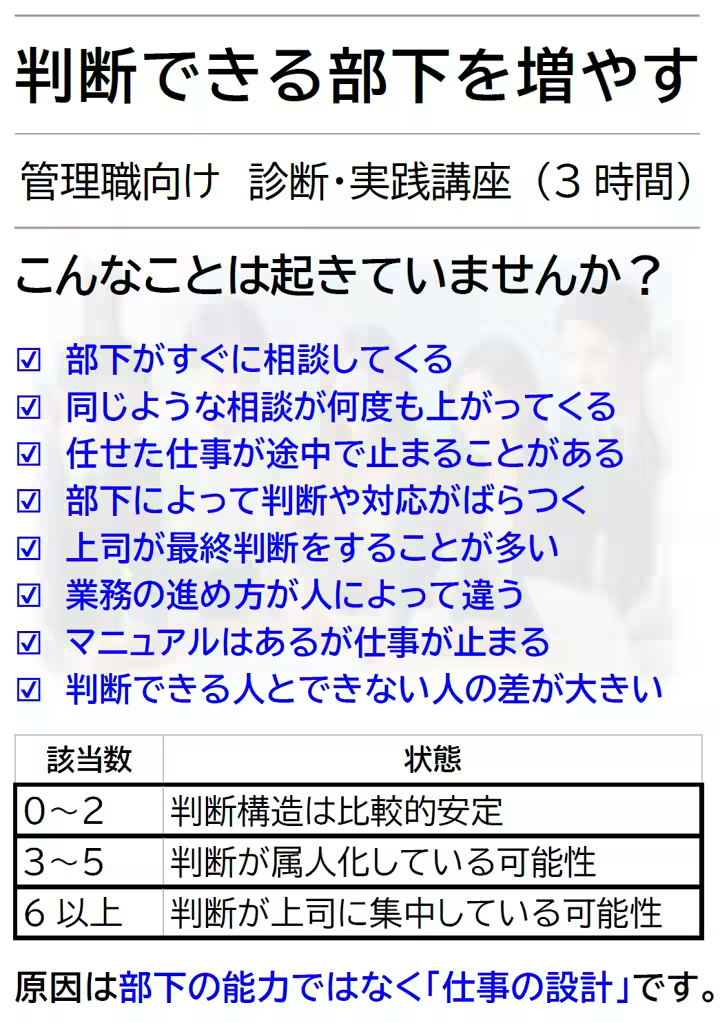
To underscore this vital need for organizations, Request Co., Ltd. has developed a specialized training program for managerial staff titled “Increasing Decision-Making Capabilities in Subordinates”. This program is designed with the aim of integrating decision-making tasks into employee roles, thereby empowering organizations to build a team proficient in navigating complex choices.
In summary, the transformation triggered by AI does not inherently diminish the importance of human judgment. Rather, the evolution of workplace roles necessitates a renewed focus on decision-making capabilities. Companies will not only need to adopt AI but also strategically foster an environment where human judgment plays a central role in ensuring long-term competitiveness.
Management Training Course Overview
Request Co., Ltd., acknowledging the aforementioned challenges, offers a course specifically designed for management. This course covers:
- - Identifying roles that necessitate judgment
- - Diagnosing points where decision-making stalls
- - Designing work that fosters judgment experience
For more information on this course, please visit: Course Details
Company Overview
Request Co., Ltd.
Headquarters: Shinjuku, Tokyo, Japan
Website: Request Co., Ltd.
Representative Director: Tomoyasu Kouhata
Contact Email: [email protected]
This company, governed by the principles of fostering better work environments, leverages data-based organizational behavior studies to support numerous enterprises in their manpower and operational developments.



Topics People & Culture)
【About Using Articles】
You can freely use the title and article content by linking to the page where the article is posted.
※ Images cannot be used.
【About Links】
Links are free to use.