



Exploring the Verifiable Propositions of Clinical Organizational Science and Their Research Potential
Introduction
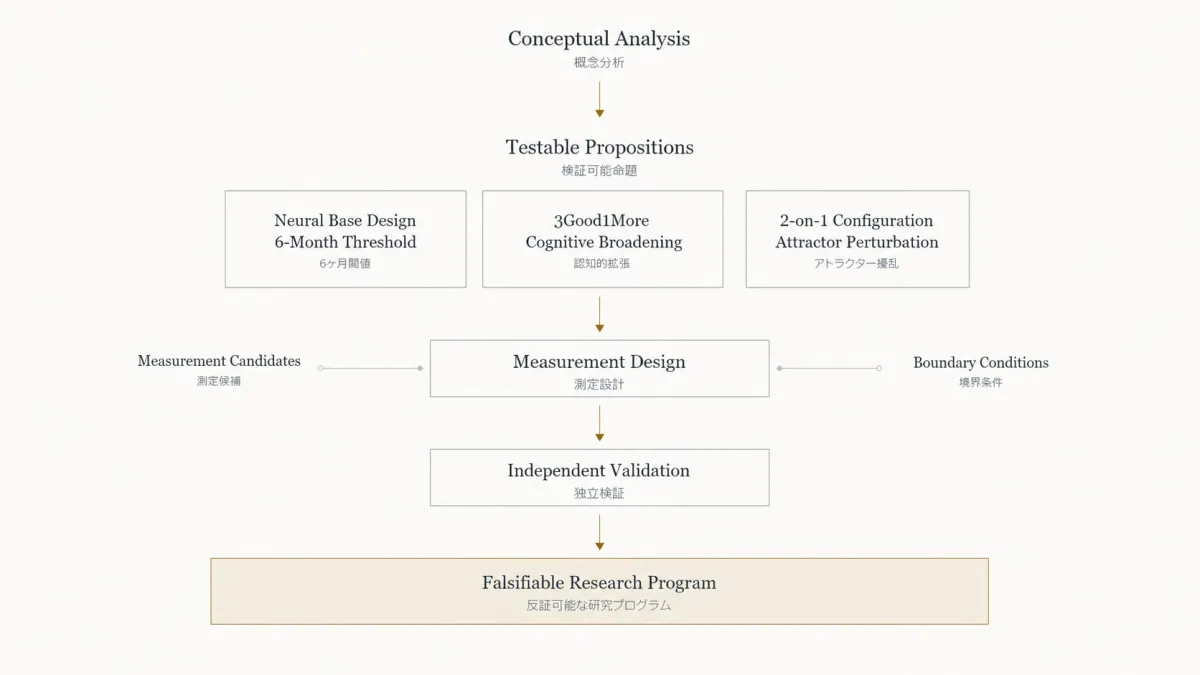
In recent years, Clinical Organizational Science (COS) has emerged as a transformative paradigm that integrates complex systems sciences, neuroscience, organizational psychology, and behavioral science. This approach not only conceptualizes the invisible interaction structures within organizations but actively designs frameworks to intervene in these dynamics. Led by CEO Makoto Yamanaka, the research firm DroR has published a significant paper titled Clinical Organizational Science: An Integrative Framework for Structural Intervention in Complex Organizations in the Frontiers in Psychology journal’s Organizational Psychology section. This article aims to present the three verifiable propositions that COS posits and how they contribute to an independent research agenda open to validation and falsification.
The Fixed Definition of COS
COS is defined as a framework that theorizes the interaction structures responsible for the active reproduction of an organization’s stable states. Unlike conventional approaches that view organizational change as a result of individual behavior transformation, COS conceptualizes it as a transition of organizational attractors. Key techniques proposed within COS include Field Gradient Theory, Loop Conversion Design, and Neural Base Design, highlighting the connection between individual habits and organizational-level changes through the concept of the emergence bridge.
The Verification Program of COS
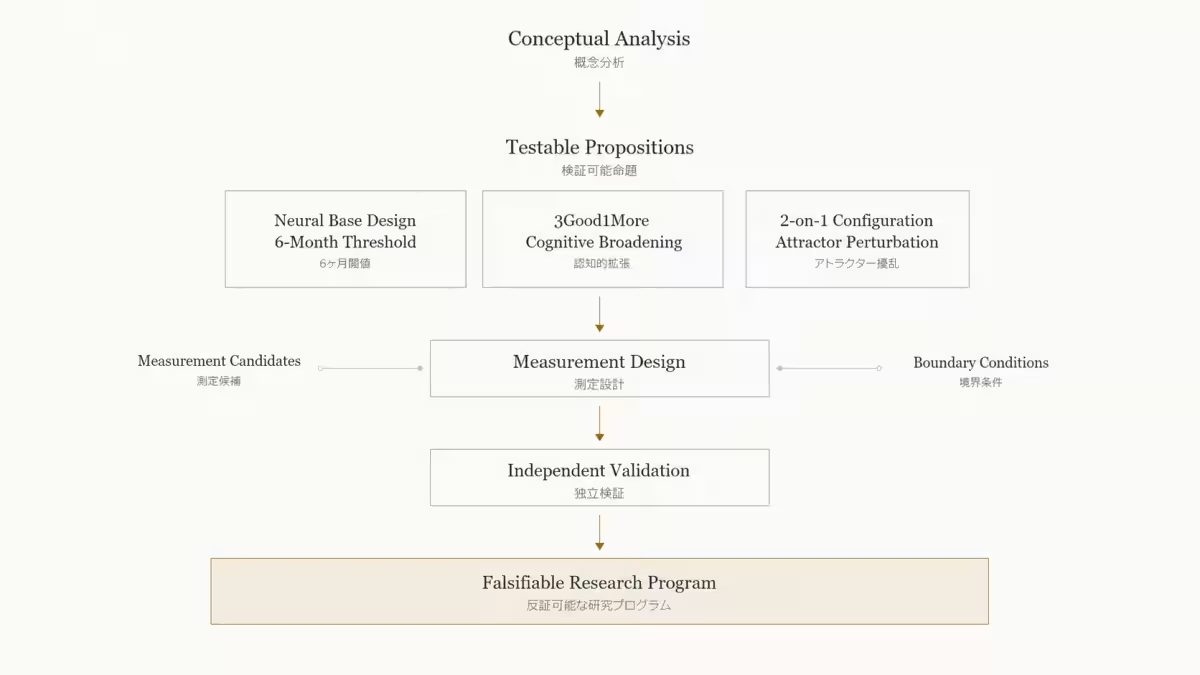
COS does not present itself as a completed empirical theory but as a conceptual analysis that integrates existing theories. It reframes the problem of organizational change as one involving structural interventions and suggests propositions that can be validated or falsified in future research. This positioning is crucial, as emphasized in news releases on EurekAlert! and Phys.org, which clarify that the paper represents conceptual analysis rather than empirical research, shining a light on propositions that other researchers may test in subsequent studies.
Proposition 1: Sustainable Implementation of Neural Base Design and Autonomy in Behavior
The first proposition suggests that organizations implementing Neural Base Design sustainably over a defined period may see behaviors like acknowledgment response sharing, gratitude sharing, physical check-ins, and the adoption of the 3Good1More approach becoming autonomously reproduced without external facilitation. Approximately six months has been hypothesized as a tentative time frame for achieving this level of autonomy, though this is not guaranteed as factors such as organization size, culture, power distance, management involvement, existing psychological safety, and crisis situations can significantly influence outcomes.
Proposition 2: Cognitive Expansion through 3Good1More
The second proposition posits that the 3Good1More approach could alter how individuals receive developmental feedback. By structurally positioning affirmative observations ahead in the feedback process, the focus of recipients may shift from defensive mechanisms towards broader possibilities for improvement. This proposition connects to Fredrickson’s Broaden-and-Build Theory, research on feedback interventions, and notions like negativity bias and cybernetics, establishing metrics such as cognitive flexibility, psychological safety, feedback acceptance, and behavior changes post-meetings.
Proposition 3: 2-on-1 Configuration and Attractor Disturbance
Finally, the third proposition addresses the dynamics created by the 2-on-1 structure as opposed to a 1-on-1 interaction. Within the framework of Field Gradient Theory, the 2-on-1 configuration may increase the transition probability of existing attractors but is contingent upon the presence of psychological safety. In environments lacking relational trust or psychological safety, this configuration could be perceived as coercive pressure, leading to negative outcomes rather than desired interactions.
Necessity for Independent Verification
It is imperative that these propositions undergo independent validation. Observations by DroR alone are insufficient, as biases can emerge when the intervener and theorist are one and the same. Therefore, collaboration with independent researchers, academic institutions, practitioners, and fellowships from the Clinical Organizational Science Research Association is essential for the rigorous testing of these propositions.
Comments from CEO Makoto Yamanaka
To nurture COS effectively, it is not merely about asserting what is deemed effective. It is critical to clarify what aspects are verifiable and where the potential for falsification lies. The three propositions serve as our research agenda; both validation and falsification are welcomed. We aim to develop COS as an open research program rather than a closed method.
Conclusion
This analysis encapsulates COS as a conceptual analysis that does not claim completed effect verification. Instead, it seeks to integrate dispersed scientific knowledge, reframing organizational change in terms of structural intervention. COS does not set to replace existing theories but rather repositions them within a structural intervention perspective while presenting itself as a valid research program to be explored and verified independently.
Next Steps
Stay tuned for the next installment, which will address conditions under which COS may be ineffective—highlighting the boundary conditions and three organizational contexts where the application of COS may face challenges. This ongoing series is designed to systematically unveil the core concepts of COS, their relations with existing theories, boundary conditions, and invitations for independent validation over time.

Topics Business Technology)
【About Using Articles】
You can freely use the title and article content by linking to the page where the article is posted.
※ Images cannot be used.
【About Links】
Links are free to use.