



New Business Proposal System's 3-5 Year Challenge Guide Released for Large Corporations
New Business Proposal System's 3-5 Year Challenge Guide Released
Filament Inc., headquartered in Osaka, has just published a practical guide entitled "3-5 Year Challenge Guide for New Business Proposal Systems" aimed at corporations that have been operating an internal business contest for several years. This guide is based on data gathered from the 2026 Business Contest Awards, specifically the insights from 66 respondents representing 40 companies engaged in the practice, along with the efforts of entries from 2025 and 2026. It aims to identify common challenges encountered as a business proposal system continues over time and highlights critical points for evaluating and adjusting these systems.
Internal business contests, or 'bizcon', usually attract attention within the company during the initial 1-2 years; however, as the contests progress, various challenges begin to surface. These can include a stagnant pool of applicants, a tendency for proposals to become less innovative, slow progress on awarded projects, and increasing pressure to report results to management. In this context, the guide reframes such challenges not simply as a sign of stagnation but as the '3-5 Year Challenge' that emerges as the roles and responsibilities shift within long-standing business proposals.
Key Insights from the Guide:
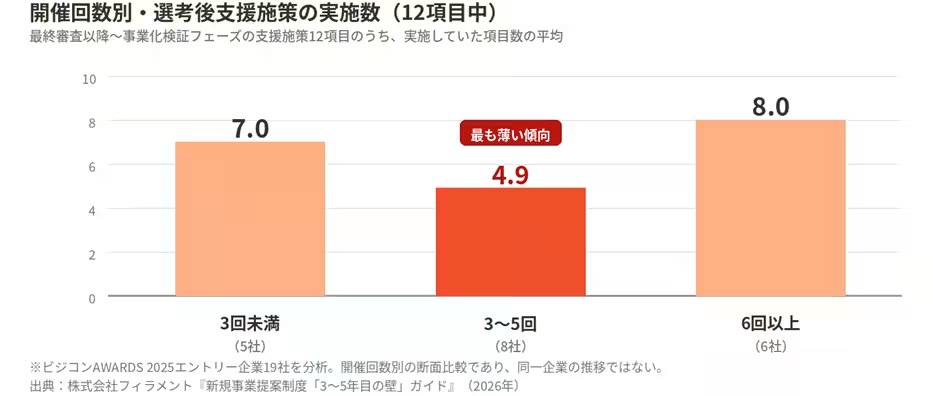
- - Companies that have held 3-5 contests exhibit the least supportive measures post-selection, averaging just 4.9 initiatives to support entries.
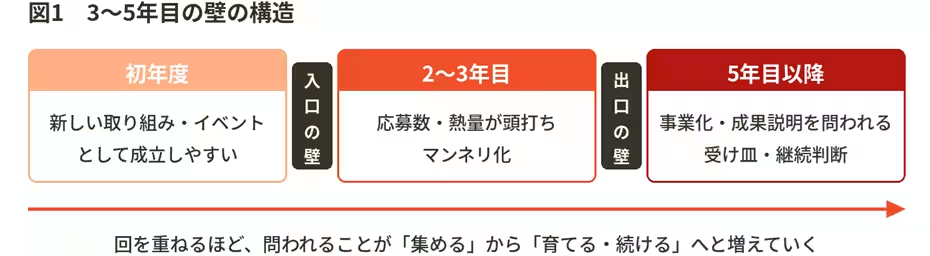
- - Once reaching the 3-5 year mark, the initial barriers remain, while new challenges related to business realization and connections with departments arise.
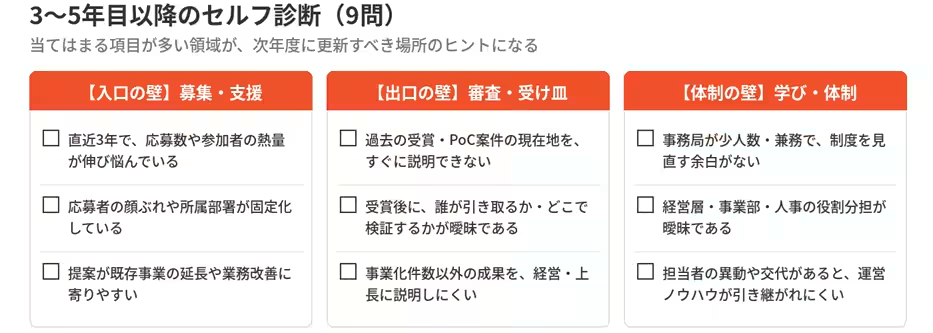
- - Successful companies continuously update their strategies concerning recruitment, support, evaluation, and overall structure.
- - When renewing systems, organizations must also consider redefining the central questions that their systems seek to address, not just the measures in place.
- - Evaluating success should not rely solely on the number of projects commercialized. Instead, outcomes should be analyzed through three lenses: business development, talent cultivation, and fostering an innovative culture.
Background of the Publication:
While initiating an internal business contest can be relatively simple, maintaining and evolving it poses a more complex challenge. Participants in the Bizcon Awards 2026 indicated they were not only focused on how to start these contests but also on understanding how long-term participants have adapted and evolved their approach over time. The most cited noteworthy programs involved insights gained from sustaining operations for a decade, showcasing the evolution of internal business contests.
The survey also indicated that businesses in their 3-5 year phase often grapple with new 'exit' challenges on top of existing 'entry' concerns. These include issues with the eventual scaling of ideas into tangible business realities or integration into pertinent departments. The guide presents this transition as an essential aspect of understanding the changing landscape of business proposal systems from entrance to successful execution.
Structuring Support for Entries:
Among the companies surveyed, those in the 3-5 year phase exhibited an underwhelming level of post-selection support, averaging only 4.9 out of 12 possible initiatives, compared to 7.0 for those with fewer contests and 8.0 for those with more than six. This indicates a trend where long-standing contests fail to maintain vigorous support mechanisms as the novelty wanes, which can hinder the successful application and proof of concepts post-election.
Additionally, one prevalent issue during this period is the 'small-sized proposals' phenomenon. While competition entries increase, many tend to be variations of existing business practices rather than innovative new ideas. This does not solely reflect on applicant capability; it can also stem from the contest’s thematic focus being too reliant on existing business lines. The guide emphasizes viewing such trends as signs prompting necessary system updates, rather than indicating failure among applicants.
Continual Updates and Evolution of the Contest:
The findings from participant details reflect a cycle of continually updating systems. Businesses often identify problems from past contests and implement changes to improve subsequent rounds. The guide classifies continuous improvement efforts into five key areas: recruitment strategies, support mechanisms, assessment practices, post-award implementation, and learning frameworks. Long-serving contests adapt to change, modifying their design and intent according to evolving challenges.
Final Thoughts:
The essence of this guide lies in provoking thought around nurturing innovative ecosystems within organizations going beyond just operational metrics. By scrutinizing the cycle of challenges faced during the third to fifth years of the proposal cycle, organizations can pivot from simply continuing or discontinuing a program to identifying what facets of their approach require renewal and improvement.
This structured reflection on past efforts may render crucial insights into methods of maintaining a thriving innovation culture while circumventing any misalignments that may arise through stagnation or lack of engagement.
Filament Inc. aims to assist organizations in successfully navigating these transitions through its comprehensive findings encapsulated within the 3-5 Year Challenge Guide, ultimately contributing to a more resilient, innovative, and productive business landscape.
For more detailed insights, the complete guide can be accessed here.
Topics Consumer Products & Retail)
【About Using Articles】
You can freely use the title and article content by linking to the page where the article is posted.
※ Images cannot be used.
【About Links】
Links are free to use.