



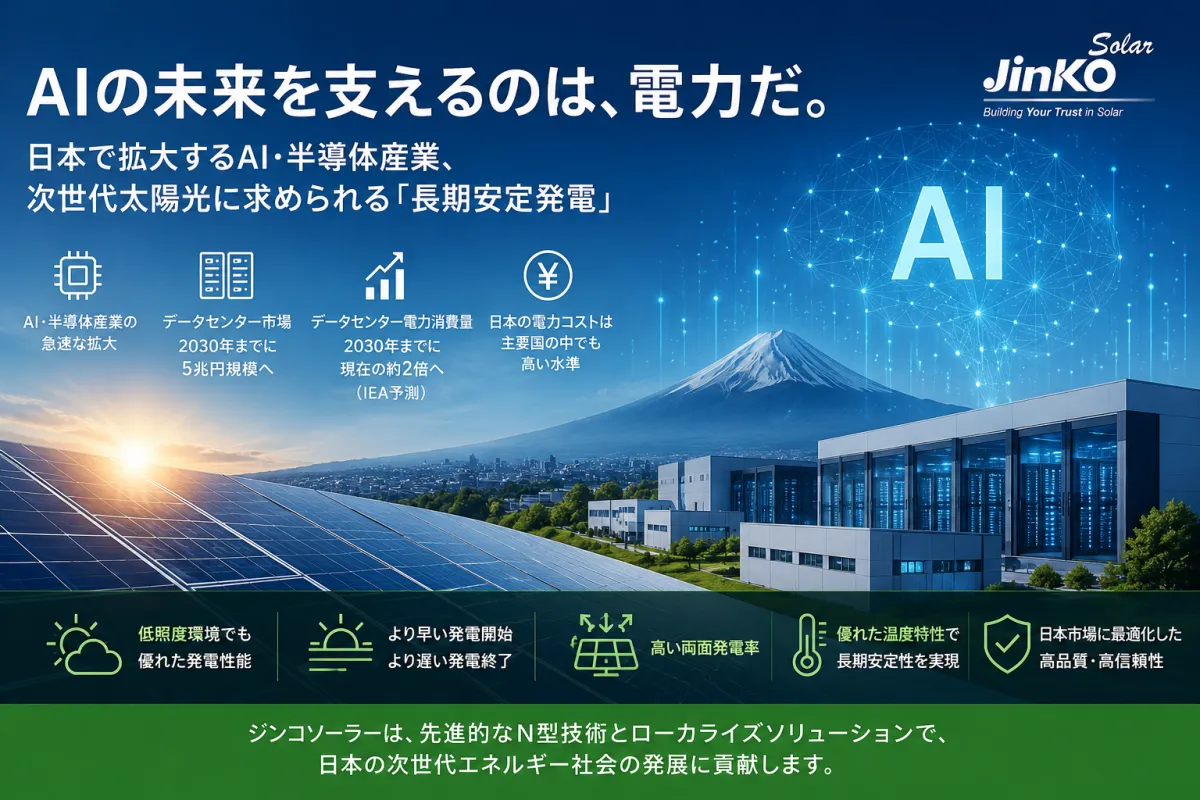
The Power Behind AI's Future: Energy Needs Sharply Rising as AI Industry Expands
The Power Behind AI's Future: Increasing Demand for Energy
The AI industry is expanding at an unprecedented rate, and one of the critical challenges that's emerging is the sharp rise in power demand. Recent reports from the International Energy Agency (IEA) indicate that the energy consumption of data centers around the world is projected to double by 2030. This increase in electricity consumption is especially pronounced due to the surge in generative AI, which is driving up the power requirements for AI-dedicated servers and data centers. Consequently, we expect significant changes to the global power infrastructure in the coming years.
In Japan, investment in the semiconductor and AI-related industries is progressing rapidly. The TSMC semiconductor factory has recently begun operations in Kumamoto, while the next-generation semiconductor project by Rapidus is in progress in Hokkaido. Moreover, the construction of data centers is accelerating within Japan as well. According to the Japan Data Center Council (JDCC), the domestic data center market is poised to grow to approximately ¥5 trillion by 2030.
However, Japan faces challenges related to high electricity costs and the need to increase the ratio of renewable energy sources. Furthermore, factors such as frequent rain, cloudy weather, limited land availability, and growing distributed power generation demands create a unique market environment that necessitates a focus not only on high output but also on 'long-term stable power generation'—especially in the next-generation solar power market.
In this context, there is increasing attention on next-generation N-type technology that can achieve high efficiency and long-term stable power generation. JinkoSolar has been maintaining a competitive edge in the Japanese market, supported by long-term investments in N-type technology and a global mass production system. As of the first quarter of 2026, JinkoSolar's cumulative shipments of N-type products exceeded 220 GW, making it a leader in the industry with both mass production capabilities and long-term proof data.
Particularly noteworthy is the Tiger Neo series, which not only boasts high conversion efficiency but also excels in power generation performance in low-illumination conditions. It also features a high bifacial generation rate and long-term stability. In a market like Japan, where cloudy days and low-light conditions are common, the ability to generate power consistently throughout the day is critical.
In trials conducted in Kagoshima, the technology demonstrated faster power generation initiation and extended generation periods even in low-light environments. On top of that, JinkoSolar has localized products designed to cater to Japan's specific roofing, climate, and installation conditions, featuring anti-glare, low reflectance, lightweight, and low-current characteristics.
Moreover, JinkoSolar's TOPCon technology provides a high bifacial generation rate and excellent temperature characteristics, making it easier to maintain stable power generation performance year-round. This feature has garnered significant interest from the market, especially in terms of ensuring 'stable long-term power supply' in the age of AI.
The demands of the AI era extend beyond mere computational power. The foundation of this future lies in a stable and sustainable energy infrastructure. As society transitions to a new phase, the value attached to solar power generation is shifting from merely 'high output' to 'long-term stable power generation.'
In conclusion, the sustainable infrastructure that will support the future of AI must adapt to these evolving requirements. The ongoing advancements in technologies like N-type and TOPCon are expected to play a pivotal role in this transformation, ultimately ensuring that the AI industry continues to thrive alongside our energy aspirations.
Topics Consumer Technology)
【About Using Articles】
You can freely use the title and article content by linking to the page where the article is posted.
※ Images cannot be used.
【About Links】
Links are free to use.