



Exploring the Brain Mechanisms That Allow Acceptance of Unfair Proposals
Understanding the Acceptance of Unfair Proposals
Recent research conducted by a group at the National Institute of Information and Communications Technology (NICT) has unveiled crucial insights into how humans rationalize and accept unfair proposals during negotiations. This phenomenon is connected to emotional processes in the brain and how they interact in complex decision-making scenarios.
Key Findings
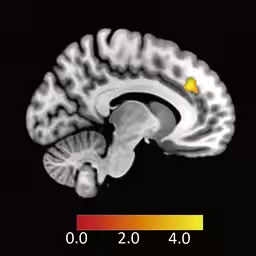
The investigation centered around the dorsal anterior cingulate cortex (dACC), a brain region pivotal in regulating emotional responses associated with unfairness. The main aim was to explore why individuals often accept unfair offers even when such decisions seem counterintuitive.
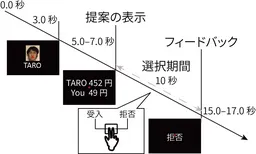
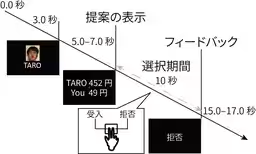
A series of functional MRI (fMRI) experiments were carried out with a cohort of 63 participants engaged in a strategic game known as the "ultimatum game." In this setup, participants received varying offers regarding the allocation of money. They were required to decide within ten seconds whether to accept or reject the proposals, which created a compelling context to observe their decision-making processes in real-time.
The Ultimatum Game
In the ultimatum game, one player, referred to as the proposer, suggests a distribution of a sum of money. The other player, the responder, must decide whether to accept the distribution or reject it entirely, resulting in both players receiving nothing. This framework effectively highlights the tension between fairness and self-interest in economic behavior.
Key Observations
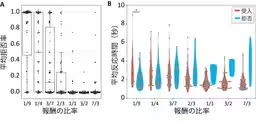
The results indicated that as offers became increasingly unfavorable, the acceptance rates dropped significantly. Conversely, when participants accepted an unfair offer, it was noted that their decision was often made more swiftly than in cases of rejection. This finding suggests a more intricate cognitive process at play beyond a simple logic of maximizing rewards.
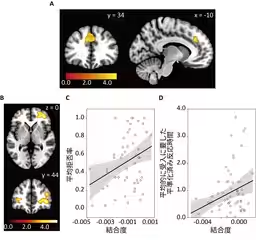
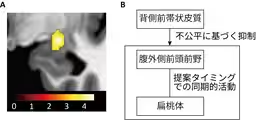
The researchers utilized the Drift Diffusion Model (DDM) to delve deep into the decision-making mechanisms, providing a more nuanced understanding of the dynamics involved. By analyzing brain areas associated with emotional responses, they found a robust connection between the dACC and the ventrolateral prefrontal cortex (vlPFC). The vlPFC was shown to suppress the emotional reactions linked to unfairness, consequently facilitating the acceptance of such offers.
Synchronicity in Brain Functions
The interactions between the dACC and vlPFC not only modulated emotional responses but could also predict participants' likelihood of accepting unfair offers and their decision-making speed. This proves that emotional regulation within the brain significantly influences economic behaviors in high-stakes environments. The study emphasizes that participants showed synchronized activity in the vlPFC and the amygdala during the presentation of unfair proposals, reinforcing the view that processing emotions plays a crucial role in negotiations.
Future Directions
Looking forward, researchers aim to further explore how modifying the emotional mechanisms identified in this study could impact the acceptance rates in unfair proposals. By understanding the causal relationship between brain activity and decision-making, it paves the way for devising negotiation systems that enhance understanding and agreement among parties.
The findings were published in the renowned journal PLOS Biology, contributing significantly to the fields of neuroscience and behavioral economics. Understanding these brain mechanisms not only sheds light on individual psychological processes but could also inform better practices in fields that rely heavily on negotiation, from personal relationships to international diplomacy.
Conclusion
This groundbreaking research opens new avenues in understanding human behavior concerning fairness in negotiations, highlighting that our brains possess sophisticated systems that operate beyond mere rationality, intertwining emotional biases with decision-making. The implications of these findings stretch broadly across various domains, promising to influence both psychological theory and practical negotiation strategies.
Research Citation:
Numano, S., Frith, C., Haruno, M. (2026). The human dorsal anterior cingulate facilitates acceptance of unfair offers and regulates inequity aversion. PLOS Biology. DOI: 10.1371/journal.pbio.3003007
Topics People & Culture)



【About Using Articles】
You can freely use the title and article content by linking to the page where the article is posted.
※ Images cannot be used.
【About Links】
Links are free to use.