



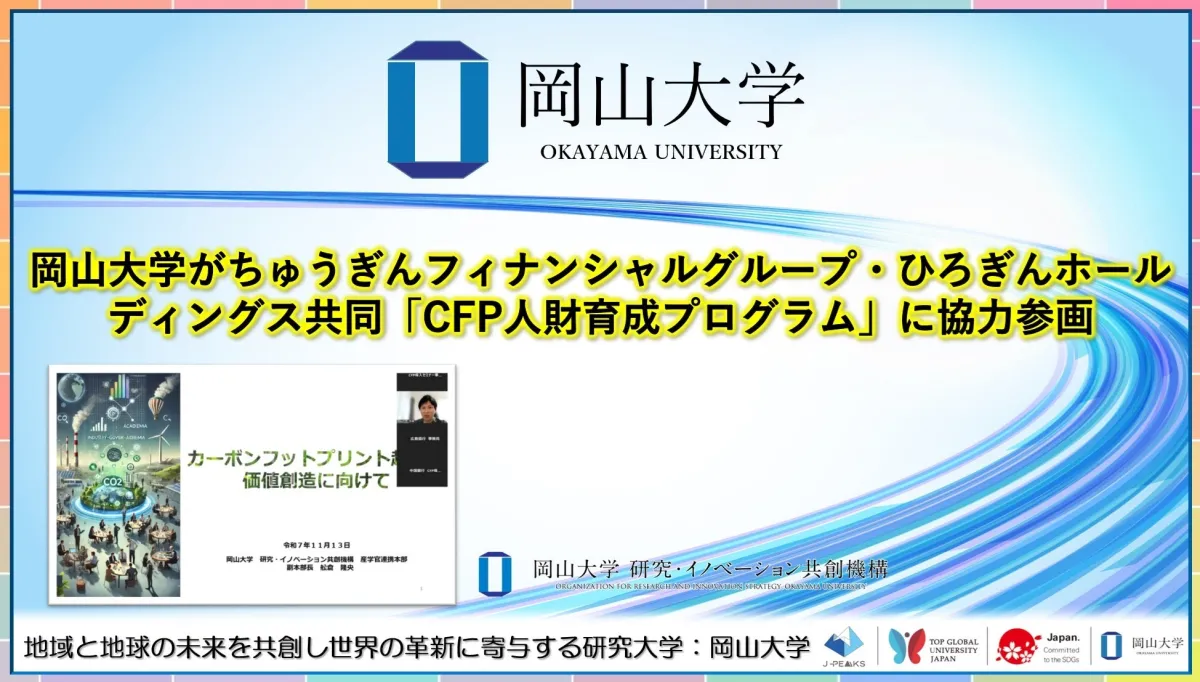
Okayama University Collaborates in Sustainability Skill Development Program with Local Financial Institutions
Okayama University Collaborates in Sustainability Skill Development Program
In a significant move towards enhancing sustainability efforts in the Sanyo region, Okayama University has joined hands with Chugin Financial Group and Hirogin Holdings for the launch of a new program titled the "Carbon Footprint (CFP) Skills Development Program." This initiative aims to cultivate talent that supports decarbonization in the financial sector, aligning with the partnership agreement established on March 28, 2025, between the two financial institutions.
The program's kickoff seminar took place on November 13, 2025, in an online format, featuring guest speaker Toshifumi Nakai from the Sustainable Management Promotion Organization (SuMPO). His presentation offered insights into global trends towards a decarbonized society and highlighted the essential roles local financial institutions play in this transition. Approximately 100 employees from various branches of both banks participated, signaling their commitment to enhancing their expertise in supporting decarbonization efforts.
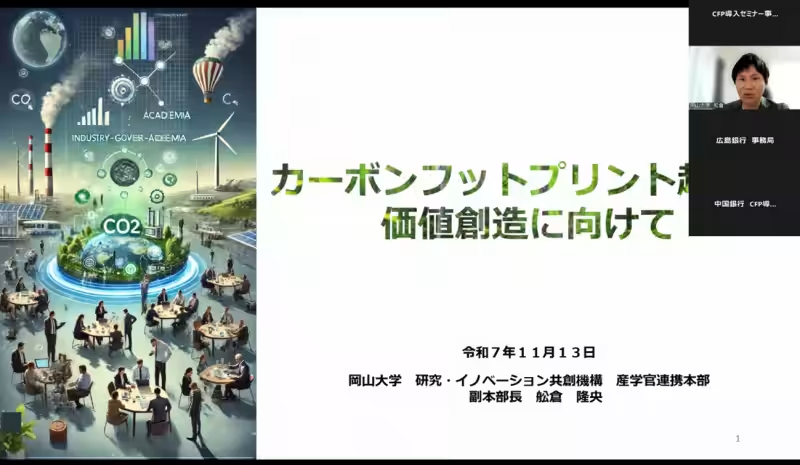
Following Nakai's presentation, Takao Funakura, deputy head of the university's Research and Innovation Co-Creation Organization, discussed the theme of "Value Creation Based on Carbon Footprint." He emphasized how visualizing the entire lifecycle of products and services through CFP is more than just managing emissions; it enables companies to understand their business structures and discover new sources of value. Funakura also showcased a collaborative initiative where students from Okayama University partnered with local companies to engage in what they call the CFP Challenge, demonstrating how this joint effort has developed a common language aimed at supporting regional decarbonization.
This initiative resonates with the goals of Okayama University’s J-PEAKS project, which focuses on enhancing research capabilities and public engagement. Administrative staff involved in research management are now linking academic research with practical implementation, directly contributing to social transformation through this program.
The program will culminate in intensive courses in late November 2025, with practical support for firms in calculating their carbon footprints expected to continue until March 2026. This venture builds on previous collaborations, including that with China Bank, which was part of a Ministry of the Environment project aimed at establishing a support system for decarbonization at the community level.
Okayama University is committed to continuing this momentum. The network of collaboration established in just over a year is expected to evolve into more significant actions toward creating a sustainable future. As the university, local businesses, government, and financial institutions work together, they are poised to tackle the challenges of decarbonization head-on. Participants are encouraged to anticipate new values that Okayama University will create in partnership with the community for a more sustainable future.
Understanding Carbon Footprint
The Carbon Footprint measures the amount of greenhouse gas emissions—from raw material procurement through to disposal and recycling—expressed as CO₂ emissions. For more information, refer to the Carbon Footprint Guidelines provided by Japan's Ministry of Economy, Trade, and Industry and the Ministry of the Environment. View Guidelines
By engaging in projects like the CFP Challenge, Okayama University is paving the path toward a more economically and environmentally sustainable future, drawing on the collective strengths of its students, local businesses, and community organizations.
Interested parties can reach out to the Research and Innovation Co-Creation Organization at Okayama University to learn more about ongoing initiatives and partnership opportunities.


Topics Other)
【About Using Articles】
You can freely use the title and article content by linking to the page where the article is posted.
※ Images cannot be used.
【About Links】
Links are free to use.