



Innovative Reactor Development for Efficient Wastewater and Waste Treatment in Biomanufacturing
Groundbreaking Reactor Design for Waste Management
Introduction
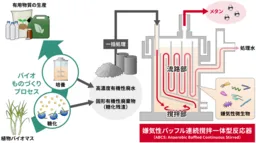
Waste and wastewater from biomanufacturing processes present significant challenges. Traditional methods of handling solid organic waste and high-strength wastewater are often inefficient and energy-intensive. Recent advancements at the National Institute of Advanced Industrial Science and Technology (AIST) have led to the development of a novel reactor system known as the Anaerobic Baffled Continuous Stirred (ABCS) reactor. This innovative reactor aims to process solid organic waste and wastewater simultaneously while recovering energy in the form of methane gas.
The ABCS Reactor: Key Features
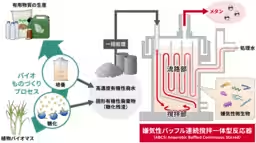
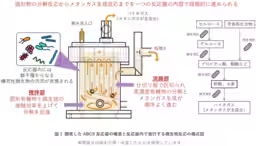
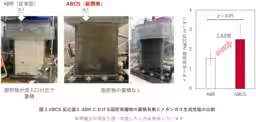
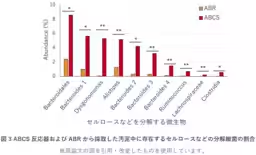
The ABCS reactor distinguishes itself by effectively partitioning its internal structure into two zones: a stirring section and a flow channel. This design enables the systematic breakdown of high molecular weight organic matter, facilitating the transition from solid waste decomposition to methane generation. The stirring chamber enhances the contact efficiency between microbial communities and solid organic constituents, thereby optimizing the digestion process. The reactor maintains operational stability for over 100 days, achieving a 1.62-fold increase in methane generation compared to conventional systems.
Implications for Biomanufacturing
Biomanufacturing is gaining traction as a sustainable alternative to fossil fuel-based processes. This method utilizes plant biomass, generating by-products such as solid organic residues (known as saccharification residue) and concentrated organic wastewater. Efficient treatment of these by-products is crucial for minimizing environmental impact and enhancing the overall sustainability of the biomanufacturing sector.
Addressing Current Challenges
Historically, solid organic waste has been treated primarily through methods involving dehydration and incineration, which are energy-intensive and not environmentally sustainable. Likewise, conventional aerobic treatment methods for high-strength organic wastewater often require significant volumes of microorganisms and oxygen, resulting in costly infrastructure.
The ABCS reactor targets these challenges directly by leveraging anaerobic digestion technology. Through microorganism-assisted degradation, organic matter can be efficiently processed, reducing environmental loads while simultaneously recovering energy as methane. In this context, the reactor design allows for the cumulative treatment of high-strength wastewater and solid organic residues—two waste streams that have previously posed substantial management difficulties.
Testing and Results
To validate its performance, the ABCS reactor underwent extensive operational testing, simulating conditions typically found in biomanufacturing. This involved processing solid organic waste and high-concentration organic wastewater. Initial results showcased a stark contrast between the ABCS reactor and standard anaerobic reactors, where the latter struggled with sludge accumulation and declining efficiency over time.
One of the remarkable outcomes of the testing was the improved methane production rate observed in the ABCS reactor. By optimizing conditions for microbial activity, this novel reactor design allows for a far greater decomposition of solid organic material, thus driving higher energy recovery rates.
Future Developments
Looking ahead, the research team is set to scale up the ABCS reactor for broader implementation. This exploration will also involve studies examining the potential for the reactor to process various solid wastes beyond biomanufacturing, such as plastics and other organic materials. As the need for sustainable wastewater treatment technologies intensifies, solutions like the ABCS reactor will undoubtedly play a pivotal role in shaping the future of waste management and energy recovery practices.
Conclusion
The advancement of the ABCS reactor is a significant step toward the sustainable processing of waste within the biomanufacturing sector. By effectively tackling the issues associated with organic waste and wastewater, this innovative reactor stands to not only improve environmental outcomes but also pave the way for a future characterized by energy self-sufficiency in waste processing.
This breakthrough underscores the importance of continued research and innovation in developing technologies that contribute to a circular economy, where waste is minimized, and resources are maximized.
Topics Environment)

【About Using Articles】
You can freely use the title and article content by linking to the page where the article is posted.
※ Images cannot be used.
【About Links】
Links are free to use.