



New Theory for Light-Induced Non-Reciprocal Magnetism Unveils Spin Chase Phenomenon
In a groundbreaking theoretical advance, a collaborative research team from Science Tokyo, Okayama University, and Kyoto University has proposed a novel method to artificially generate 'non-reciprocal interactions' in solids using light. This innovative approach allows for the manipulation of electron interactions, breaking the traditional law of action and reaction typically observed in physics.
The researchers, led by Ryo Hanai of Science Tokyo, Daiki Ootsuki of Okayama University, and Rina Tazai of Kyoto University, introduced a concept where light exposure creates specific pathways for electrons to escape within a solid, effectively dismantling the usual reciprocal forces.
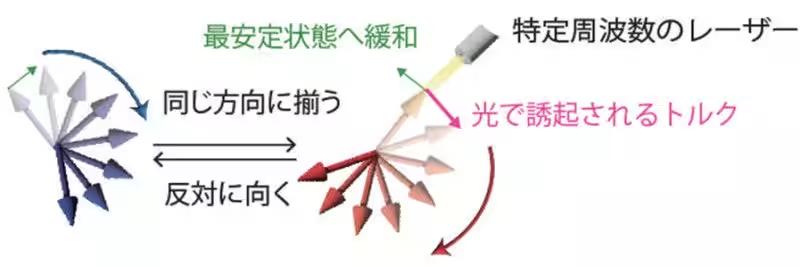
The theoretical implications of this work are particularly striking when applied to two layers of magnetic metals. In such a system, while one layer seeks to align its magnetization in the same direction as the other, the opposite layer naturally tends to orient itself in the reverse direction. This leads to a fascinating scenario where the two magnetic layers enter a continuous 'chase' state, perpetually rotating around each other.
Traditionally, all matter at thermal equilibrium adheres to Newton's third law of motion, which states that for every action, there is an equal and opposite reaction. However, in non-equilibrium systems, especially under constant energy inflow, deviations from these laws can occur. Examples of non-reciprocal interactions are well-documented in active matter systems, where individual agents exhibit behaviors driven by their inherent energy sources, leading to interactions that do not conform to traditional reciprocity.
In this study, the team proposed to adapt such phenomena common in biological systems to solid-state physics. By designing scenarios where light energy is strategically directed toward specific electrons, the researchers theorized that they could induce non-reciprocal interactions in a magnetic medium. This manipulation results in a system where one magnetic layer desires to align with the other (ferromagnetic), while the second layer prefers to turn away (antiferromagnetic), ultimately creating a dynamic environment of perpetual rotation between the two layers of magnetization.
Furthermore, by varying factors such as the frequency and intensity of the light, it should be feasible to control the rotation's activation and speed. The potential applications could extend into fields requiring frequency modulation, where the output frequency can be adjusted depending on the input laser strength, effectively enhancing technological approaches in quantum materials.
The significance of these findings has been recognized in the scientific community, with the study slated for publication on September 18, 2025, in the esteemed journal 'Nature Communications.'
With the advancement of this theory, researchers anticipate opening a new frontier in the study of non-equilibrium materials science. This could lead to innovative applications in optics, quantum technologies, and beyond, establishing a clearer understanding of non-reciprocal behaviors in solid-state physics and their manipulation via light.
The paper detailing the research is titled 'Photoinduced Non-Reciprocal Magnetism,' authored by Ryo Hanai, Daiki Ootsuki, and Rina Tazai, and can be accessed through the DOI link 10.1038/s41467-025-62707-9.
Such advancements position Japan at the forefront of materials science research, showcasing the potential for groundbreaking discoveries that might not only enrich academic knowledge but also spur technological innovations applicable in various domains, including electronics and quantum computing.


The researchers, led by Ryo Hanai of Science Tokyo, Daiki Ootsuki of Okayama University, and Rina Tazai of Kyoto University, introduced a concept where light exposure creates specific pathways for electrons to escape within a solid, effectively dismantling the usual reciprocal forces.
The theoretical implications of this work are particularly striking when applied to two layers of magnetic metals. In such a system, while one layer seeks to align its magnetization in the same direction as the other, the opposite layer naturally tends to orient itself in the reverse direction. This leads to a fascinating scenario where the two magnetic layers enter a continuous 'chase' state, perpetually rotating around each other.
Traditionally, all matter at thermal equilibrium adheres to Newton's third law of motion, which states that for every action, there is an equal and opposite reaction. However, in non-equilibrium systems, especially under constant energy inflow, deviations from these laws can occur. Examples of non-reciprocal interactions are well-documented in active matter systems, where individual agents exhibit behaviors driven by their inherent energy sources, leading to interactions that do not conform to traditional reciprocity.
In this study, the team proposed to adapt such phenomena common in biological systems to solid-state physics. By designing scenarios where light energy is strategically directed toward specific electrons, the researchers theorized that they could induce non-reciprocal interactions in a magnetic medium. This manipulation results in a system where one magnetic layer desires to align with the other (ferromagnetic), while the second layer prefers to turn away (antiferromagnetic), ultimately creating a dynamic environment of perpetual rotation between the two layers of magnetization.
Furthermore, by varying factors such as the frequency and intensity of the light, it should be feasible to control the rotation's activation and speed. The potential applications could extend into fields requiring frequency modulation, where the output frequency can be adjusted depending on the input laser strength, effectively enhancing technological approaches in quantum materials.
The significance of these findings has been recognized in the scientific community, with the study slated for publication on September 18, 2025, in the esteemed journal 'Nature Communications.'
With the advancement of this theory, researchers anticipate opening a new frontier in the study of non-equilibrium materials science. This could lead to innovative applications in optics, quantum technologies, and beyond, establishing a clearer understanding of non-reciprocal behaviors in solid-state physics and their manipulation via light.
The paper detailing the research is titled 'Photoinduced Non-Reciprocal Magnetism,' authored by Ryo Hanai, Daiki Ootsuki, and Rina Tazai, and can be accessed through the DOI link 10.1038/s41467-025-62707-9.
Such advancements position Japan at the forefront of materials science research, showcasing the potential for groundbreaking discoveries that might not only enrich academic knowledge but also spur technological innovations applicable in various domains, including electronics and quantum computing.
Topics Consumer Products & Retail)
【About Using Articles】
You can freely use the title and article content by linking to the page where the article is posted.
※ Images cannot be used.
【About Links】
Links are free to use.