



Understanding the Complex Feelings of Students Towards School: A Deep Dive into Recent Research
Exploring Students’ Attitudes Toward School: Insights from Recent Research
A recent survey conducted by the Hakuhodo Education Foundation's Kodomo Kenkyujo has illuminated the complex feelings that elementary and middle school students hold towards their educational environment. The study, titled "Reiwa School," involved students from 4th to 9th grades across Japan and provided fascinating insights into their thoughts and emotions regarding school.
Positive Feelings Toward School
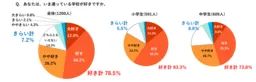
The survey indicated that an impressive 80% of students expressed a liking for their current school. Interestingly, the differentiation between those who like or dislike school seems centered around the relationships students have with their classmates, friends, and teachers.
Specifically, about 12% of the respondents confessed to loving their school, while about 40% reported liking it. However, it's noteworthy that this preference varies significantly between different school levels—83.3% of elementary school students liked their school compared to only 73.8% of middle schoolers. This suggests a decline in feelings of affection for school as students transition to higher grades, possibly reflecting increased academic pressures or social dynamics.
The responses indicate that positive relationships within the classroom can greatly influence a student's overall enjoyment of school life. Students who reported strong bonds with their classmates and teachers are significantly more likely to express a fondness for school.
Dread in the Morning
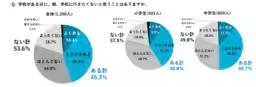
Conversely, nearly half of the surveyed students admitted to occasionally experiencing reluctance or outright dislike when it comes to heading to school in the morning, with 26.8% specifying that this feeling is particularly strong on Mondays. This statistic underlines a common struggle students face at the start of each week, uncovering a more complex psychological landscape at play.
Interestingly, while many enjoy school, the fact that so many express occasional discontent suggests that the structure and expectations within educational environments may require reevaluation.
The Dual Nature of School
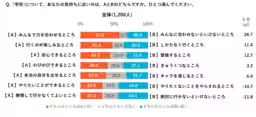
The survey further highlights that while 60% of students view school as a place where they work together with their peers, 50% also see it as a fun place to be. However, there's a counterbalance, as about 40% perceive it as a mandatory environment where they often do things they don't want to. This duality illustrates the intricate feelings students harbor regarding their education. The positives are often juxtaposed with feelings of obligation, leading to a complex emotional experience.
The students conveyed varying opinions on school events as well: a significant 80% of respondents believe that school trips should be maintained, and 66.3% feel the same about sports days. Yet, when it comes to academic lessons, students overwhelmingly prefer a learning style that allows them to pursue their interests at their own pace rather than a uniform approach.
Desire for Change
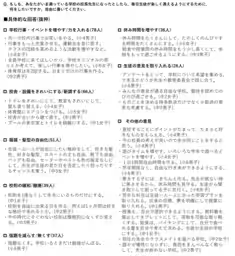
In a follow-up question about what changes they would like to see if they were school principals, an overwhelming 78% of students expressed a desire for increased focus on school events and activities. This reveals an intrinsic motivation for social engagement and collective enjoyment, suggesting that even in a challenging educational atmosphere, students yearn for enriching extracurricular experiences.
Moreover, students expressed significant support for the improvement of school facilities and a call for more input from their peers in decision-making processes. These insights underline the need for schools to adapt and meet the evolving needs of their students, fostering environments where they can express themselves freely and connect meaningfully.
Conclusion
The






Topics Other)
【About Using Articles】
You can freely use the title and article content by linking to the page where the article is posted.
※ Images cannot be used.
【About Links】
Links are free to use.