



KCT Launches New Course on Knowledge Science and AI Solutions at Gadjah Mada University
KCT Launches New Course on Knowledge Science and AI Solutions
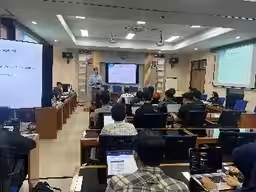
In response to the rising demand for education in generative AI technologies, Knowledge Creation Technology (KCT), led by President Masayuki Kawamura, is proud to announce the launch of a donation-based course titled "New Solutions Development Using Knowledge Science and AI" at Gadjah Mada University (UGM) in Yogyakarta, Indonesia. This initiative focuses on the intersection of AI advancements and practical applications, aiming to cultivate skilled professionals capable of navigating the complexities of modern AI.
Background and Objectives of the Course
As AI continues to evolve, we find ourselves moving from a phase of merely utilizing this technology to fully integrating it into our systems, creating a new paradigm of co-creation between humans and AI. Recognizing this shift, KCT believes that workforce development must extend beyond short-term skills training to be a long-term strategy that involves redesigning industrial structures and organizations.
Research indicates a potential shortage of up to 124,000 AI professionals in Japan by 2030, highlighting the urgent need for a skilled workforce proficient in AI research, development, utilization, and governance. KCT and UGM have joined forces to address this critical issue, focusing on developing highly skilled technical personnel through foundational research and societal implementation in the field of computer science.
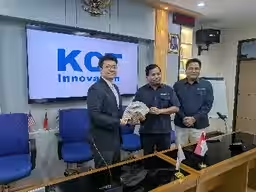
KCT and UGM formalized their partnership by signing a Memorandum of Understanding (MoU) in October 2024, enabling the introduction of the second installment of this unique donation course in November 2025. This special course targets UGM students and will lead to an internship program conducted by KCT's Solutions Services Division in February 2026, aimed at enhancing their capabilities in alignment with societal demands.
Students will not only gain expertise through course lectures and internships but also engage with Japanese culture and history by experiencing life in Kumamoto, ultimately increasing their interest in pursuing careers in Japan.
Course Highlights
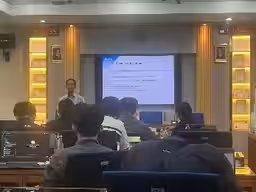
The inaugural course, "New Solutions Development Using Knowledge Science and AI," targets upper-level students from UGM's Computer Science and Engineering faculties. The curriculum focuses on applied research in generative AI, designed to unveil solutions for specific problems. Lecturers will include KCT engineers and researchers actively involved in generative AI, alongside distinguished professionals from knowledge science and industry entrepreneurship who will engage students in lectures and discussions.
Lecture Topics:
- - Lecture 1: Experiential Innovation Management - Exploring Directions in the AI Era through the Lens of Knowledge Science and Technology History
- - Lecture 2: The Future Society Created by KCT
- - Lecture 3: Overview of AI System Development Technology I
- - Lecture 4: Overview of AI System Development Technology II
- - Lecture 5: Overview of AI System Development Technology III
- - Lecture 6: Comprehensive Overview
Company Overview
Established in July 2008 in Tokyo, KCT specializes in developing ICT system solutions across various sectors, including finance, agriculture, telecommunications, and space. By collaborating strategically with organizations such as Engagelively in California and AI startups like DEN-NO from the University of Tokyo, KCT has established partnerships with major industries to deliver diverse technological solutions.
University Overview
Gadjah Mada University, located in the historic city of Yogyakarta, Indonesia, is one of the country's leading national universities. Established in 1949 by merging multiple higher education institutions, it offers a diverse range of academic programs and consistently ranks high in global university rankings, especially in research and educational quality.

Topics Other)
【About Using Articles】
You can freely use the title and article content by linking to the page where the article is posted.
※ Images cannot be used.
【About Links】
Links are free to use.