


Developing a High-Precision Simulation of Underground Viscous Fingering for Enhanced Oil Production and CO₂ Prediction
Precision Simulation of Viscous Fingering in Underground Fluid
Researchers from Waseda University have made significant strides in predicting the complex behaviors of fluids underground with the development of a high-precision simulation method aimed at understanding a phenomenon known as "viscous fingering." This intricate behavior occurs when different fluids, such as oil and water, interact in porous rock, often resulting in a branching flow that has implications for oil production and CO₂ storage. Traditional simulation methods struggled to accurately depict this behavior, limiting understanding of how fluids actually spread in underground reservoirs.
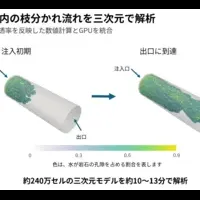
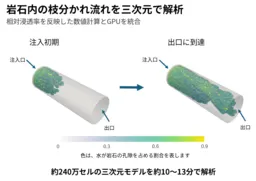
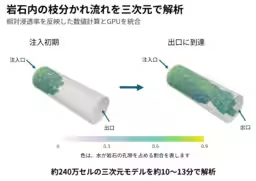
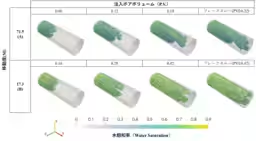
The new simulation technique employs three-dimensional computational fluid dynamics (CFD) to capture the dynamic branching and merging of flows within a rock matrix. By incorporating metrics like relative permeability, which measures how easily different fluids can flow through rock, the researchers were able to create a model that simulates fluid movement with unprecedented accuracy. This model operates on a vast scale, employing around 2.4 million computational cells compared to the typical thousands previously used, allowing renderings of fluid dynamics to be executed in approximately 10 to 13 minutes — a significant improvement over CPU timings, which could be 13 to 26 times slower.
Understanding the Mechanisms of Viscous Fingering
When water or CO₂ is injected underground, the pathways these fluids take are not always predictable. The phenomenon of viscous fingering emerges due to the differences in viscosity between the fluids being introduced and those already present. For instance, if a less viscous fluid tries to push out a more viscous one, substantial instability can develop, causing the injected fluid to take on broadly branched pathways instead of a straightforward flow.
Historically, simulating these complex interactions has been a challenge. Previous methods have failed to capture the fine-grained details of how fluids migrate through rock, primarily due to the limitations in computational power and resolution. By integrating the Corey-type relative permeability models with advanced CFD and harnessing the speed of GPU computations, the Waseda team has created a more effective framework for understanding these impactful subsurface phenomena. Their innovations allow for both stable and unstable displacement behavior to be analyzed over practical timeframes, leading to better predictions for energy resource management.
Validation and Results
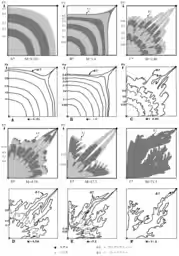
The researchers undertook validation by comparing their simulation outcomes with existing theoretical frameworks, confirming that their model could appropriately replicate fluid displacement behaviors typically observed in field scenarios. Notably, their three-dimensional models captured the intricate branching pathways of fluids within a homogeneous cylindrical rock, showing how differences in fluid properties affect flow characteristics and dynamics extensively.
Societal Implications
The implications of this research extend well into the fields of energy and environmental management. By improving the accuracy of predictions related to CO₂ geological storage and enhanced oil recovery techniques, the framework can enhance efficiency in resource extraction and aid in understanding the long-term impacts of CO₂ injection into geological formations. Such advancements not only contribute to resource optimization but also support environmental goals related to carbon capture and storage, an increasingly critical global challenge.
Future Directions
Looking ahead, the team at Waseda University plans to refine their model further by comparing results with real-world three-dimensional flow experiments. By integrating other factors such as capillary pressure, gravity, and geological heterogeneity, as well as the physical properties of CO₂, they hope to develop an even more robust simulation that closely resembles real subsurface conditions. This could lead to even greater efficiency in oil recovery methods and improved practices in CO₂ storage, thereby addressing essential issues surrounding energy utilization and environmental protection.
As we face a future where resource management and ecological sustainability are paramount, innovations like these will be crucial. The team emphasizes their commitment to developing methods that allow for better understanding and manipulation of underground fluid dynamics, contributing positively to energy and environmental sectors.
Topics Consumer Technology)

【About Using Articles】
You can freely use the title and article content by linking to the page where the article is posted.
※ Images cannot be used.
【About Links】
Links are free to use.