



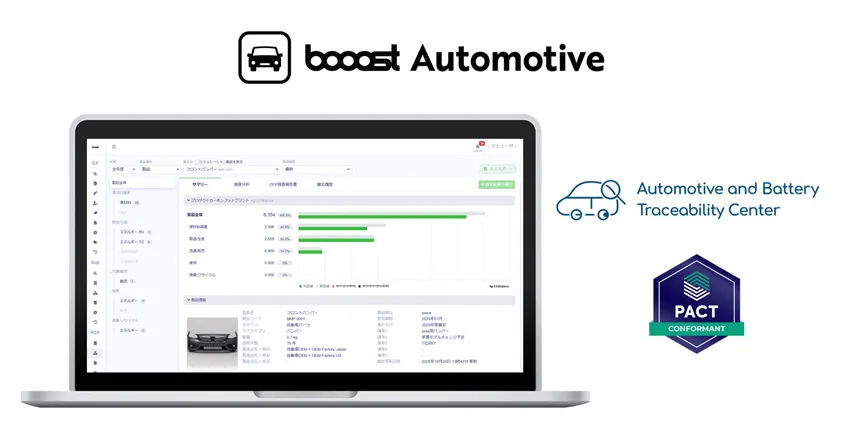
Booost Launches Comprehensive Automotive Solution to Drive Sustainability Transformation
Booost Unleashes 'booost Automotive' Solution for the Automotive Industry
In an era marked by an urgent need for sustainability, Booost Inc., headquartered in Shinagawa, Tokyo, has unveiled a groundbreaking solution tailored for the automotive sector. Known for being a leader in the sustainability ERP space, Booost aims to facilitate the Sustainability Transformation (SX) of companies by rolling out its latest offering, 'booost Automotive', set to launch in November 2025. This move follows the success of its solutions such as 'booost Manufacturing' for manufacturing industries and 'booost Logistics' for the logistics sector.
The Innovative Features of 'booost Automotive'
The 'booost Automotive' solution stands out by delivering both product-level carbon footprint calculations and corporate-level management on a unified platform—making it the first of its kind in the automotive industry. This sophisticated system ensures precise assessments each step of the way, aligning corporate strategies with international sustainability standards and disclosure regulations such as the EU Battery Regulation, CSRD, and SSBJ.
Notably, the platform also allows businesses to seamlessly manage their greenhouse gas (GHG) emissions across their entire supply chain, from raw materials to finished products. This comprehensive visibility into emissions data is pivotal as automakers face increasing pressure to comply with stringent international guidelines on carbon emissions.
Furthermore, Booost has implemented connectivity features aligned with the Ministry of Economy, Trade and Industry's industrial initiative, the Uranus Ecosystem. These features include compliant functionalities based on Open Data Spaces (ODS), which will pave the way for data interoperability and collaboration across companies and sectors.
Understanding the Current Landscape: A Call to Action
The automotive industry is rapidly evolving, driven by the shift towards electrification and connectivity. As the demand for comprehensive GHG emission disclosures throughout the product lifecycle escalates, it is crucial for automakers to have an intricate understanding of their entire supply chain's carbon footprint. Adhering to global PCF guidelines like ISO14067 has never been more urgent. Completing this task with existing fragmented systems, which often separate product-level and organizational-level reporting, has proven challenging. Companies now require a unified method to manage both aspects effectively while also gauging financial impacts comprehensively.
As per new EU Battery regulations, manufacturers will soon need to disclose product-level carbon footprints and issue a 'Battery Passport' to ensure traceability and sustainability guarantees by 2027. By then, not only will automakers need to adapt, but their suppliers—of batteries, parts, and materials—will also require systems to manage and share GHG data across the entire lifecycle.
Additionally, with policy changes such as the Carbon Border Adjustment Mechanism (CBAM) and the International Sustainability Standards Board (ISSB) introducing new reporting standards, the pressure on the automotive sector to upgrade data governance and comply with multiple regulations is intensifying.
Key Components of 'booost Automotive'
GHG and PCF Calculations Based on PACT Methodology
The solution adheres to the PACT Methodology, an international standard led by the European Commission and WBCSD, aiming to provide precise and comparable GHG emissions and product carbon footprint calculations. It is designed to address the complex multi-tier structures typical in the automotive sector while ensuring compliance with international traceability requirements, including those related to the Battery Passport.
Data Governance for Sustainability Reporting
'booost Automotive' provides a robust platform for managing sustainability disclosures in line with major global initiatives such as CSRD, ISSB, and SSBJ. This allows companies to oversee everything—from calculating product-level carbon footprints to consolidating group reports—ensuring efficient engagement with a spectrum of domestic and international regulations.
Centralized Visualization of Supply Chain Emissions
With integrated management of lifecycle data—from material acquisition to production and distribution—companies can track emissions spanning Tier 1 to Tier 4 suppliers. This visibility into the supply chain emissions calculated at the product level will enable better accountability and environmental impact assessments.
Automation of Supplier Engagement
To enhance supplier collaboration, 'booost Automotive' automates the process of environmental and human rights due diligence, streamlining data collection and verification to bolster data reliability and traceability.
Simulation for Decarbonization Strategies
The platform also assists businesses in assessing potential GHG reduction initiatives—from changes in energy sources to material selections—facilitating informed decision-making processes aimed at achieving sustainability goals.
Looking Ahead: A Commitment to Sustainability
Booost is committed to reinforcing its position as a key player in supporting the automotive and manufacturing supply chains in their decarbonization journeys while ensuring compliance with international regulations and disclosure standards. By systematizing best practices tailored to industry specifics, Booost aims to perpetually assist companies in their Sustainability Transformations and enhance their corporate presence in the global arena.
For more details and updates about the 'booost Automotive' initiative, visit Booost’s official website.

Topics Consumer Products & Retail)
【About Using Articles】
You can freely use the title and article content by linking to the page where the article is posted.
※ Images cannot be used.
【About Links】
Links are free to use.