



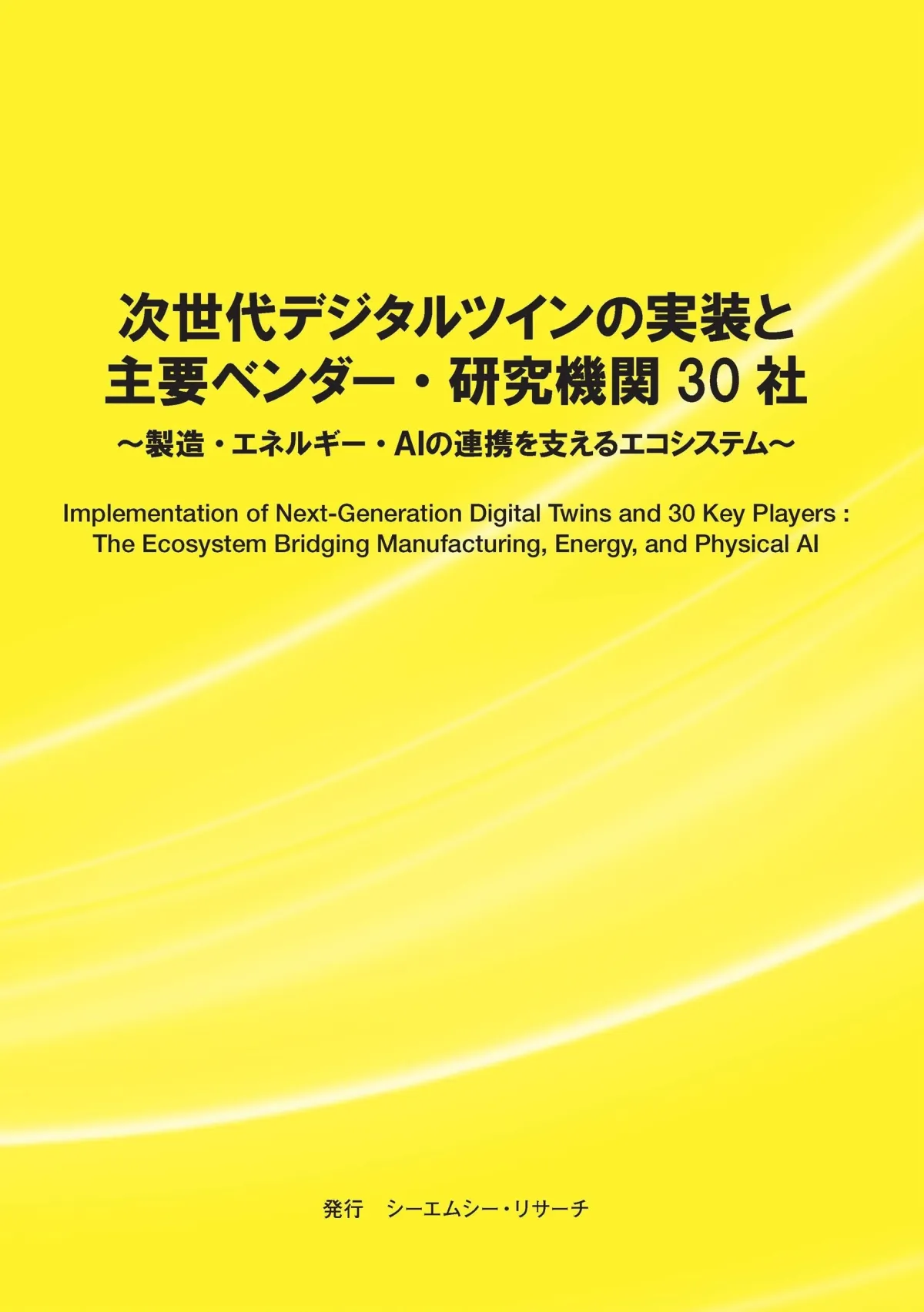
Implementation of Next-Generation Digital Twins: Overview of Key Vendors and Research Institutions
The Future of Digital Twins in Manufacturing and Energy
In the advancing landscape of the 2020s, Japan's manufacturing, materials, and device sectors are facing a critical turning point that risks undermining their competitive edge. The traditional sources of competitiveness—skilled labor and process know-how—are transforming into unsustainable assets amid changing workforce structures and the rise of AI-driven development. The reliance on prototype-driven development is becoming a disadvantage when competing against global rivals, impacting development lead times and yield improvement rates. This report introduces the next-generation digital twin as a strategic solution to this fundamental structural issue. The essence of this innovative approach lies in deconstructing and reconstructing tacit knowledge into replicable and calculable digital assets. The concept of digital assets, as defined within this report, refers to a structured interconnection of multi-layered data, including materials characteristics, process conditions, equipment behaviors, and energy consumption, creating a continuous foundation for decision-making value.
By vertically integrating this asset from materials innovation (MI) to mass production processes, and even extending to energy operations, companies can redesign not just operational optimization but the very capital productivity itself.
Evolution of Digital Twins
Digital twins have evolved from mere visualization tools to decision-making engines. Traditional data-driven AI, or surrogate models, excel in learning correlations based on observed data; however, they inherently face limitations when extrapolating in data-deficient regions with physical constraints. In contrast, hybrid modeling that integrates physical models with AI—particularly through the application of Physics-Informed Neural Networks (PINNs)—maintains physical integrity in predictions, even in regions with sparse data. This allows for the pre-derivation of optimal conditions while reducing dependence on experiments and prototypes. Such approaches have proven particularly effective in multiscale and strongly nonlinear processes, such as electrode coating and drying in battery production, as well as atomic layer deposition (ALD) for semiconductors. Previously, the adjustment of parameters typically relied on heuristics, but the introduction of hybrid models enables the reduction of effective dimensionality in parameter space and enhances sensitivity analysis. Consequently, this significantly lowers the uncertainty during scale-up and accelerates the vertical ramp-up from lab to mass production lines, which often experience discontinuous changes in conditions.
Shifting Competitive Axes
The competitive landscape is expanding from merely the manufacturing realm to embracing integrated optimization that includes energy domains. Progress in institutional frameworks, underscored by Europe’s Digital Product Passport (DPP) and Carbon Border Adjustment Mechanism (CBAM), mandates environmental burden management at the product level. In the near future, an energy-linked digital twin that integrates manufacturing processes with energy consumption will become standard, requiring dynamic optimization across factories, data centers, and battery systems. The surge in power consumption in data centers underscores the necessity for advanced operational optimization, including cooling fluid control and load balancing, not only aiming to improve Power Usage Effectiveness (PUE) but also optimizing Total Cost of Ownership (TCO) in data center operations and lowering Levelized Cost of Storage (LCOS) across energy systems.
This report provides a detailed analysis of 30 key vendors and research institutions, clarifying the requirements for Cyber-Physical Systems (CPS) implementation and prioritizing investment in these areas. By presenting a comprehensive architecture that integrates physical models, AI models, data frameworks, and control systems, it identifies bottlenecks in implementation and outlines approaches to overcome them. Only companies that achieve the digital assetization and transform physical phenomena into controllable entities will solidify their competitive advantage in next-generation industries. This book serves as a framework for decision-making for corporate executives and technology strategy leaders.
Report Organization and Key Themes
The report is structured into four main parts:
1. Digital Assetization of Tacit Knowledge and Structural Risks in Japan: It discusses the strategic pathway for transforming tacit knowledge into digital assets amid Japan's structural risks in materials and device industries.
2. Hybridization of Physical Models and AI: This section details the technical foundations for developing self-predictive CPSs using PINNs and the implementation methodologies involved.
3. Process-Specific Implementations: Focusing on battery manufacturing, semiconductor production, and chemical manufacturing, it explores implementation strategies and their quantifiable impacts.
4. Optimizing Green Infrastructure: It examines energy consumption visualization and dynamic optimization models for linking manufacturing and data centers, aiming to establish a sustainable industrial ecosystem.
As Japan's CMC Research continues to lead in advanced technologies through publications and seminars covering various market trends, this report stands out as an essential resource for executives aiming to navigate the complexities of modern manufacturing and energy challenges.
Topics Consumer Technology)
【About Using Articles】
You can freely use the title and article content by linking to the page where the article is posted.
※ Images cannot be used.
【About Links】
Links are free to use.