




Unraveling the Gathering Behavior of Soft Particles in Microchannels
Unraveling the Gathering Behavior of Soft Particles in Microchannels
A recent collaborative research effort involving Osaka University, RIKEN, Kansai University, and Okayama University has made a significant advancement in understanding the behavior of soft particles in microchannels. This research, published in the Journal of Fluid Mechanics, highlights how the gathering patterns of particles can dramatically change based on their deformability.
Key Findings
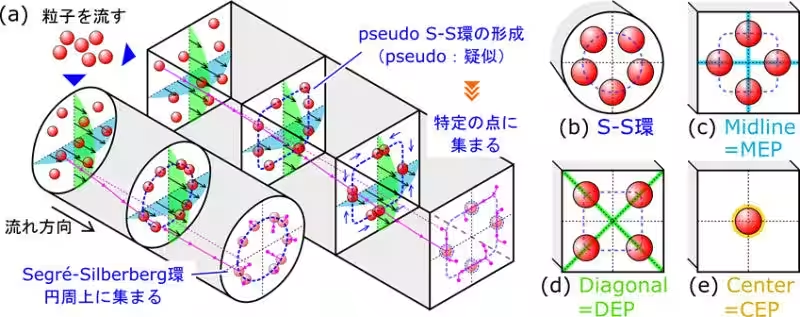
The study found that while traditional research has focused primarily on rigid particles in microfluidic channels, the behavior of soft particles, such as those mimicking biological cells, hasn't been fully understood. Prior predictions using numerical calculations lacked experimental validation until now. The researchers have developed a technique to create soft hydrogel particles that approximate cellular behavior, allowing them to experimentally verify the gathering behaviors of these particles.
Using the powerful Fugaku supercomputer, large-scale numerical simulations were conducted alongside the new theoretical framework to uncover the mechanisms behind the changing gathering patterns in microchannels. Notably, the findings showed that while rigid particles tend to cluster near the walls of the channel, soft hydrogel particles preferentially gather at the center or along the diagonal of the channel cross-section.
Mechanisms Behind the Changes
The researchers constructed a phase diagram based on Reynolds number and capillary number, identifying the conditions under which dramatic shifts in gathering patterns occur, termed 'phase transitions'. This study not only deepens our understanding of fluid dynamics but also opens new avenues for technological advancements in fluid-based devices.
Implications for Future Applications
The practical applications of these findings are substantial. By utilizing the deformability of cells and particles in liquids, the research paves the way for the development of next-generation microfluidic devices. This could lead to highly efficient cell selection technologies for early cancer detection and other biomedical uses, highlighting the potential impact in medical engineering fields.
In a comment from Yuuma Hirohata, a PhD student involved in the study, he expressed the challenges faced in simulations due to the complexity of forces acting on the particles, which required extensive computational time even with Fugaku. Hirohata notes the satisfaction in being able to express complex fluid phenomena through a unified theory, as well as the potential societal benefits that may arise from this innovative particle selection method.
This research was supported by grants from the Japan Society for the Promotion of Science and the Japan Agency for Medical Research and Development, among others, showcasing a strong collaborative effort in advancing scientific knowledge. The article, titled “Experimental and numerical study on the inertial migration of hydrogel particles suspended in square channel flows,” was released online on September 18, 2025.
The collaborative group's dedication to unraveling the interactions within microfluidic systems continues to contribute to both scientific literature and practical applications, underscoring the importance of advanced computational resources like Fugaku in modern research.
For more details, you can access the press release here.




Topics Health)
【About Using Articles】
You can freely use the title and article content by linking to the page where the article is posted.
※ Images cannot be used.
【About Links】
Links are free to use.