



Japan’s Views on Corporate Sustainability: A Call for Action
Understanding Japanese Perspectives on Corporate Sustainability
Getty Images, one of the world’s leading stock photo platforms, has unveiled significant insights regarding sustainability and climate change perceptions in Japan through its VisualGPS research. This comprehensive survey, conducted in collaboration with MarketCast, analyzed the views of over 10,000 consumers and experts across 26 countries, providing a crucial look at how Japanese citizens perceive the role of corporations in sustainability.
The Role of Corporations in Sustainability
The Sustainable Development Goals (SDGs), adopted by the United Nations in 2015, have become a guiding principle for countries striving towards sustainability. However, Japan's progress has reportedly stagnated since 2017, with the country projected to rank 19th globally in SDG achievement by 2025. The VisualGPS findings reveal that 75% of Japanese respondents believe climate change directly impacts their lives, a figure surpassing the 69% global average.
Despite this concern, a striking 80% of Japanese citizens express that they feel insufficient actions are being undertaken to combat climate change. This sentiment clearly highlights a growing call for corporate leadership in sustainability initiatives.
Consumer Expectations from Corporations
When asked about who should lead sustainability efforts, 81% of Japanese respondents stated that if the government does not take action, corporations should step up. This expectation is higher than the global average of 75%. Yet, there remains a significant gap: nearly 40% of those surveyed believe that companies are not making any substantial efforts towards sustainability.
In the context of these findings, many corporations appear hesitant to convey their sustainability initiatives effectively, a trend referred to as “Greenhushing.” This highlights a disconnect between consumer expectations and corporate communication practices.
Visual Communication in Sustainability
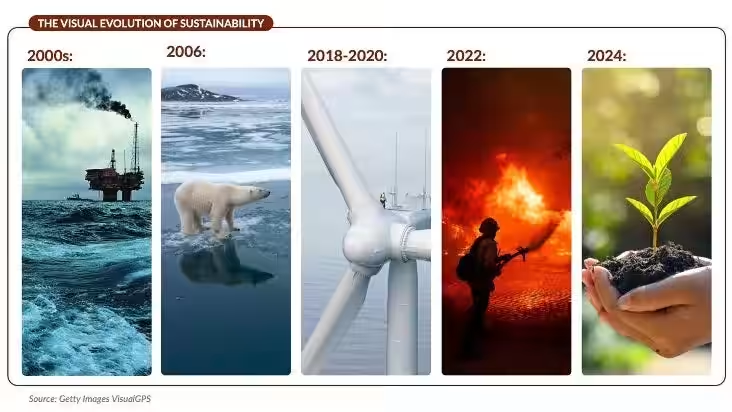
Effective visual communication is essential for corporations to relay their sustainability measures to consumers. The report outlines notable trends in how businesses visually depict their sustainability efforts. For example, imagery has evolved from symbolic representations, such as polar bears in 2006, to more realistic depictions of climate-related disasters between 2018 and 2022. Recently, there has been a shift towards more conceptual visuals rather than straightforward representations.
Notably, visuals that indicate sustainability efforts from Japanese companies are a mere 9%, which is significantly lower compared to global standards. While many visuals often depict beautiful landscapes or abstract concepts, there has been an increase in images showing people enjoying nature over the past year. This shift serves to remind viewers of the nature that could be lost to climate change.
However, visuals directly addressing climate change remain below 2%, leaving many Japanese citizens dissatisfied. They seek more “honest and realistic” representations of sustainability actions, firmly believing that even small, transparent initiatives can inspire meaningful change.
The Importance of Storytelling
Trust is born from companies sharing both their successes and challenges in a transparent manner. Engaging storytelling that captures both the positive and negative aspects of sustainability efforts fosters loyalty and favorable perceptions of brands. For brands, narrating a “true story” about their sustainability journey is not just ethical; it also enhances engagement and loyalty from consumers.
Five Key Strategies for Visualizing Sustainability
The report distills five vital strategies for corporations aiming to communicate sustainability effectively through visuals:
1. Authenticity over Perfection: Transparency and authenticity build trust. Brands that candidly share both their accomplishments and challenges are more likely to gain support from consumers.
2. Balance Between Environmental Anxiety and Optimism: Combining a sense of urgency about climate change with a message of feasible positive action motivates consumers.
3. Highlighting Green Tech Potential: Showcasing real examples of green technology solutions inspires hope and trust in consumers while making climate action relatable.
4. Promoting Sustainable Practices: Communicating simple, actionable steps, such as reducing food waste or choosing eco-friendly products, can encourage consumer participation in sustainability.
5. Integrated Approach: Brands that embed sustainability into their products, services, and overall communication create deeper emotional connections with consumers.
Conclusion
As climate risks increasingly correlate with business risks, the report underscores the necessity for marketers, brand managers, and PR professionals to construct visual messages that align with their sustainability strategies. The full report, titled "Sustainability at the Crossroads," is available for download on Getty Images' VisualGPS page.
In summary, the survey’s insights reveal a critical perspective among Japanese consumers regarding corporate responsibility in sustainability. They highlight not only the demand for tangible actions but also for honest communication that fosters trust and strengthens brand loyalty. As the sustainability landscape evolves, staying aligned with consumer expectations will be vital for corporate success in Japan.











Topics Consumer Products & Retail)
【About Using Articles】
You can freely use the title and article content by linking to the page where the article is posted.
※ Images cannot be used.
【About Links】
Links are free to use.