



Innovative Drone and AI Project for Sewer Inspection by Nissui Con and Partners
Nissui Con’s Innovative Sewer Inspection Project
In a groundbreaking initiative, Nissui Con, alongside partners Liberaware, Kansei Kogyo, and Acuity, with support from Chiba City, has been selected for the Ministry of Land, Infrastructure, Transport, and Tourism's AB-Cross Project for the fiscal year 2023. This scheme aims to transform sewer inspection processes through the integration of drone technology and artificial intelligence (AI). By creating a comprehensive inspection method, the project seeks to modernize traditional practices reliant on manual labor, enhancing both efficiency and sustainability in infrastructure management.
Project Overview
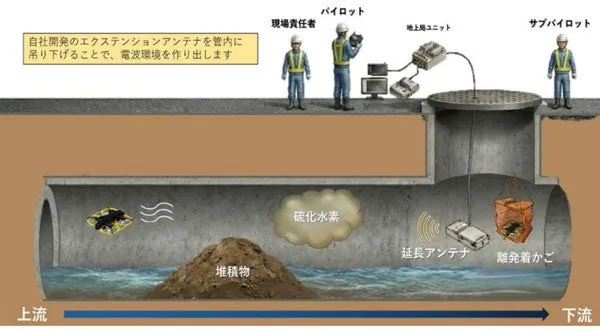
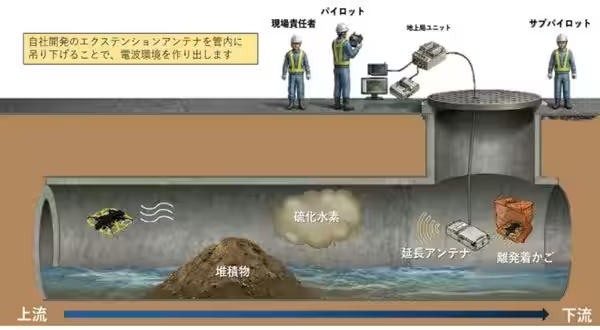
The proposed project combines advanced capabilities of drones specifically designed for navigating narrow spaces and high-water environments within sewage systems. Utilizing high-resolution cameras and AI analysis, this initiative aims to move beyond qualitative assessments of decay and achieve a new standard of precision and efficiency in sewer inspections.
By enhancing drone capabilities such as flight distance and environmental resilience, the project intends to expand its application to long-distance pipelines and difficult-to-survey sections. This enhancement will significantly improve the management and maintenance of sewer infrastructure, contributing to the establishment of a sustainable and safe inspection system.
Background and Challenges
Inspection of sewer pipes using drones is increasingly recognized as a vital technology, especially regarding safety and access to hard-to-reach areas. Currently, drone-based inspections predominantly focus on visual data collection, which limits the ability to gauge precise metrics such as crack width and degradation progression. This project addresses these limitations by developing quantitative diagnostics and enhancing the accuracy of locating issues.
Project Objectives
The primary goal of this project is to advance sewer inspection methodologies towards a No Entry standard, which entails complete automation and labor reduction. The core of this initiative relies on the indoor inspection drone, termed "IBIS2," coupled with AI technology to facilitate quantitative crack measurement and self-positioning capabilities. This focus aims to broaden the applicability of drone inspections to more challenging areas while improving diagnostic accuracy.
Implementation Phases
The project will proceed in two major phases:
Phase 1
In the first phase, the team will assess the current performance metrics of the IBIS2 drone, including flight stability, endurance, video quality, and positioning precision within real sewage pipelines in Chiba City. By identifying technological constraints, they seek to clarify the aspects that need improvement.
Phase 2
Building on the findings from Phase 1, enhancements will be made to the drone's design, control systems, imaging, and analytical capabilities. A second round of testing will take place under similar conditions to evaluate improvements.
Collaborative Structure
The project involves a collaborative effort among various stakeholders:
- - Liberaware (Chiba City HQ): Project management, and drone evaluation.
- - Kansei Kogyo (Setagaya, Tokyo): Field operation design and proof-of-concept management.
- - Nissui Con (Shinjuku, Tokyo): Research operations support and assessment of dissemination strategies.
- - Acuity (Minato, Tokyo): Development and validation of AI-based imaging diagnostic models.
- - Chiba City: Provides field access for the project.
Each partner brings unique expertise to ensure the project's success, focusing on evaluating and improving the platform's imaging systems and diagnostic methodologies.
Commitment to Sustainable Water Infrastructure
Nissui Con aims to leverage its extensive knowledge in the planning, design, and maintenance of water infrastructure to spearhead this innovative project. By harnessing AI for deterioration diagnosis and image analysis, the team not only aims to enhance pipeline health evaluations but also to support preventive maintenance strategies effectively.
This initiative represents a significant step towards achieving sustainable management of water infrastructure. It positions the involved parties at the forefront of technological advancement, facilitating a healthier, more sustainable society through innovative water management solutions.
Conclusion
With the execution of this groundbreaking project, Nissui Con and its partners are not just adopting technology but are redefining the standards of sewer maintenance. As this project unfolds, it promises to enhance the future of infrastructure management in Japan significantly, ensuring public safety and environmental sustainability.
Topics Consumer Technology)
【About Using Articles】
You can freely use the title and article content by linking to the page where the article is posted.
※ Images cannot be used.
【About Links】
Links are free to use.