



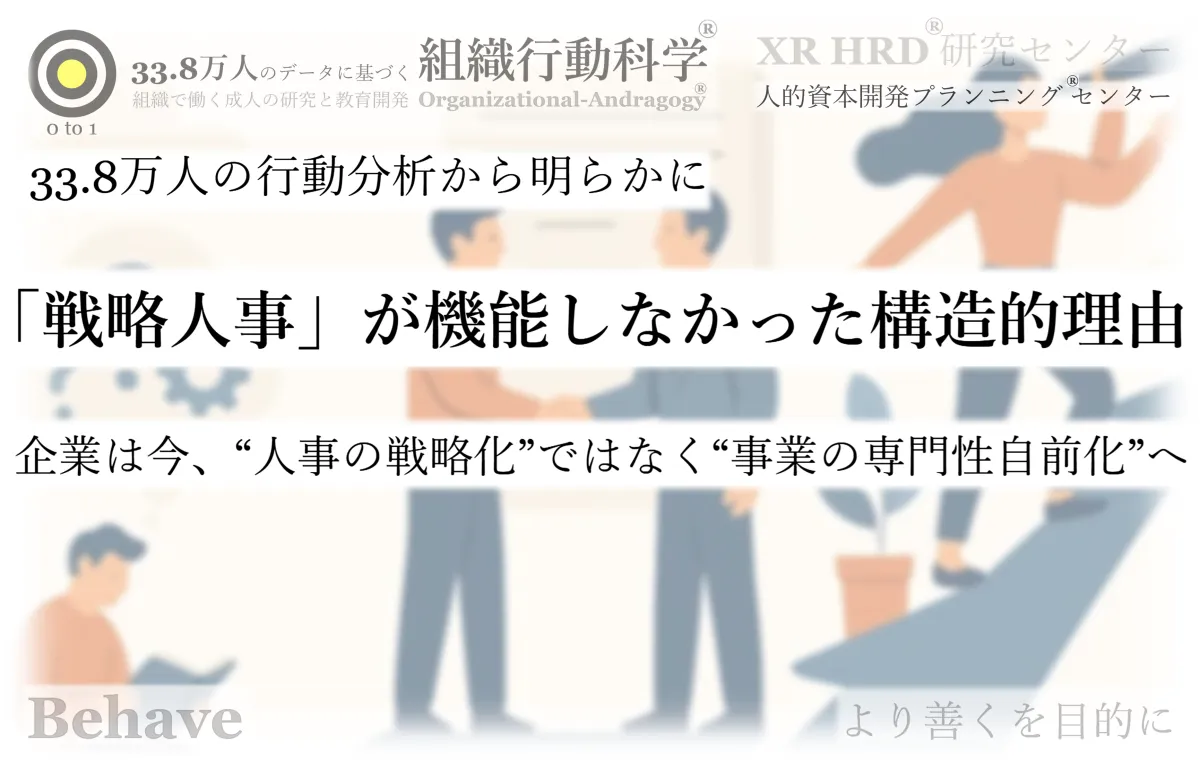
Unveiling the Structural Reasons Behind the Limitations of Strategic HR
Understanding the Limitations of Strategic HR
Recent findings from Request Inc., headquartered in Shinjuku, Tokyo, have brought to light significant insights regarding the effectiveness of Strategic HR practices in modern organizations. Based on behavioral data from 338,000 employees across 980 companies, their new report titled "Limitations of Strategic HR - Addressing Specialized Functions Beyond HR" explores why the much-touted concept of Strategic HR has often failed to bring about the desired outcomes.
The Promising Beginnings of Strategic HR
During the 2000s, the idea of Strategic HR gained prominence, suggesting that HR should act as a partner in management processes. This led to the adoption of various systems and methodologies in many organizations, aimed at aligning human resource functions with business goals. However, as the report indicates, despite these efforts, major challenges arose that hindered the effectiveness of these initiatives.
Persistent Challenges in Implementation
1. Lack of Development in Specialized Knowledge: Even with the appointment of Chief Human Resources Officers (CHROs), companies often found that their specialized business knowledge was not being cultivated effectively.
2. Stopping at Metrics: The approach to managing human capital often stagnated at merely creating performance metrics, failing to translate these indicators into actionable behaviors on the ground.
3. Inadequate Job Description Refinement: There was a noticeable inability to reflect the value creation processes in job descriptions, which limited the effectiveness of performance evaluations.
These ongoing issues have resulted in the realization that the anticipated benefits of Strategic HR have not been fully realized.
Structural Limitations of HR Departments
The report identifies a fundamental structural limitation of HR departments: their inability to assume specialized functions inherent to specific business areas. With the stabilization of work patterns and a focus on reforming work practices, it is now clear that the objective should not be the "strategization" of HR. Instead, organizations must focus on developing their own specialized functions and cultivating value creation mechanisms through practical experience.
Advancing the Discussion: Linking Competitive Position with Human Capital
In the latter part of the report, frameworks for redefining human capital requirements according to a company’s competitive position—be it as a Leader, Challenger, Follower, or Nicher—are introduced. Furthermore, a new collaborative model called “Strategic Fit Human Capital” is suggested, where the HR department crafts the framework while the business units provide the substance.
Free Access to Valuable Insights
This report is designed for corporate executives, HR leaders, and those responsible for talent development within organizations. It aims to assist in the reconstruction of human capital management strategies. As an open resource, interested parties can access it for free.
About Request Inc.
Request Inc., founded with the mission to "Strive for Better," leverages the principles of organizational behavioral science to support businesses across Japan. Backed by research from seven institutes, they analyze why and how workplace behaviors occur, providing insights through five theoretical domains: behavioral control, motivation-reward, relationship building, cognitive thinking, and habit formation, thus offering organizations tools for improvement.
Company Overview
- - Company Name: Request Inc.
- - Location: 4F Keio Frente Shinjuku, 3-4-8 Shinjuku, Tokyo 160-0022
- - Corporate Site: Request Group
- - Leadership Profile: Profile
- - Company Introduction Download: Download

Topics Business Technology)
【About Using Articles】
You can freely use the title and article content by linking to the page where the article is posted.
※ Images cannot be used.
【About Links】
Links are free to use.