



Exploring Clinical Organizational Science and Lewin's Field Theory for Structural Interventions
Understanding Clinical Organizational Science (COS) and Lewin's Field Theory
Clinical Organizational Science (COS) integrates complex systems science, neuroscience, and organizational psychology to actively reproduce interaction structures that maintain an organization's stability. The new publication titled Clinical Organizational Science: An Integrative Framework for Structural Intervention in Complex Organizations, by Makoto Yamanaka, CEO of DroR, offers fresh insights into how COS redefines behavior change as a problem of interaction design rather than solely individual transformation.
The Foundation of the Research
COS is designed as a framework that allows researchers and practitioners to observe and intervene in the "invisible interaction structures" within organizations. The recent study published in the Frontiers in Psychology highlights its novel approach through a detailed examination of connected theories and practices. The emphasis is placed on how COS connects with Lewin’s Field Theory, providing a clear pathway from theoretical understanding to practical application.
In this overview, we will address how COS challenges existing theories, extends their reach, and proposes verifiable inquiries into organizational behavior. This release serves as part of a series that spans from May 7 to June 5, aimed at elucidating the fundamental concepts and implications of Clinical Organizational Science.
The Fixed Definition of COS
The concept of Clinical Organizational Science merges various fields — complex systems science, neuroscience, organizational psychology, and behavioral science — into a cohesive framework aimed at interventions within organizational structures. Unlike traditional views that see organizational change merely as individual behavioral adjustment, COS asserts that changes occur through the transition of organizational attractors using core techniques such as Field Gradient Theory, Loop Conversion Design, and Neural Base Design. To connect individual habits with wider organizational changes, COS introduces the concept of the emergence bridge.
Insights from Lewin's Field Theory
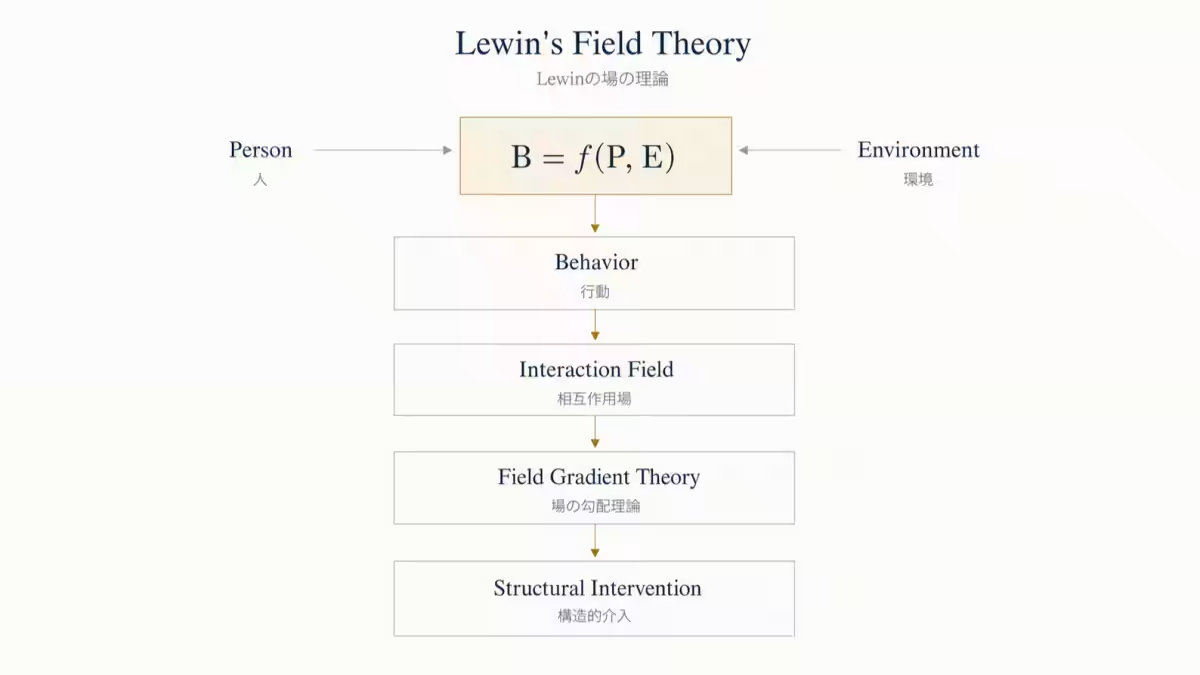
Kurt Lewin’s field theory postulates behavior (B) as a function (f) of the person (P) and the environment (E), where B = f(P, E). This idea is a cornerstone of COS, as it emphasizes that focusing solely on individual consciousness and attitudes in organizational transformations limits the effectiveness of interventions to conventional methods like training and goal setting.
If behavior emerges from the interaction field, the scope of intervention must extend beyond individual actions; it should encompass the very structure of interactions that precipitate behaviors. This means examining the environment in which behaviors occur, which is what COS strives to achieve.
Understanding the Field in COS
In COS, the field is more than just a benign atmosphere; it encompasses the intricate web of conditions that lead to specific behaviors. This includes considerations of meeting structures, protocols for responses, feedback styles, and the organizational rhythms that govern daily, weekly, and monthly operations. Without altering these structures, even if individuals exhibit new behaviors temporarily, organizations often revert to their previous attractors. COS integrates the principles of Lewin’s field theory within a perspective of organizations as complex adaptive systems, which enables a more effective strategy for intervention.
Connecting to Field Gradient Theory
Field Gradient Theory operates within COS to manipulate Lewin's field theory effectively. By introducing asymmetry into existing interaction fields, such as through configurations like 2-on-1 setups, COS seeks to increase the probabilities of transitioning organizational attractors. However, it is crucial to clarify that this approach does not enforce specific behaviors but rather alters the structural conditions that facilitate certain reactions while inhibiting others.
The Importance of Psychological Safety
A critical aspect highlighted by COS is that changing the field does not always guarantee positive outcomes. If the foundational elements of psychological safety and trust are absent, implementing a 2-on-1 structure can be perceived as coercive pressure rather than a constructive influence. In such cases, rather than weakening existing attractors, they may become even more entrenched.
Thus, COS supports a foundational layer of Neural Base Design, which incorporates practices of trust, confirmation responses, gratitude expressions, and physical check-ins to ensure that Field Gradient Theory can function as intended.
COS: Inheriting and Expanding upon Lewin’s Concepts
The relationship between Lewin’s Field Theory and COS can be summarized as follows:
| Perspective | Lewin's Field Theory | COS Expansion |
|---|---|---|
| ------ | ---------- | ---------- |
| Behavior Perspective | Behavior is a function of person and environment | Behavior is reproduced through interaction structures and attractors |
| Intervention Focus | Field and environment | Meeting structures, response norms, feedback loops, organizational rhythms |
| Methodology | Back and forth between theory and practice | Clinical embedding through BPO and structural intervention |
| Verification Question | Does field change behavior? | Does field gradient increase attractor transition probabilities? |
Commentary from CEO Makoto Yamanaka
"COS places significant emphasis on Lewin's notion of B = f(P, E). Before trying to change individuals, we must first understand the field from which behaviors arise. This is a constant realization when engaging with organizations in practice." Yamanaka describes the Field Gradient Theory as a modern re-articulation of classical insights into structural intervention within today’s organizations, emphasizing that the effectiveness of such interventions is still an area that requires verification.
Positioning of This Release
This publication constitutes a Conceptual Analysis, presenting theoretical propositions for COS rather than asserting completed effectiveness evaluations. It aims to integrate previously disconnected scientific insights into a framework conceptualizing organizational change as a structural intervention dilemma while suggesting topics for future testing and refutation.
Thus, connections to existing theories in this series do not claim that COS replaces established frameworks but rather repositions current knowledge in psychology, organizational routines, and behavioral sciences from the viewpoint of structural interventions.
Looking Ahead
Stay tuned for the next article to be released on May 22, at 10 AM, titled “Clinical Organizational Science and Kauffman’s Theory of Complex Adaptive Systems - Reconceiving Organizational Change as Attractor Transition.” In this, COS will further explore the theoretical foundations that underpin its take on organizations as complex adaptive systems with attractors.
About the Published Study
The paper titled Clinical Organizational Science: An Integrative Framework for Structural Intervention in Complex Organizations has been featured in the Organizational Psychology section of the Frontiers in Psychology, recognized as an international peer-reviewed journal, published as a Conceptual Analysis. You can access it here.
Topics Business Technology)

【About Using Articles】
You can freely use the title and article content by linking to the page where the article is posted.
※ Images cannot be used.
【About Links】
Links are free to use.