



Innovative Research Unveils the Science Behind Mattress Performance and Sleep Quality
Unveiling the Science of Sleep: Mattress Research Insights
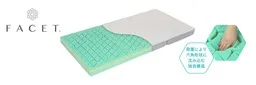
In a groundbreaking study presented at the 67th Congress of the Japanese Society of Ergonomics, Inoac Corporation collaborated with professors from Ritsumeikan University to explore the intricate relationship between mattress design and sleep quality. By assessing the effectiveness of their flagship product, the "FACET" mattress with hexagonal slit technology, the research aims to ground the popular belief of what constitutes a good night’s sleep in empirical data.
The Relationship Between Mattress Resistance and Ease of Turning
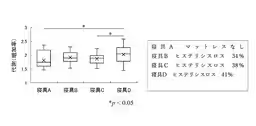
High-resilience mattresses have long been touted for their ease of movement during sleep. However, to date, this assertion lacked objective evaluation. The study aimed to analyze how mattress features influence the ease of turning over at night. Using three types of mattresses, each differing in hysteresis loss and featuring and not featuring the hexagonal slits, participants repeatedly performed rolling movements. The research quantitatively measured the metabolic costs associated with these motions, providing new insights.
Hysteresis loss refers to the energy lost when a material is compressed and does not return the same amount of energy when released. The research found that high-resilience materials with minimal hysteresis loss exerted less physical burden on the body during rolling, confirming the experiential understanding within the bedding development industry.
This research provides a solid foundation to the claim that high-resilience mattresses facilitate easier turnover, validating prior assumptions with scientific rigor.
Visualizing Sleep Body Movements: Impact of Mattress Structure
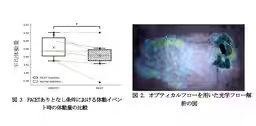
Adjustments made during sleep, including turning over and posture modification, are crucial for alleviating body strain. The study employed optical flow analysis to assess how the hexagonal slits affect movements during sleep without the need for cumbersome sensors on participants' bodies.
Traditionally, assessments of bodily movement during sleep required either wearable devices or sensors placed beneath mattresses, methods that inadvertently disrupt sleep patterns. The findings suggest that optical flow analysis could be an effective and non-invasive method to assess body movements in space during sleep.
The study revealed that while the frequency of movements did not significantly differ with or without the hexagonal slits, the overall motion volume was considerably lower when slits were present. This indicates that the mattress design aids body fitting and requires smaller movements for posture adjustments.
Evaluating the Impact of Mattress Structures on Post-Sleep Condition
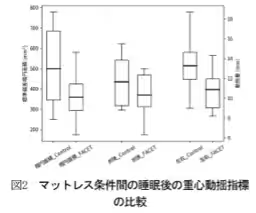
Previous evaluations of mattresses predominantly focused on sleep comfort. This study shifted the lens to how mattress differences affect post-sleep recovery and alertness levels in individuals. Using the Center of Pressure (COP) sway test and the Psychomotor Vigilance Test (PVT), the research examined the state of recovery in body balance and alertness after waking up.
Results indicated that participants remained more balanced upon waking when using the hexagonal slit mattresses, suggesting enhanced stability in postural control. These findings establish that mattress construction affects not only in-sleep bodily movements but also the recovery of physical functions after waking.
A New Paradigm for Mattress Evaluation
Historically, mattress evaluations focused on subjective measures of comfort, but this research pioneers a holistic approach by examining the interconnectedness of turning ease, bodily movements during sleep, and wake-up conditions. It demonstrates that mattress structure significantly impacts human physiology.
Inoac Corporation is committed to advancing objective and reproducible bedding development through continued partnerships with universities and research institutions. By integrating human structure, sleep dynamics, and material characteristics, Inoac aims to reshape our understanding of sleep quality and mattress efficacy.
Overview of the 67th Congress of the Japanese Society of Ergonomics
Event Date: May 23-24, 2026
Location: Takiko Campus, Nagoya City University
Presentations:
1. "Objective Evaluation Method of Bedding Focused on Ease of Rolling Over"
2. "Evaluation of Body Movements During Sleep Using Optical Flow Analysis and the Impact of Mattress Structure"
3. "Effects of Mattress Differences on Post-Sleep Physical Functioning and Alertness"
Company Overview
Inoac Corporation, headquartered in Nagoya, is a leader in the manufacturing sector, specializing in polyurethane foam, rubber, plastics, and composite materials. With decades of experience in polymer chemistry, the company develops high-performance materials tailored for diverse industries, from automotive to everyday consumer products.
Official website

Topics Consumer Products & Retail)
【About Using Articles】
You can freely use the title and article content by linking to the page where the article is posted.
※ Images cannot be used.
【About Links】
Links are free to use.