



FANCL Develops Enhanced Moisturizing Nano Capsules with Liquid Crystal Niosomes
FANCL's Breakthrough in Skincare Technology
FANCL Corporation has successfully innovated in the realm of skincare by developing a novel type of nano capsule known as liquid crystal niosomes. The primary aim of this research is to enhance the moisturizing effects of skincare products, particularly through the integration of human-type ceramides. With a focus on stability, FANCL has already incorporated high-moisture human-type ceramides into niosomes, which are a specialized type of nano capsule. Building upon this foundation, they utilized a unique crystallization process to combine human-type ceramides with liquid crystals, resulting in a newly developed product that boasts superior moisture retention compared to previous ceramide-only niosomes.
This groundbreaking research was presented at the 63rd Annual Meeting of the Japan Oil Chemistry Society held in Nagano in September 2025.
The Composition and Structure of Liquid Crystal Niosomes
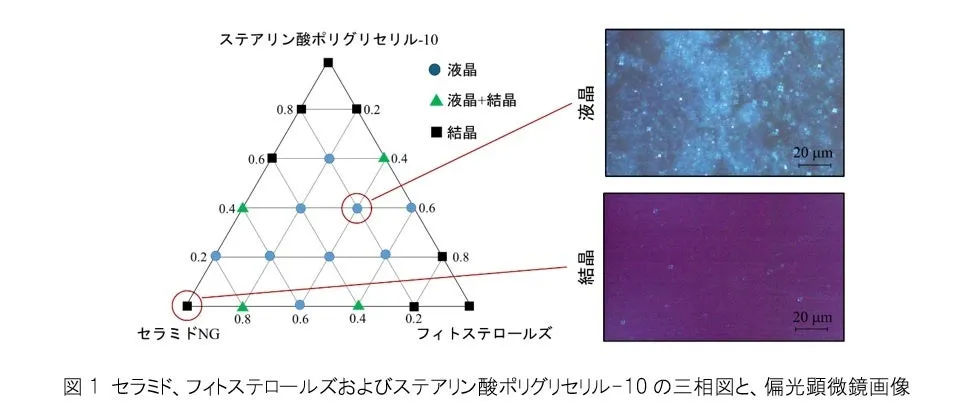
To achieve the optimal mixture for creating liquid crystal compositions, specific ratios of human-type ceramides, phytosterols, and polyglycerol stearate were combined. Using a polarized microscope, researchers were able to confirm the formation conditions of the "liquid crystal" state. It was clearly established that, at certain ratios, liquid crystal formation occurred, while other ratios resulted in a mixture of crystal and liquid crystal states.
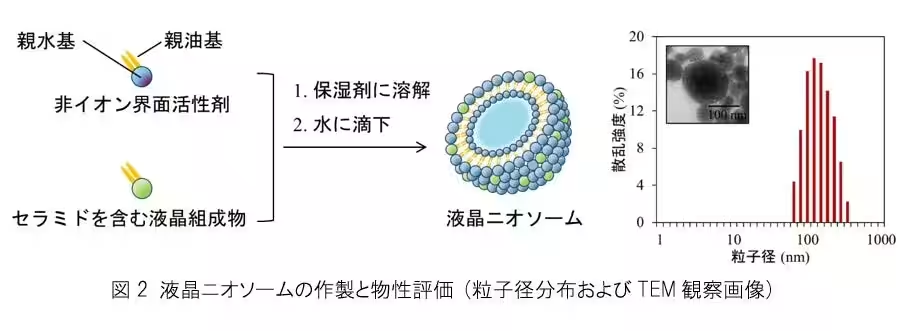
The newly developed liquid crystal niosomes were characterized as spherical with approximately 150 nm in diameter. Testing revealed that over a temperature range of 20 to 40 degrees Celsius, their membrane exhibited greater flexibility compared to conventional ceramide niosomes.
Observing Changes Under Skin-Like Conditions
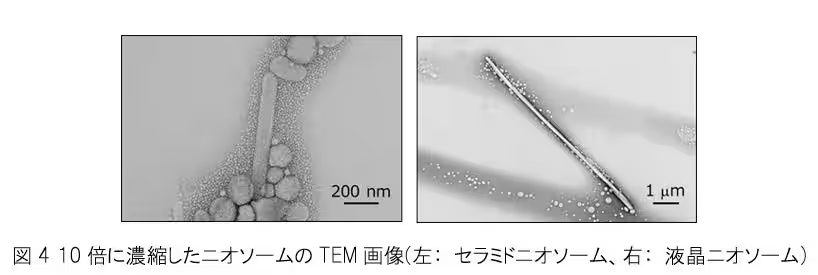
Under conditions that simulated moisture evaporation from the skin, the liquid crystal niosomes transformed into a significant fibrous structure. In contrast, traditional ceramide niosomes maintained their spherical or rod-like shapes.
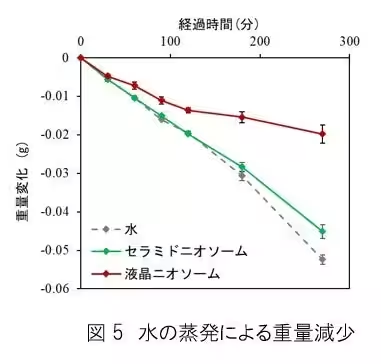
Water permeability tests using membrane filters demonstrated that the application of liquid crystal niosomes markedly reduced moisture evaporation. This significant transformation into a fibrous structure not only aids in moisture retention but also enhances the skin's barrier functions.
Addressing Previous Challenges with Ceramides
Historically, ceramides are known to possess a high degree of crystallinity, leading to stiffer membrane structures that are less effective when applied to the skin. The goal of incorporating them into niosomes in a liquid crystalline form is to maintain the necessary flexibility to optimize their moisturizing effect. The study aimed to develop liquid crystal niosomes that could deliver these benefits more effectively.
Research Methodology and Findings
Understanding the Ratio for Liquid Crystal Formation
In creating liquid crystal compositions containing human-type ceramides, various ratios of ceramides, phytosterols, and polyglycerol stearate were mixed and observed under polarized microscopy. Results revealed that at specific ratios, liquid crystal structures were formed, indicating a successful approach to designing the desired product.
Fabrication of Liquid Crystal Niosomes
To fabricate the niosomes, non-ionic surfactants were dissolved in moisturizing agents followed by the addition of water. During the creation of the niosome membrane, when the liquid crystal composition was included, it infused into the membrane, leading to the formation of liquid crystal niosomes. Electron microscopy confirmed that these niosomes had a spherical morphology about 150 nm in size.
Evaluating Membrane Properties
The research investigated the membrane properties of liquid crystal niosomes versus traditional ceramide-only niosomes. Employing fluorescence measurements, various temperature ranges were examined to evaluate membrane fluidity. Increased membrane fluidity, as indicated by lower fluorescence anisotropy values, was observed consistently for liquid crystal niosomes across various temperatures, demonstrating their advantageous structural characteristics.
Changes Under Concentration
Further investigations examined the microstructural changes when liquid crystal niosomes and ceramide niosomes were concentrated tenfold, simulating conditions similar to those found on skin when moisture evaporates after application. While ceramide niosomes maintained their nano-sized spherical structures, liquid crystal niosomes transformed into extensive fibrous structures, suggesting membrane fusion under concentrated conditions.
Examining Moisture Permeation Suppression
To verify liquid crystal niosome functionality, tests on moisture permeation through membrane filters were conducted. The study compared liquid crystal niosomes, ceramide niosomes, and water treatments in a sealed setup to observe water evaporation. Results showed that while the water-treated filters exhibited no moisture retention, the liquid crystal niosomes significantly inhibited evaporation, likely due to the fibrous structures forming a barrier to moisture loss.
Anticipating Future Impacts
The findings highlight the potential of liquid crystal niosomes to not only maintain moisture retention but also to enhance skin barrier function when applied. FANCL's innovative approach to incorporating liquid crystal technology into niosomes presents a promising advancement in skincare, paving the way for more effective moisturizers that leverage the benefits of human-type ceramides.
Conclusion
FANCL's commitment to researching and developing stable and effective moisturizing agents has led to the creation of liquid crystal niosomes, setting a new standard in the skincare industry. With their enhanced functionality, these niosomes represent a significant leap forward in delivering lasting hydration and supporting the skin's natural barrier.
Topics Consumer Products & Retail)
【About Using Articles】
You can freely use the title and article content by linking to the page where the article is posted.
※ Images cannot be used.
【About Links】
Links are free to use.