



Identifying Reasons for Stalled AI Adoption in Construction Companies
Understanding AI Implementation Challenges in Construction
In the fast-evolving landscape of the construction industry, integrating artificial intelligence (AI) has become crucial. Yet, many companies find themselves facing hurdles that impede progress. Shikumi Inc., a leading consultancy based in Shibuya, Tokyo, has released a comprehensive report titled "Five Common Patterns and Solutions for AI Adoption in Construction Companies," now available for free download. This document delves into the typical patterns that halt AI adoption and offers practical strategies to overcome these obstacles.
The Need for Effective AI Adoption Strategies
Construction sites often echo similar sentiments:
My day ends with organizing daily reports and photos.
Estimating costs consumes my entire evening.
Knowledge about optimal procedures seems confined to veteran staff.
Despite a labor shortage, hiring remains challenging.
Even when AI tools are procured and accounts are set up for everyone, reports indicate that three months later, often only a handful of employees are utilizing the tools for minor tasks like research or editing, while the majority continue relying on traditional workflows and individual skills. Conversely, some companies radically shift their operations within the same timeframe, redesigning workflows where AI aids in daily reporting and document processing, creating a state where tasks can be handled efficiently by anyone.
The differentiation between success and stagnation hinges not on tool capabilities but rather on three critical design aspects:
1. Task Decomposition: Deciding which processes should be automated by AI.
2. Verification Rules Design: Establishing who reviews what critical components to prevent mistakes.
3. Establishment of Retention Mechanisms: Ensuring operations remain consistent even during peak times.
These essential factors are often overlooked when adopting SaaS solutions leading to a stop in effectively implementing AI. The report aims to clarify these design considerations at a practical level.
Key Insights from the Report
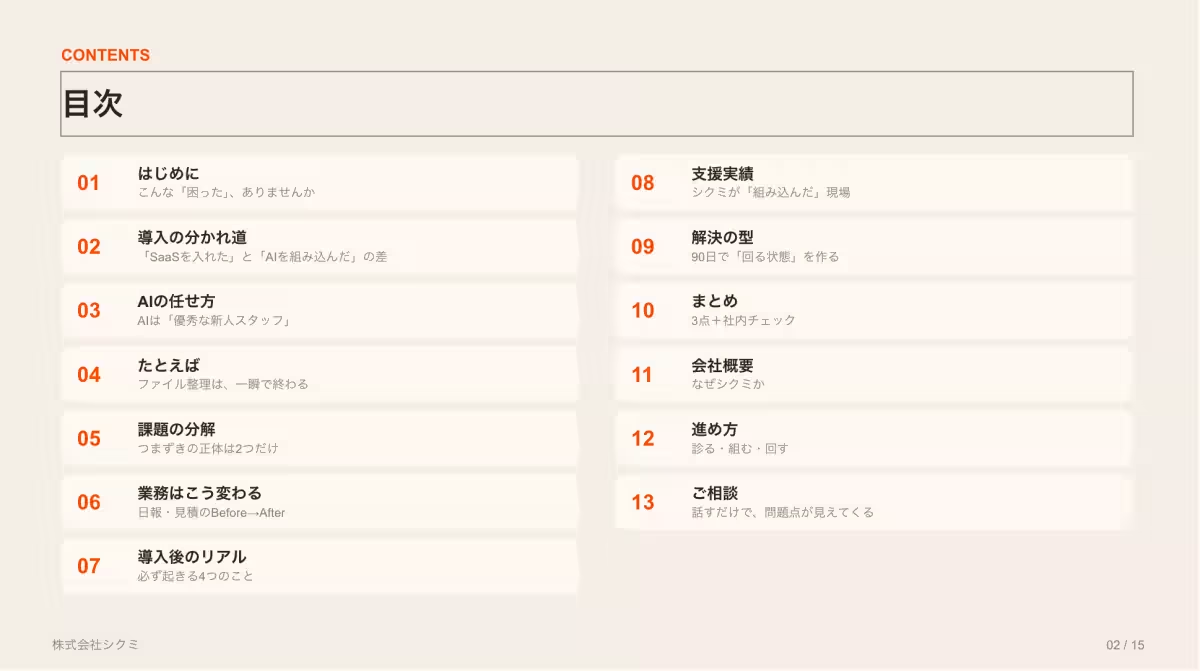
1. Two Root Causes of Failures:
The five common failure patterns boil down to two fundamental mistakes: "Starting from the Wrong Place" and "Failing to Establish a Continuation Framework." The report streamlines the understanding of these failures, pairing them with effective avoidance strategies.
2. AI as an Efficient New Employee:
It categorizes construction tasks into three types for AI implementation:
- Fully Automated Tasks: Tasks like drafting daily reports, organizing construction photos, and communication with subcontractors.
- Human-Finalized Tasks: Initial drafting of estimates, safety documentation, and client communication that require human input for finishing.
- Decision-Making Tasks: Complex duties that necessitate human judgment, like project scheduling and client negotiations.
This categorization helps companies identify which tasks to prioritize for AI delegation.
3. Before and After Transformation:
It contrasts traditional workflows with AI-enhanced processes. For instance, the shift from cumbersome daily report preparation involves transforming the method from writing memos post-visit to sending real-time photos, with AI sorting and drafting them for review. Similar transformations are outlined for generating estimates, showcasing a clear division between automated and manual responsibilities.
4. Anticipating Post-Implementation Issues:
Common pitfalls are discussed, such as an increase in time spent correcting AI outputs in the second week, discrepancies in tool usage between employees in the first month, accuracy plateaus noted in the second month, and accumulating exceptions by the third month. This section outlines strategies to navigate these challenges throughout the timeline.
5. A 90-Day Roadmap:
The report provides a structured approach for achieving a self-sufficient operational state within 90 days, guiding companies through phases of observation, assembly, testing, and operational management, offering tangible outputs for each stage.
Previous Success Stories
Shikumi Inc. has successfully assisted companies in reducing research-related tasks from several hours to just about ten minutes daily. By implementing a systematic approach that allows AI to gather information based on predefined criteria, employees transitioned from reviewing all entries to making final decisions. There’s also an example of automating paper document sorting to eliminate time lost searching for files.
These examples highlight how effective AI implementation can radically improve operations, although results may vary based on specific tasks and data conditions.
Who Should Read This Report?
This report is highly recommended for individuals and organizations who:
Are unsure of where to start with AI implementation.
Face issues with adopted tools failing to produce results.
Have knowledge bottlenecks tied to specific staff members.
Experience labor shortages coupled with hiring challenges.
By reading this document, you will identify actionable steps to begin transforming your operations through AI adoption.
Topics Other)
【About Using Articles】
You can freely use the title and article content by linking to the page where the article is posted.
※ Images cannot be used.
【About Links】
Links are free to use.