



Unveiling Cellular Mechanisms for Stress Response and Gene Activation Under Environmental Strain
Understanding the Mechanisms of Cellular Stress Response
In the ever-changing environment, living organisms exhibit adaptive evolution, particularly at the cellular level. Cells actively communicate and respond to external cues such as stressors by appropriately activating genes essential for survival and function. The process of gene activation involves transcription factors—proteins that bind to the upstream regions of genes to initiate transcription, which copies the DNA blueprint into RNA for protein synthesis.
Recent research led by Professor Kouji Hirota's lab at Tokyo Metropolitan University has made significant strides in elucidating how cells distinguish the type of environmental stress and activate the appropriate gene response mechanisms. The study focuses on the fission yeast's fbp1 gene, which is specifically activated in response to glucose starvation stress, providing a model for understanding the intricate processes involved in gene regulation.
The Research Background
The transmission of signals from external stimuli to gene activation within cells is facilitated through receptor proteins in the cell membrane. These signals eventually lead to the activation of transcription factors. Crucially, the structure of chromatin plays an essential role in this process. For transcription to occur, chromatin must relax, allowing transcription factors easier access to DNA.
Professor Hirota and his collaborative researchers, including Dr. Charles Hoffman from Boston University, have previously established that the Tup1 protein, conserved from yeast to humans, serves as a global repressor of transcription. Their studies indicated that Tup1 plays a vital role in maintaining chromatin's closed state, leading to gene inactivation. Despite previous findings, the precise molecular mechanisms governing stress-specific transcription responses remained elusive.
In this latest study, the research team investigated how transcription factor binding is regulated according to various stress types in fission yeast, particularly examining the consequences of Tup1 absence on the fbp1 gene's activation.
Findings of the Study
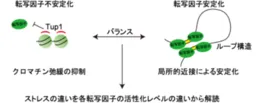
The researchers observed that fbp1 transcriptional activity could be inappropriately activated when Tup1 was absent, even in response to nitrogen starvation—an unanticipated stress for fbp1. The activation involved transcription factors Atf1 and Rst2, which contributed to this unusual behavior. Each factor binds to separate DNA regions, yet through a looping mechanism of the genome, they stabilize each other's binding. Notably, disrupting this loop structure eliminated the aberrant non-specific transcription.
This study revealed a two-fold mechanism: on one hand, Tup1 prevents transcription factor binding through chromatin stabilization; on the other, local genomic loop structures conditionally stabilize transcription factors' proximity for effective activation. Together, they maintain a delicate balance, ensuring that transcription responses to stress are precisely regulated.
Implications and Future Directions
The implications of this research extend far beyond fission yeast, hinting at similar regulatory mechanisms existing in more complex organisms, including humans. As cells communicate with their environment, understanding these fundamental strategies may illuminate how transcription factors orchestrate diverse responses under various stress conditions.
Further exploration into the collaborative interactions among transcription factors will refine our understanding of gene regulation under stress. This foundational research paves the way for future investigations that could enhance our comprehension of more sophisticated transcriptional control mechanisms in higher organisms.
Discussion
The discovery of these mechanisms fosters our understanding of genetic responses to environmental stress, with potential applications in health, agriculture, and biotechnology. By grasping the intricacies of how cells manage stress at the molecular level, we can strategize better approaches to bolster organism resilience in the face of environmental challenges.
Conclusion
Ultimately, this research emphasizes the complexity behind cellular responses to stress and highlights the importance of ongoing exploration within the realm of molecular biology. As scientists delve deeper into genetic regulation mechanisms, we can anticipate advancements in various fields that leverage the power of transcriptional controls for innovative solutions to pressing challenges.
References
- - Published on September 7, 2026, in the journal Nucleic Acids Research.
- - Article: Dual Regulation of Transcription Factor Binding by Tup11/12-Mediated Destabilization and DNA Loop-Mediated Stabilization Ensures Stress-Specific Gene Activation in Fission Yeast.
- - DOI: 10.1093/nar/gkag847
- - URL: Nucleic Acids Research
Topics Health)



【About Using Articles】
You can freely use the title and article content by linking to the page where the article is posted.
※ Images cannot be used.
【About Links】
Links are free to use.