




Analysis of the Surprising Shift in Japan's Capital Markets: Understanding the Structural Renaissance
A New Era for Japan's Capital Markets
YCP Holdings, headquartered in Singapore and led by CEO Hiroki Ishida, has recently published an insightful white paper titled Structural Renaissance of Japan’s Capital Markets: How the Coexistence of the Tokyo Stock Exchange, Activists, and PE Funds Drives Corporate Value Creation and New Market Discipline. This comprehensive analysis addresses the structural changes affecting Japan's capital markets and presents the underlying factors supporting this transformation.
Declining Listings: A Shift Toward Quality Rather Than Quantity
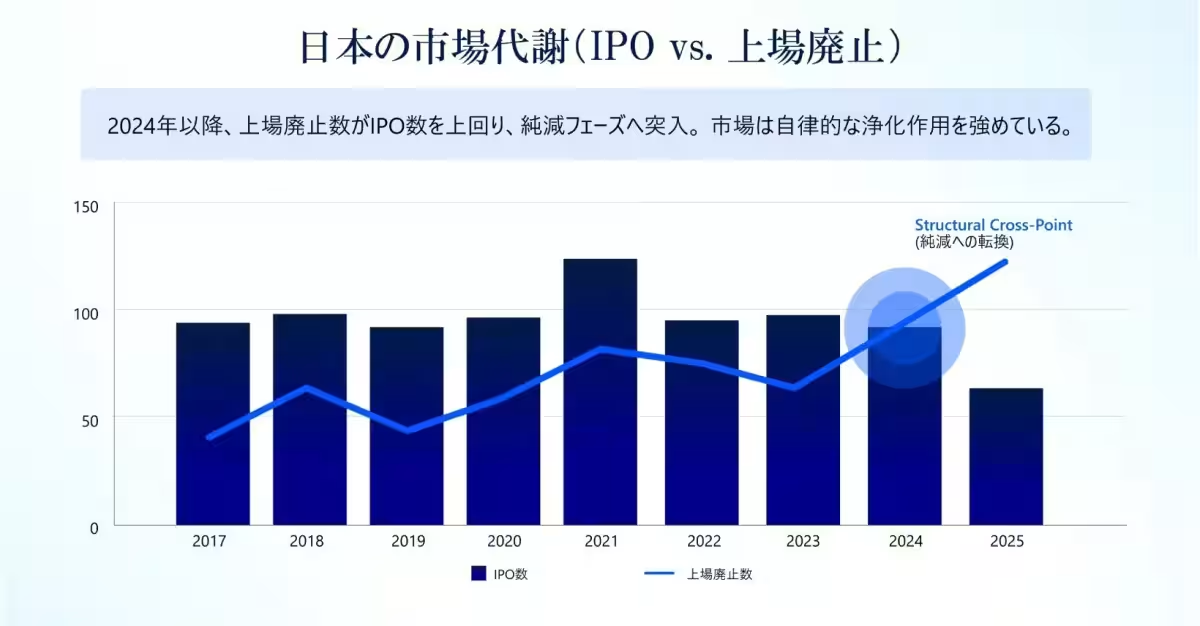
In 2024, Japan's stock market observed a significant trend where the number of delisted firms exceeded that of newly public IPOs. The white paper interprets this not as mere market contraction but as a pivotal transition from quantity to quality, emphasizing capital efficiency, corporate governance, and market discipline. This evolution mirrors trends observed in the United States, where the number of listed companies plummeted from 8,090 in 1996 to around 4,010 in 2024, while market capitalization surged approximately 7.3 times during the same period. This evolution suggests that the market is increasingly characterized by a focus on a select group of robustly competitive companies.
The white paper further delineates the divergence in trends between the number of listed firms and market valuation in Japan, the United States, and Europe, shedding light on Japan's potential transition toward a more selective market structure.
Three Key Drivers Accelerating the Structural Change in Japan
The transformative changes in Japan's capital market are primarily fueled by three influential factors: Tokyo Stock Exchange (TSE) reforms, activism, and private equity (PE) funds.
1. Tokyo Stock Exchange Reforms
The TSE has instituted reforms that emphasize capital cost management and stricter requirements for maintaining a listing. These reforms compel companies to enhance their capital efficiency and improve corporate value.
2. Activist Investors
Originally focused on shareholder returns, activist investors now engage in comprehensive structural reforms, advocating for optimization of business portfolios, reevaluation of management strategies, and governance reforms.
3. Private Equity (PE) Funds
PE funds are increasingly facilitating corporate transformations through various methods such as take-private deals, management buyouts (MBO), and business carve-outs. They provide essential funding, leadership talent, and operational insights necessary for these changes.
The intersection of these three dynamics is reforming capital allocation, driving corporate restructuring, and initiating a new cycle of value creation within Japan's capital market.
Key Insights from the White Paper
1. Private equity is emerging as a strategic avenue for corporate transformation, with management buyouts reaching a record 26 cases anticipated in 2025. Delisting is not viewed as an exit but as a means to advance structural reforms and enhance corporate value over the long term.
2. Japan's PE market is poised for further growth, fueled by favorable conditions such as undervalued companies, governance reforms, and conducive financing environments. PE funds are affirming their role as transformative partners by offering capital, management expertise, and operational know-how.
3. Shareholder activism is increasingly promoting M&A and corporate transformation, with around 70% of activist proposals targeting shareholder returns, financial policies, and governance-related improvements. Such proposals can serve as catalysts for business restructuring, including delistings.
Future Outlook
Looking ahead, Japan's capital market may evolve into a bifurcated structure, featuring listed companies striving for growth in alignment with global investor demands and private firms engaged in long-term business regeneration and structural reforms. Within this context, adopting a hybrid capital strategy—strategically navigating between public and private markets based on growth phases and management challenges—will become increasingly vital.
To explore the structural changes and strategic choices facing corporations in Japan's capital markets further, we invite you to read the full white paper available at: Full White Paper.
About YCP
YCP is a consulting firm with a strong presence in 23 locations and a team of over 700 professionals. It provides a wide range of professional services focused on diverse areas such as business strategy, M&A, operations, supply chain, digital transformation, marketing, and sustainability, particularly in Asia, including Japan, Greater China, Southeast Asia, and India. For more details, visit the YCP website at YCP Website.

Topics Financial Services & Investing)
【About Using Articles】
You can freely use the title and article content by linking to the page where the article is posted.
※ Images cannot be used.
【About Links】
Links are free to use.