




Discovering the Evolutionary Ancestor of Human Cytoskeleton in Archaea: New Insights
Discovering the Evolutionary Ancestor of Human Cytoskeleton in Archaea: New Insights
Recent research by a collaborative team including RIKEN, Nagoya University, VISTEC, Okayama University, and the Japan Science and Technology Agency (JST) has unveiled astonishing insights into the origins of the eukaryotic cytoskeleton. This groundbreaking study, published in the journal "Science Advances," reveals significant findings about the evolution of microtubules—crucial structures in cells that play vital roles in cell shape, division, and substance transport.
The Research Team and Methodology
The pioneering research was led by Linh T. Tran, a special researcher at RIKEN, alongside Makito Miyazaki, the director of the structural cell biology research team, and Akihiro Narita, an associate professor at Nagoya University. Their efforts were complemented by contributions from Charles Robinson at VISTEC and other experts in the field. This international group embarked on analyzing proteins from Asgard archaea, which are believed to have emerged approximately 2.7 billion years ago.
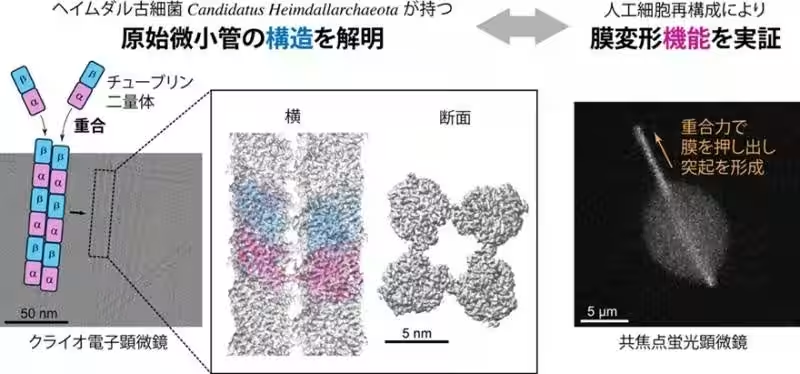
The Discovery: Primitive Microtubules
The key discovery stems from examining a specific type of Asgard archaea known as Heimdallarchaeales. The researchers discovered a type of protein resembling tubulin, which is pivotal for forming microtubules in eukaryotic cells. They identified a




Topics Other)
【About Using Articles】
You can freely use the title and article content by linking to the page where the article is posted.
※ Images cannot be used.
【About Links】
Links are free to use.