




JAL and TIAT Launch Groundbreaking Facial Recognition Boarding Trials
Pioneering Trials in Facial Recognition for Boarding
Japan Airlines (JAL) and Tokyo International Airport Terminal Corporation (TIAT) have embarked on a groundbreaking initiative by participating in the Data & Technology Proof of Concepts program hosted by the International Air Transport Association (IATA). This initiative marks a significant stride toward enhancing the international air travel experience through advanced technology.
The Concept Behind the Proof of Concept
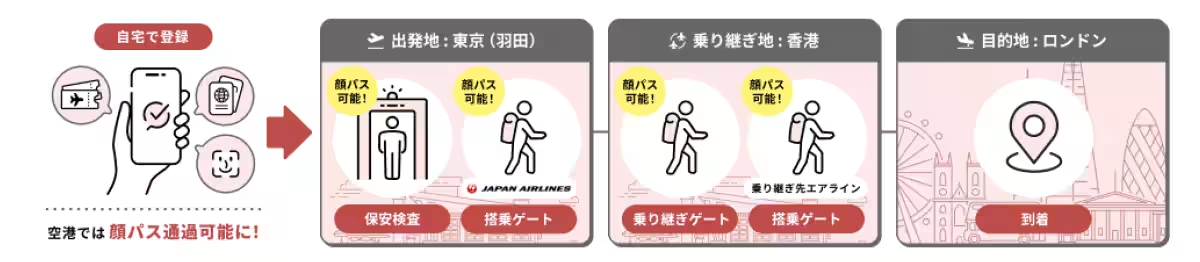
the trial involves utilizing digital identities to facilitate boarding and transfer processes through facial recognition. Passengers can link their boarding passes and passport information via a smartphone mobile wallet, allowing for a seamless identification process at the airport. This innovative approach not only aims to eliminate the need for passport verification at check-in but also hopes to integrate security checks, immigration procedures, and transfers in a fully contactless and efficient manner. The successful execution of this concept is a world first, signifying a monumental leap toward future air travel systems.
A Comprehensive Overview of the Proof of Concept (PoC)
In the PoC, travelers can book their flights through a smartphone application, where they can preload essential digital credentials—boarding pass, passport, and facial data—into their mobile wallet. At the airport, identification occurs solely through facial recognition technology, streamlining the overall boarding and transfer procedure.
This proof of concept segmented multiple use cases, analyzing technology viability and addressing challenges essential for the standardization of digital identity-related technologies. The focus was on customizing solutions to meet the diverse needs of today’s travelers.
Use Case Examples
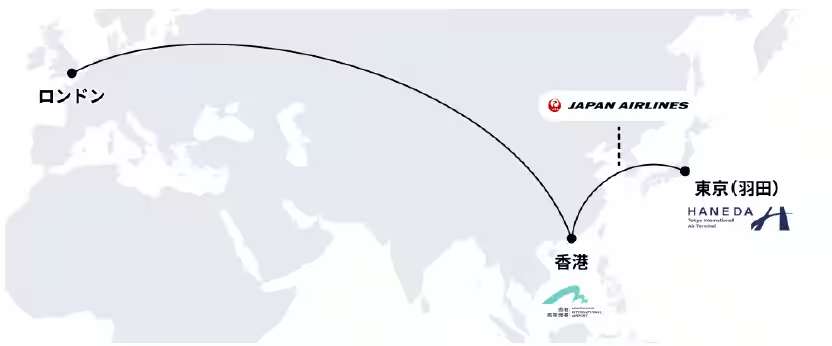
The trials were conducted on a prototype demo wallet application that expanded the current Face Express service. Verification routes included:
- - Haneda to Hong Kong (Flight JL029)
- - Hong Kong to London (Flight BA032)
Key Outcomes of the Proof of Concept
The PoC yielded significant findings, particularly concerning the following aspects:
- - Demonstrated the personal identification and interoperability capabilities across three different mobile wallets.
- - Validated two types of biometrics—one-to-one and one-to-many (1:N) recognition methods—at airport facilities (transfer security gates and boarding gates).
- - Confirmed integration with existing airport systems, utilizing foundational infrastructure such as Face Express in Haneda and Flight Token in Hong Kong.
These advancements greatly simplify the travel protocol from booking to boarding, significantly reducing human error. Such achievements are expected to lay the groundwork for future standardization in travel technology.
Future Perspectives
As we look to the future, the collaboration between JAL and TIAT offers exciting prospects for air travel. The insights and technologies gleaned from the PoC will help to tailor a more pleasant flying experience tailored to individual needs. Both companies are committed to continuing their involvement in proof-of-concept studies and to driving transformative innovations in air travel services.
For further information on this initiative and to visualize the future of boarding experiences, check out the video link here and explore additional details on the IATA's website here.







Topics Other)
【About Using Articles】
You can freely use the title and article content by linking to the page where the article is posted.
※ Images cannot be used.
【About Links】
Links are free to use.