



Understanding the Mechanism Behind Enhanced Liquid Absorption in Bubbles
Enhanced Liquid Absorption through Bubble Dynamics
Recent research has unveiled a crucial understanding of how the movement of bubbles can significantly affect the rate at which liquids are absorbed. Until now, it was generally accepted that the liquid absorption capacity of bubbles was primarily dictated by their osmotic pressure. However, a research group at Tokyo Metropolitan University, led by Kento Tamaki and including Naoya Yanagisawa and Professor Rei Kurita, found discrepancies between theoretical predictions and experimental results regarding absorption speeds. This inconsistency prompted them to investigate further.
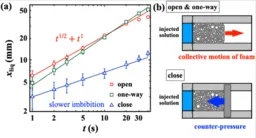
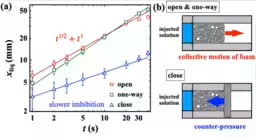
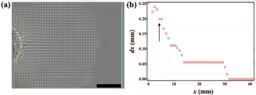
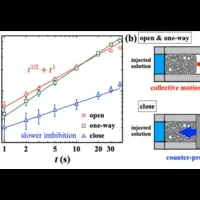
The team discovered that bubbles do not just remain static; they can move and compress in response to liquid penetration. This movement is essential as it can accelerate the absorption process. When bubbles are allowed to move freely, they can relocate in response to incoming liquid, leading to an apparent increase in absorption speed. Conversely, when bubble movement is restricted, absorption is hindered because compression from the liquid’s entry generates counteracting pressure—effectively slowing the process.
This finding highlights that absorption mechanics involve not just capillary forces, similar to those that govern liquid movement in narrow tubes, but also the dynamic response of the bubbles themselves. For example, when examining various boundary conditions—where bubbles could be essentially free-moving, partially restricted, or completely immovable—the researchers noticed variations in how quickly liquids infiltrated the bubble structure. Under free movement conditions, absorption was notably faster.
The significance of this research lies in its potential applications. Bubbles are widely used in bioengineering, environmental cleanup, and many industrial processes to collect oils and micro-particles. By understanding the mechanics of how bubbles interact with liquids—specifically, how the ability to move or deform impacts absorption—scientists and engineers can design better methods for extraction efficiencies.
The implications extend beyond just bubble dynamics. This study encourages a broader perspective when analyzing various soft structures such as emulsions and gels, emphasizing the necessity to treat these materials as adaptable systems rather than fixed porous substances. The adaptability allows for enhanced liquid absorption, which can be beneficial in numerous contexts, including water filtration, oil recovery, and even medical applications.
Experimental Observations
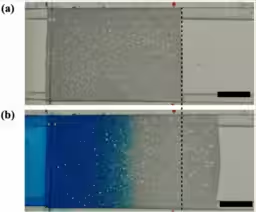
The research involved a series of experiments where the group manipulated the boundary conditions affecting bubble mobility. For instance, under completely open conditions where bubbles were free to move, the researchers observed faster liquid infiltration. On the other hand, when bubble movements were constrained, absorption rates significantly decreased. These contrasting results clearly demonstrated the pivotal role of bubble dynamics in liquid absorption processes.
Furthermore, close analysis showed that when liquid was introduced, it propelled the entire bubble structure, allowing the bubbles to absorb significantly more liquid quickly. In contrast, when embedded in a closed environment, the compressive response of the bubbles created significant counterpressure that ultimately inhibited any liquid absorption.
Future Directions
The findings published in the journal Communications Physics highlight a new design framework for enhancing liquid absorption by considering bubble dynamics. Future research could focus on practical applications of this knowledge in real-world recovery processes and exploring three-dimensional bubble formations, potentially leading to more efficient utilization techniques in diverse fields.
With ongoing advancements in materials science, understanding the interplay between liquid properties and structural dynamics in soft materials can pave the way for innovative solutions to some of the world's pressing environmental challenges. In summary, recognizing and harnessing the movement of bubbles can lead to revolutionary improvements in technologies that depend on liquid absorption, thus broadening their practical applications and enhancing their effectiveness.
Topics Other)

【About Using Articles】
You can freely use the title and article content by linking to the page where the article is posted.
※ Images cannot be used.
【About Links】
Links are free to use.